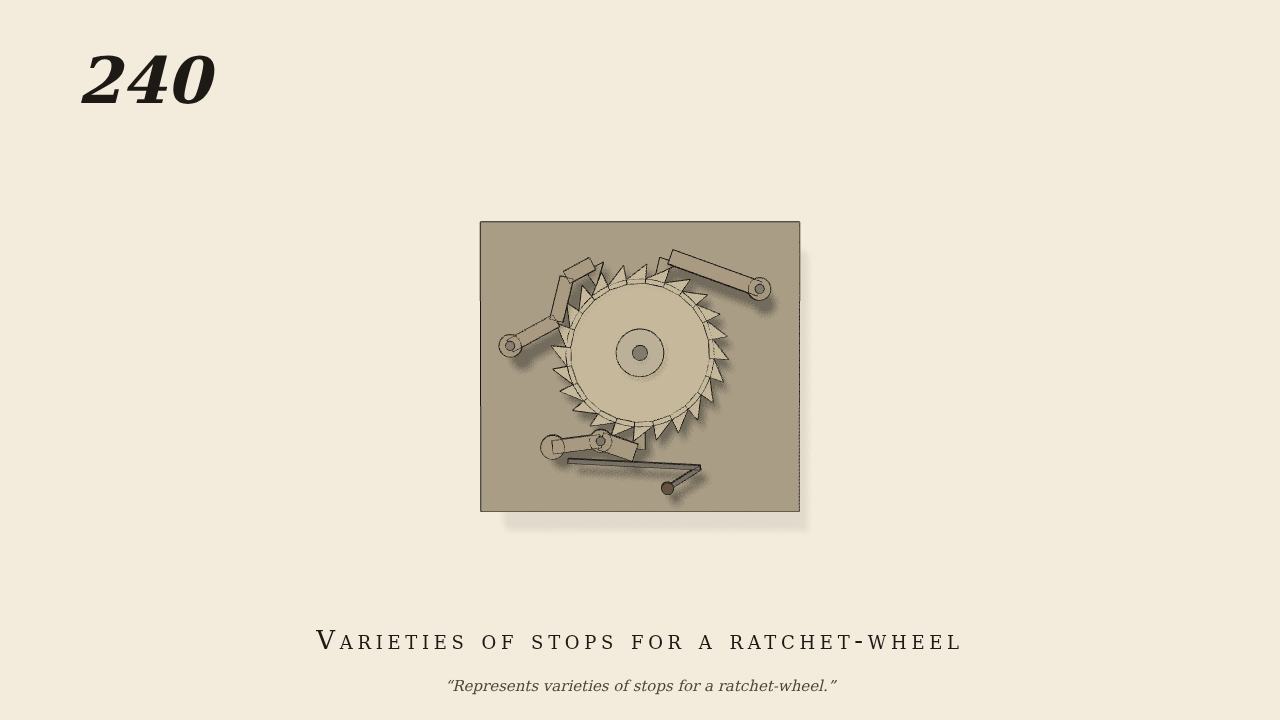
Varieties of stops for a ratchet-wheel
Represents varieties of stops for a ratchet-wheel.
Only the input is driven; every other part of this model moves by physics (MuJoCo), and its ratios are measured. Run it live, change its parameters, or switch the friction off to see the output stop.
- Modelled as
- A ratchet-wheel of 24 teeth (tips radius 6, roots 5) is rocked to and fro by hand, +-0.1963 rad at 0.5 Hz (the only driven joint), about one and a half teeth each stroke. Each tooth has a radial face looking clockwise and a slope behind. Three stops of the plate's kinds stand round it, their ends a whole number of teeth apart so that all three catch together. A is a straight pawl on a pivot to the right, lying on the top teeth. B is a hook curving up from a pivot on the left, over a tooth, with its end hooked down in front of the next face, so the face pulls it rather than pushes it. C is a short click on a pin below, with a tail and knob, held up by a flat spring (a joint spring). Each pivot stands on the line along which the face pushes the end: a little outside it for A and C, which the face pushes, and inside it for B, which the face pulls. Either way the face draws the end deeper. A and B lie on the teeth by their weight and a light spring. Gravity on.
- Measured
- Turning counter-clockwise, the slopes lift all three stops over each tooth: A, B and C each clicked 4 or 5 times in 9 s. Turning clockwise, the faces meet the ends and the wheel stops. The wheel goes round counter-clockwise exactly one tooth (0.2618 rad) for each to-and-fro (0.2356, 0.4974, 0.7592, 1.0210 rad at the end of each beat). Contact penetration 0.13 mm.
- Notes
- Brown gives only the title. The spring under C is drawn but stands still; its force is a joint spring on the click. Placing the ends whole teeth apart makes the three share the hold. Set a third of a tooth apart, they would hold the wheel three times as finely.
Film (MP4) · Still (PNG) · Spec (YAML) · Model (MJCF)