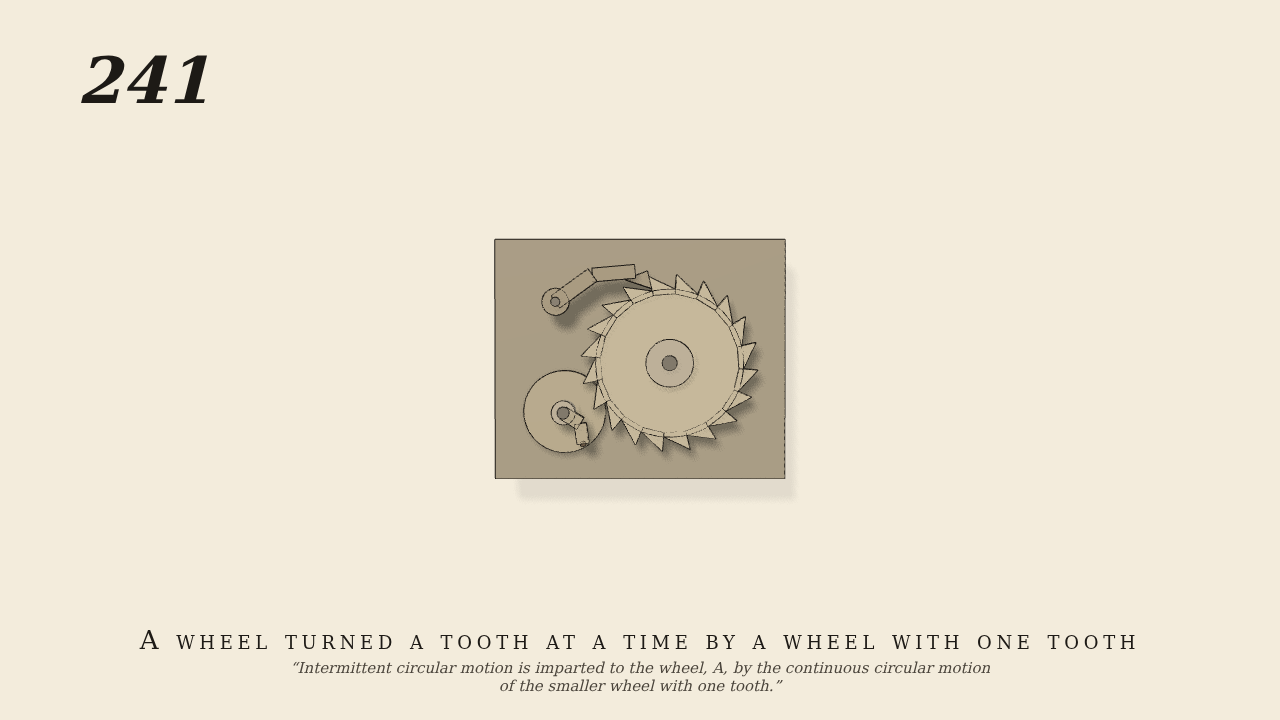
Intermittent circular motion is imparted to the wheel, A, by the…
Intermittent circular motion is imparted to the wheel, A, by the continuous circular motion of the smaller wheel with one tooth.
Only the input is driven; every other part of this model moves by physics (MuJoCo), and its ratios are measured. Run it live, change its parameters, or switch the friction off to see the output stop.
- Modelled as
- The wheel A has 20 ratchet teeth (tips radius 6, roots 5), each face looking counter-clockwise, on a bearing with a little friction (0.002). The smaller wheel, below on the left, turns counter-clockwise at 30 rev/min (the only driven joint). Its one tooth is a curved finger whose end, a pin, passes once a turn into A's teeth, reaching 0.45 past the roots. A click on a pivot at the upper left, held down by a spring and its weight, rides over the slopes and drops in front of the next face. Gravity on.
- Measured
- Each turn, the pin drops into the gap in front of a face and carries it clockwise until it runs out past the tips, about one and a half teeth. The click, riding the next slope, then sets A back to the tooth it dropped behind (run-back at most 0.128 rad). A stands still while the finger is away. A turns -0.0491 times the small wheel's angle over 0.5 to 8.5 s, against -0.05 (one tooth in 20 each turn), and the click falls 5 times. Contact penetration 0.10 mm.
- Notes
- Brown gives no sizes. The pin must drop into the deep part of the gap, just in front of a face. If it lands on a slope it drives A backwards against the click and jams, and if it reaches too deep it wedges between the face and the next slope. The teeth are phased to the finger so that it always meets a face, and the click returns A to the same place each turn, so the phase repeats.
Film (MP4) · Still (PNG) · Spec (YAML) · Model (MJCF)