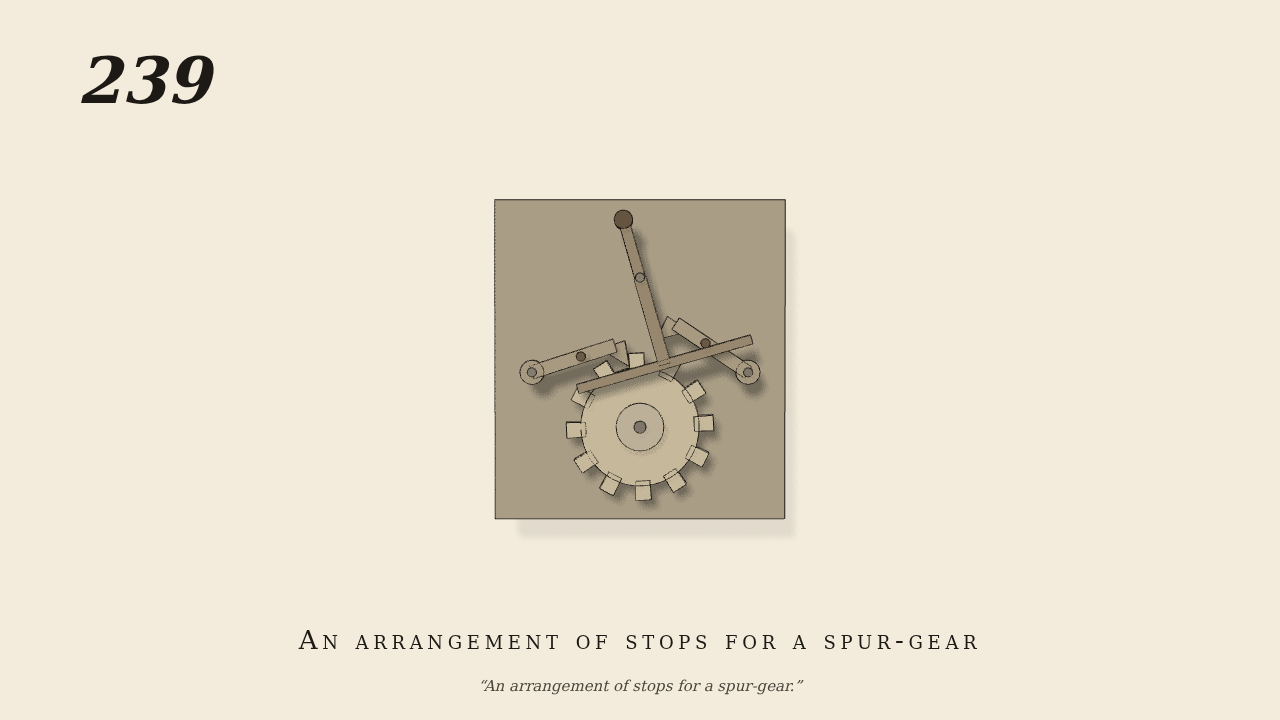
An arrangement of stops for a spur-gear
An arrangement of stops for a spur-gear.
Only the input is driven; every other part of this model moves by physics (MuJoCo), and its ratios are measured. Run it live, change its parameters, or switch the friction off to see the output stop.
- Modelled as
- A spur-gear of 12 teeth (tips radius 5, roots 4) is rocked to and fro by hand, +-0.39 rad at 0.5 Hz (the only driven joint), so each stroke is about one and a half teeth. Two stops on pivots either side, as in the plate, hang over it with their hooked ends in two gaps at the top. Each end has a face on one side and a slope on the other. The left stop's face holds the gear turning counter-clockwise, and its slope rides over the teeth when the gear turns clockwise. The right stop is the mirror image. Each pivot stands on the line along which a tooth pushes the face, a little outside it, so a pushed face draws the stop deeper in. A light spring and the stop's weight keep each end down. The operator chooses with a rocker hung above the gear: a hand lever on a damped spring, moved over about half a second. Its beam passes under a pin on each stop. Gravity on.
- Measured
- Both stops down (0 to 1.5 s): the gear is held both ways, moving only -0.061 to 0.059 rad in the play. Right stop lifted (1.5 s): the gear goes clockwise exactly one tooth (0.5236 rad) for each to-and-fro, and the left stop clicks over a tooth each time. Left stop lifted instead (7.5 s): the gear goes counter-clockwise one tooth per to-and-fro, and the right stop clicks. Both down again (12.5 s): held. Contact penetration 0.36 mm. In the viewer the Stops control sets the rocker: both down, right lifted or left lifted.
- Notes
- Brown gives only the title. Reading the plate, the two stops are pawls facing each other: together they lock the gear, and lifting one lets it turn the other way only. The rocker that lifts them is ours; the plate shows only the stops.
Film (MP4) · Still (PNG) · Spec (YAML) · Model (MJCF)