An escapement
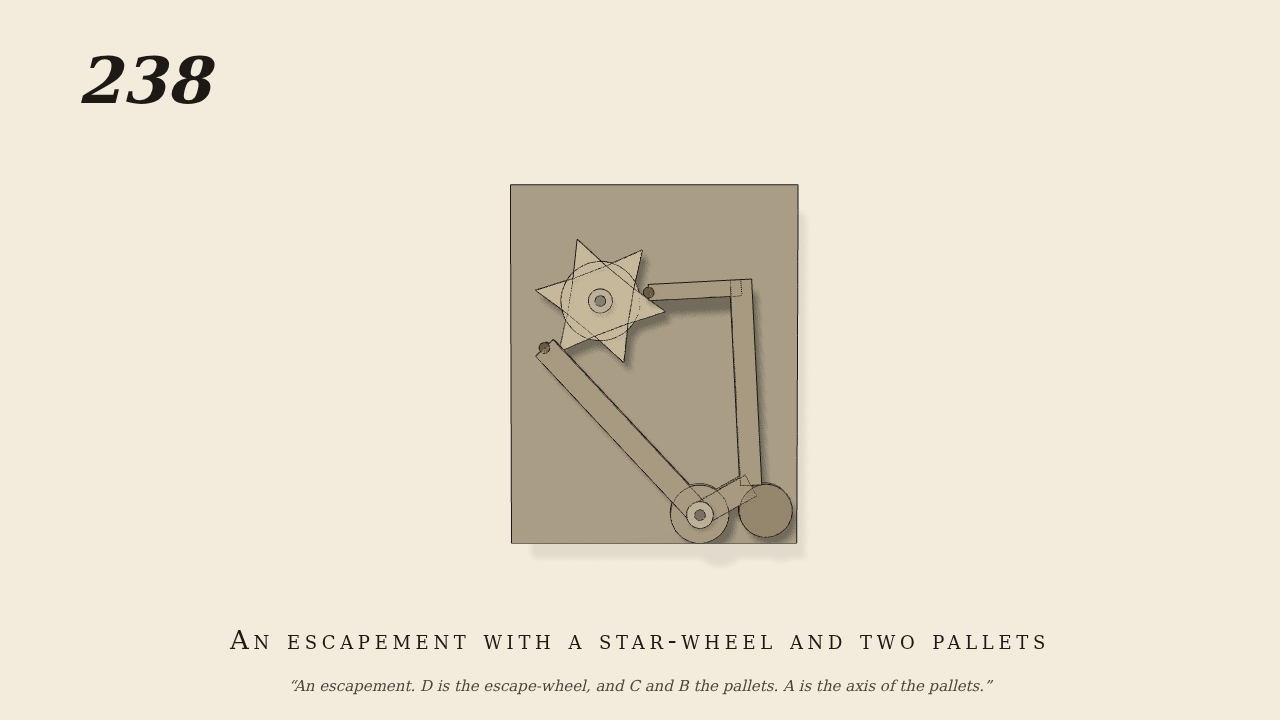
An escapement. D is the escape-wheel, and C and B the pallets. A is the axis of the pallets.
Only the input is driven; every other part of this model moves by physics (MuJoCo), and its ratios are measured. Run it live, change its parameters, or switch the friction off to see the output stop.
- Modelled as
- The escape-wheel D is a star of 6 symmetric points (tips radius 5, roots 3) turned counter-clockwise by a constant torque of 0.02 (a clock's weight; the only driven joint). The pallets B and C are pins of radius 0.4 on a frame turning on the axis A below the wheel: B under the wheel at the lower left, C level with it on the right, 2.5 teeth apart round the wheel, each 0.4 inside the points at rest. A sits where the tangents to the wheel at B and C meet, so both pins move straight in and out by the same amount. A counterpoise balances the frame on A, and a joint spring (the balance-spring, 0.6) centres it. Gravity on.
- Measured
- A point's flank pushes one pin out, which swings the frame and puts the other pin in front of a point half a tooth on; that point drives it back. The frame vibrates +-4.5 degrees, steady from first third to last, and the wheel advances 0.52360 rad per beat over 38 beats, exactly half a tooth (pi/6). Contact penetration 0.21 mm.
- Notes
- The plate gives no sizes. With A where the plate puts it relative to our wheel, nearer B than C, the pin farther from A moves 1.3 times as far as the nearer one; it ran into the receding flank in front of it faster than that flank got out of the way, and wheel and frame locked after 5 degrees whatever the spring. A at the tangents' meeting point (in the plate's direction from D, a little farther off) gives equal motions and runs cleanly. Without the counterpoise the frame, its weight above A, tips over on the spring once the pins are out of the wheel.
Film (MP4) · Still (PNG) · Spec (YAML) · Model (MJCF)