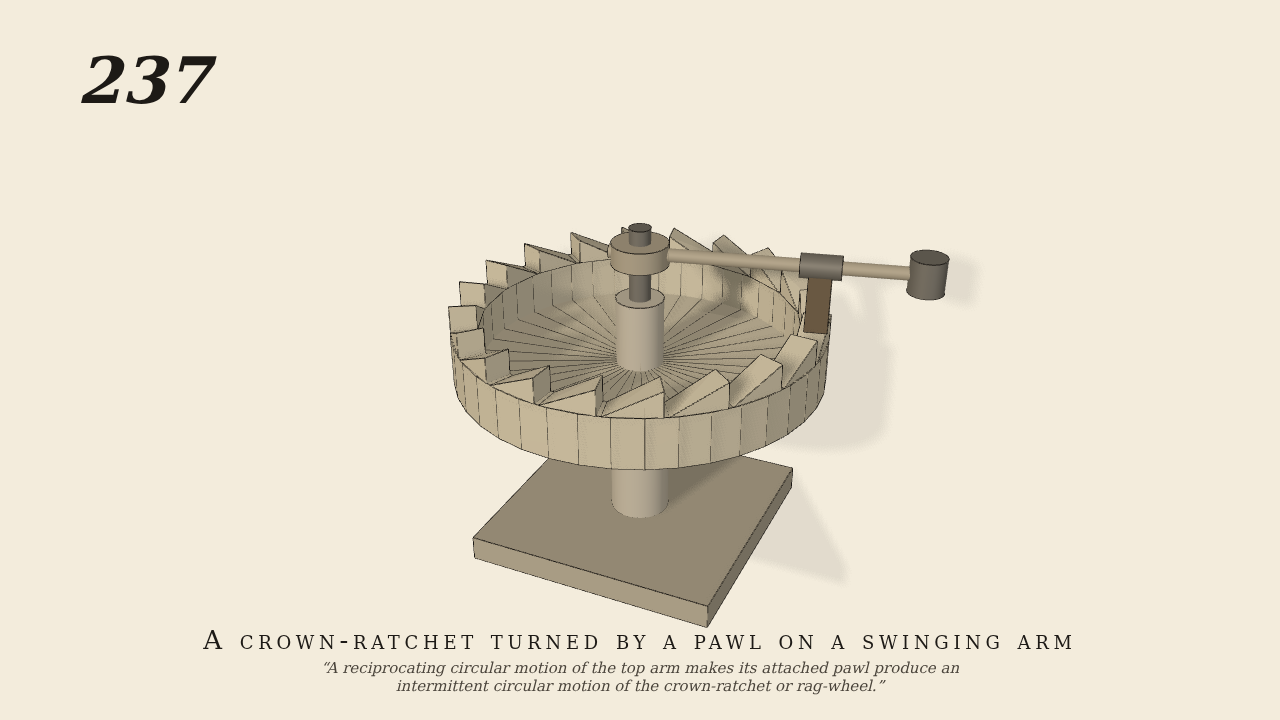
A reciprocating circular motion of the top arm makes its attached…
A reciprocating circular motion of the top arm makes its attached pawl produce an intermittent circular motion of the crown-ratchet or rag-wheel.
Only the input is driven; every other part of this model moves by physics (MuJoCo), and its ratios are measured. Run it live, change its parameters, or switch the friction off to see the output stop.
- Modelled as
- A crown-ratchet (rag-wheel) of 20 teeth stands up from the rim of a drum of radius 8 on an upright shaft. Each tooth rises counter-clockwise over most of the pitch to a vertical face 1.2 high, and the drum has a little bearing friction. On top of the shaft the arm turns to and fro, +-0.2356 rad (three quarters of a tooth) at 0.5 Hz (the only driven joint). Over the teeth the pawl hangs from a pin along the arm, leaning 35 degrees ahead in the driving (clockwise) direction, and lies on the teeth by its weight. Gravity on.
- Measured
- Turning clockwise, the pawl's end meets a tooth's vertical face and carries the wheel with it. Turning back, it climbs the next tooth's slope and drops behind it (5 times in 10 s), and the wheel stands. The wheel advances -0.15689 rad per beat of the arm over 8 beats, against -0.15708 for one tooth to each to-and-fro, and never goes back more than 0.0001 rad. Contact penetration 0.09 mm.
- Notes
- The plate gives no sizes. There is no click, so the wheel stops wherever the arm's stroke ends, and any creep of the hand (a velocity servo lagging under the load) adds to or takes from the advance. The bearing friction is kept low (0.05) so the lag is small (0.1% a tooth), yet enough that the pawl's return doesn't drag the wheel back.
Film (MP4) · Still (PNG) · Spec (YAML) · Model (MJCF)