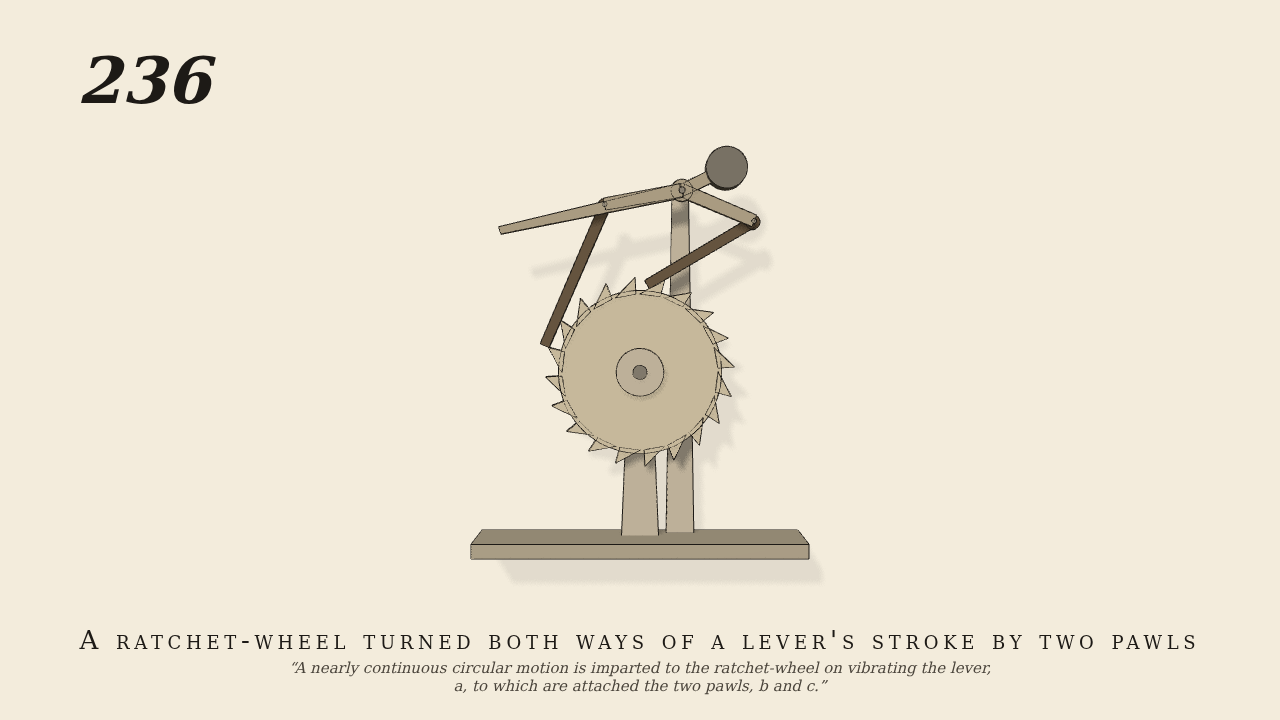
A nearly continuous circular motion is imparted to the…
A nearly continuous circular motion is imparted to the ratchet-wheel on vibrating the lever, a, to which are attached the two pawls, b and c.
Only the input is driven; every other part of this model moves by physics (MuJoCo), and its ratios are measured. Run it live, change its parameters, or switch the friction off to see the output stop.
- Modelled as
- A ratchet-wheel of 20 teeth (tips 8, roots 6.9; radial backs) on a fixed centre, with a little bearing friction. The lever a turns on a centre above the wheel and is rocked by hand by its long handle, +-0.3 rad at 0.5 Hz (the only driven joint); a counterpoise beyond the centre balances the handle. Pawl b hangs from a pin 6.5 left of the centre and lies by its weight against the teeth on the wheel's left. Pawl c is pinned 6.5 to the right of and below the centre and lies by its weight on the teeth on top. Gravity on.
- Measured
- As the handle goes down, b pushes the teeth on the left down while c slides back over the teeth on top. As it goes up, c draws the teeth on top to the left while b slides back up over the teeth on the left. So the wheel goes on counter-clockwise at each stroke, both ways: 0.31416 rad per beat of the lever over 8 beats, one tooth (2 pi/20) exactly, and it never goes back more than 0.0014 rad. Contact penetration 0.35 mm after the first second.
- Notes
- The plate gives no sizes; the pins and the pawls' lengths were measured from it. Each pawl's stroke along the wheel is about 1.5 teeth, so it drops behind one tooth each return and drives one tooth each stroke. The counterpoise keeps the handle's weight from making the hand (a velocity servo) creep.
Film (MP4) · Still (PNG) · Spec (YAML) · Model (MJCF)