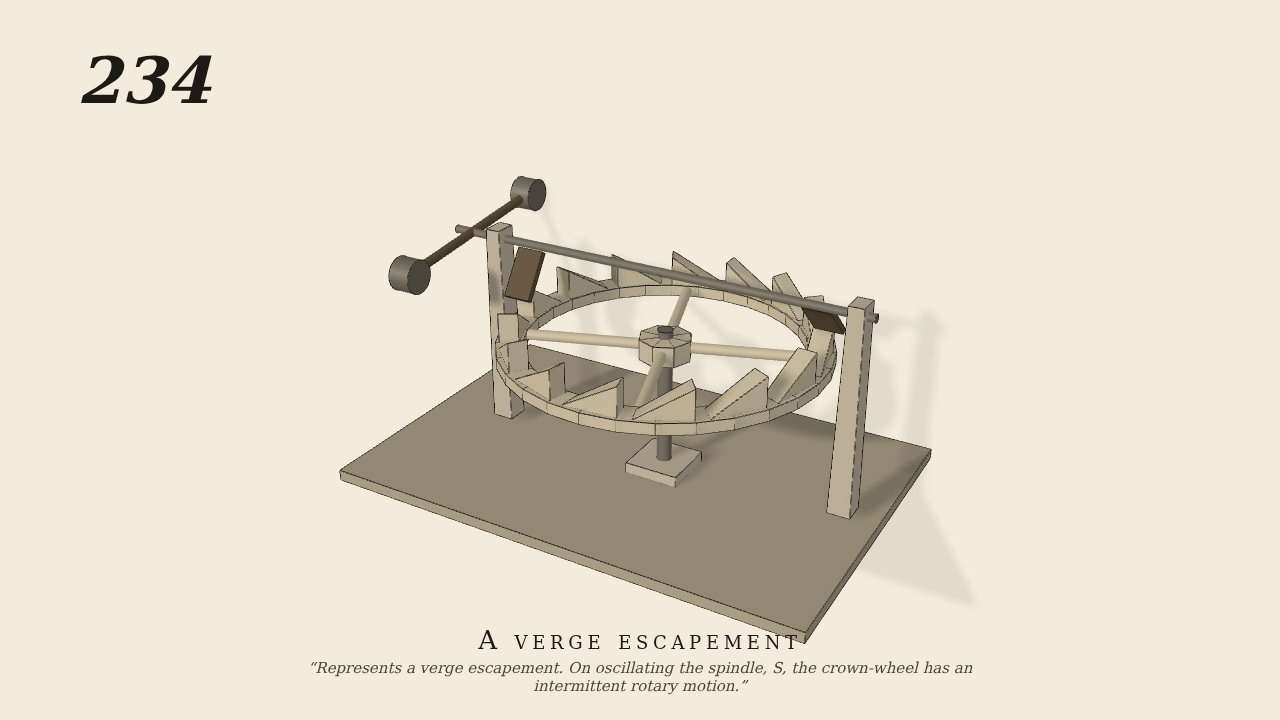
A verge escapement
Represents a verge escapement. On oscillating the spindle, S, the crown-wheel has an intermittent rotary motion.
Only the input is driven; every other part of this model moves by physics (MuJoCo), and its ratios are measured. Run it live, change its parameters, or switch the friction off to see the output stop.
- Modelled as
- A crown-wheel of 15 sawtooth teeth on a circle of 8, its axis upright, driven by a constant torque of 0.01 (a clock's weight; the only driven joint). Above it the spindle S lies along a diameter at height 3.7, carrying two pallets (length 3, leaning +-40 degrees) at the two ends of the diameter and, outside the frame, a foliot with two weights. Spindle and wheel turn freely in their bearings (damping 0.0005); gravity on.
- Measured
- The teeth on the near and far side of the wheel move in opposite directions, so a tooth pushing one pallet turns the spindle one way until that pallet slips off its tip and the other pallet, now swung into the far side, meets a tooth and drives it back. The wheel advances 0.20942 rad per beat of the spindle over 31 beats (half a tooth is 0.20944), and the spindle swings 13.4 degrees each way, the same in the first and last thirds of the run. Contact penetration 0.09 mm after the first second.
- Notes
- The plate gives no sizes. The pallets lean 40 degrees, but the swing settles at about 13 degrees, because with a light foliot each impulse is used up quickly. The control holds the wheel by torque, not speed, so when contact is off it runs away instead of keeping its speed.
Film (MP4) · Still (PNG) · Spec (YAML) · Model (MJCF)