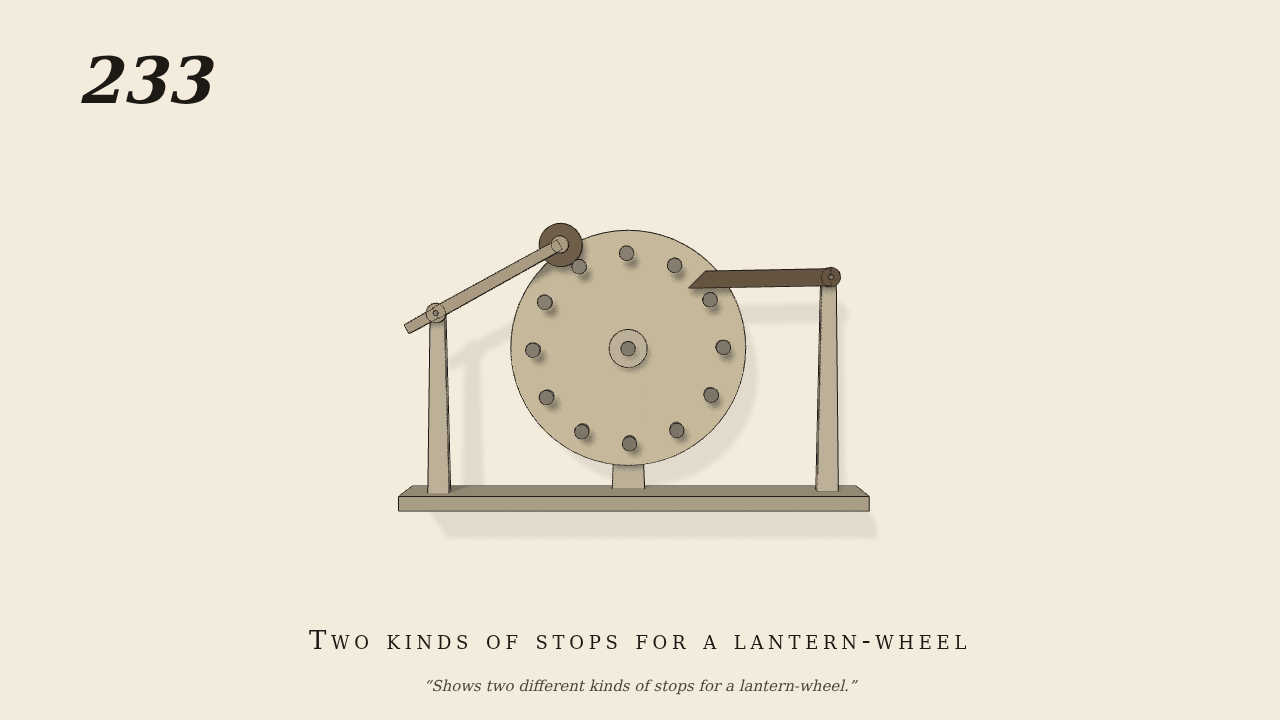
Two different kinds of stops for a lantern-wheel
Shows two different kinds of stops for a lantern-wheel.
Only the input is driven; every other part of this model moves by physics (MuJoCo), and its ratios are measured. Run it live, change its parameters, or switch the friction off to see the output stop.
- Modelled as
- A wheel with 12 staves (radius 0.6) on a circle of 8, turned to and fro by hand +-0.628 rad at 0.5 Hz (the only driven joint, a velocity servo of limited torque, like a hand), gravity on. On the right a click, pivoted on a post, lies by its weight on a rest (a joint range) with its end between two staves. On the left a roller (radius 1.8, turning on its own pin) on a lever pivoted on a second post lies by the lever's weight between two staves.
- Measured
- Turning the wheel counter-clockwise the staves lift the click by its underside and it drops behind each; turning it back, the stave behind meets the click's end and the wheel stops, so it goes on two staves to each to-and-fro: mean 0.524 rad/s (two staves every 2 s; one stave would be 0.262), never back more than 0.209 rad (the 12 degrees by which the hand's stroke overshoots two staves). The click drops 10 times in 10 s; the roller rides over the staves and settles the wheel between them (its lever lifts 15 times). Contact penetration 0.18 mm after the first second.
- Notes
- The plate gives no sizes. The hand's stroke is two staves and 12 degrees: with less overshoot the click had not dropped behind the second stave when the hand turned back. The wheel is both the driven joint and the output, so the control uses a new metric, ratchet: the wheel's net forward travel (clamped at 0) over the hand's whole path, over four whole to-and-fros.
Film (MP4) · Still (PNG) · Spec (YAML) · Model (MJCF)