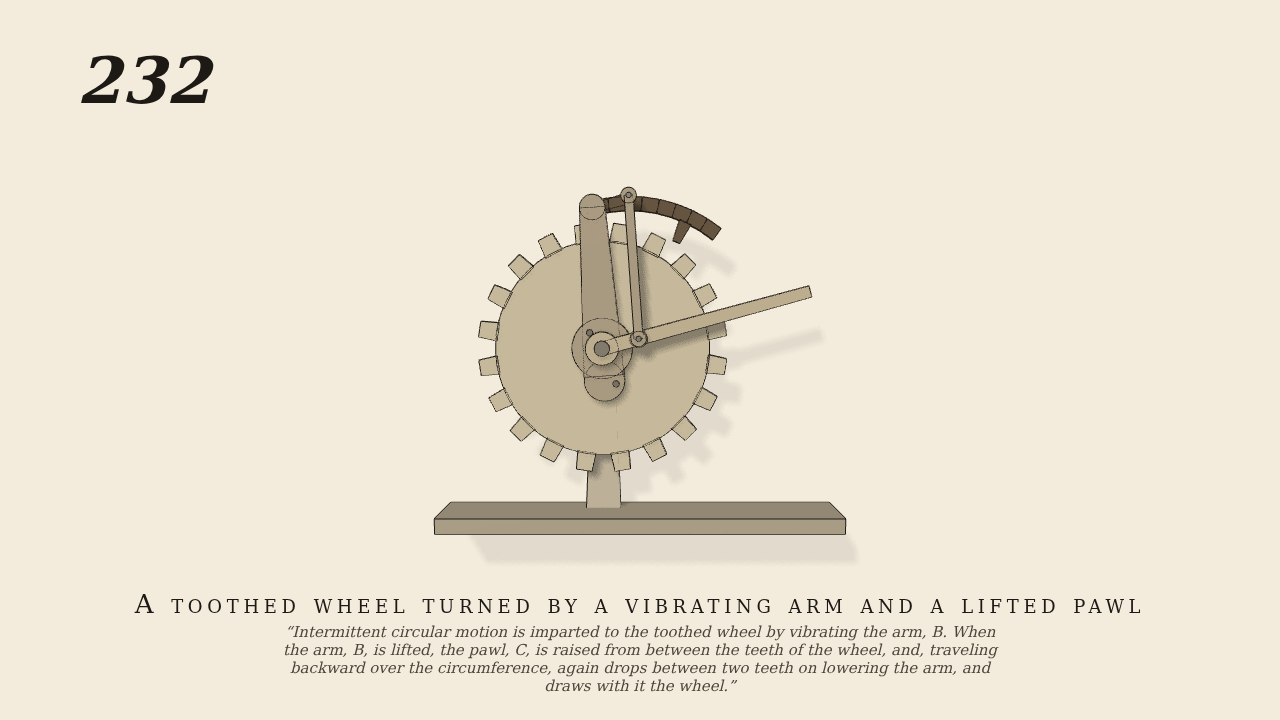
Intermittent circular motion is imparted to the toothed wheel by…
Intermittent circular motion is imparted to the toothed wheel by vibrating the arm, B. When the arm, B, is lifted, the pawl, C, is raised from between the teeth of the wheel, and, traveling backward over the circumference, again drops between two teeth on lowering the arm, and draws with it the wheel.
Only the input is driven; every other part of this model moves by physics (MuJoCo), and its ratios are measured. Run it live, change its parameters, or switch the friction off to see the output stop.
- Modelled as
- A 20-tooth wheel (tips 10, roots 8.6) on a fixed centre against a little bearing friction (gravity on). On the same centre turn the arm A, held by its own bearing friction, and the lever B, rocked by hand +-0.283 rad at 0.5 Hz (the only driven joint). A pin on A, 11.2 above the centre, carries the curved pawl C, whose tooth drops between the wheel's teeth at 50 degrees from the right. A link from B's pin (3 out) to C's lug (3 from C's pin) makes a parallelogram, so B turning on A turns C on its pin; C has 0.2 rad of play on A (a joint range).
- Measured
- Lifting B first raises C out of the teeth, then carries A and C back over a tooth; lowering B drops C between two teeth and draws A, C and the wheel forward. The wheel advances -0.15715 rad per beat of B over 8 beats (one tooth, 2 pi/20, to each to-and-fro; expect -0.15708), never runs back (largest run-back 0), and contact penetration stays at 0.04 mm.
- Notes
- The plate gives no sizes. The tooth's place is chosen so that lifting C moves its tooth out and slightly back from the flank it drove (with it higher up the lift wedged against the flank and dragged the wheel on). The bearing friction of A and the wheel keeps them from coasting past the end of the stroke.
Film (MP4) · Still (PNG) · Spec (YAML) · Model (MJCF)