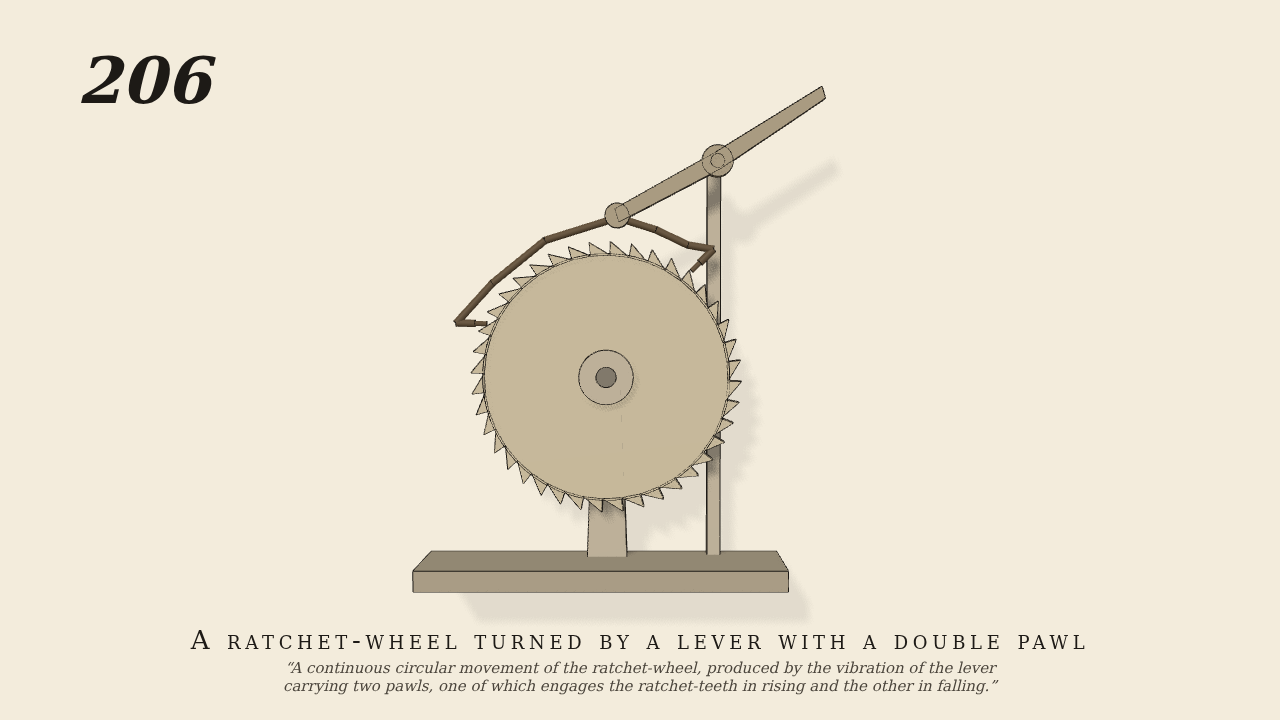
A continuous circular movement of the ratchet-wheel, produced by…
A continuous circular movement of the ratchet-wheel, produced by the vibration of the lever carrying two pawls, one of which engages the ratchet-teeth in rising and the other in falling.
Only the input is driven; every other part of this model moves by physics (MuJoCo), and its ratios are measured. Run it live, change its parameters, or switch the friction off to see the output stop.
- Modelled as
- A 40-tooth ratchet-wheel turns on a fixed centre. A lever on a fulcrum above and to its right is rocked by hand, plus or minus 0.3 rad at 0.5 Hz; this is the only driven joint. A pin on the lever's short arm carries the double pawl. As in the plate, the pawl straddles the top of the wheel and hooks among the teeth on both sides. It is made as two arms on the one pin, so each hook falls into the teeth by its own weight and rides over them on the return. As the lever rises, the left hook lifts the teeth on the left side. As it falls, the right hook presses the right side down.
- Measured
- Over 10 beats the wheel advances -0.2355 rad per beat of the lever, or 1.50 teeth per stroke, 3 teeth per rise and fall (expected -0.2356). The rise gives the larger share. The wheel never runs back more than 0.0007 rad. Max penetration 0.47 mm after 0.5 s.
- Notes
- The wheel carries a little bearing friction, so it stands between strokes. The plate's single curved piece is split at its pin into two arms so that both hooks can bear at once; the drawn arcs are clear of the teeth and only the hook ends touch them.
Film (MP4) · Still (PNG) · Spec (YAML) · Model (MJCF)