An illustration of the transmission of rotary motion from one…
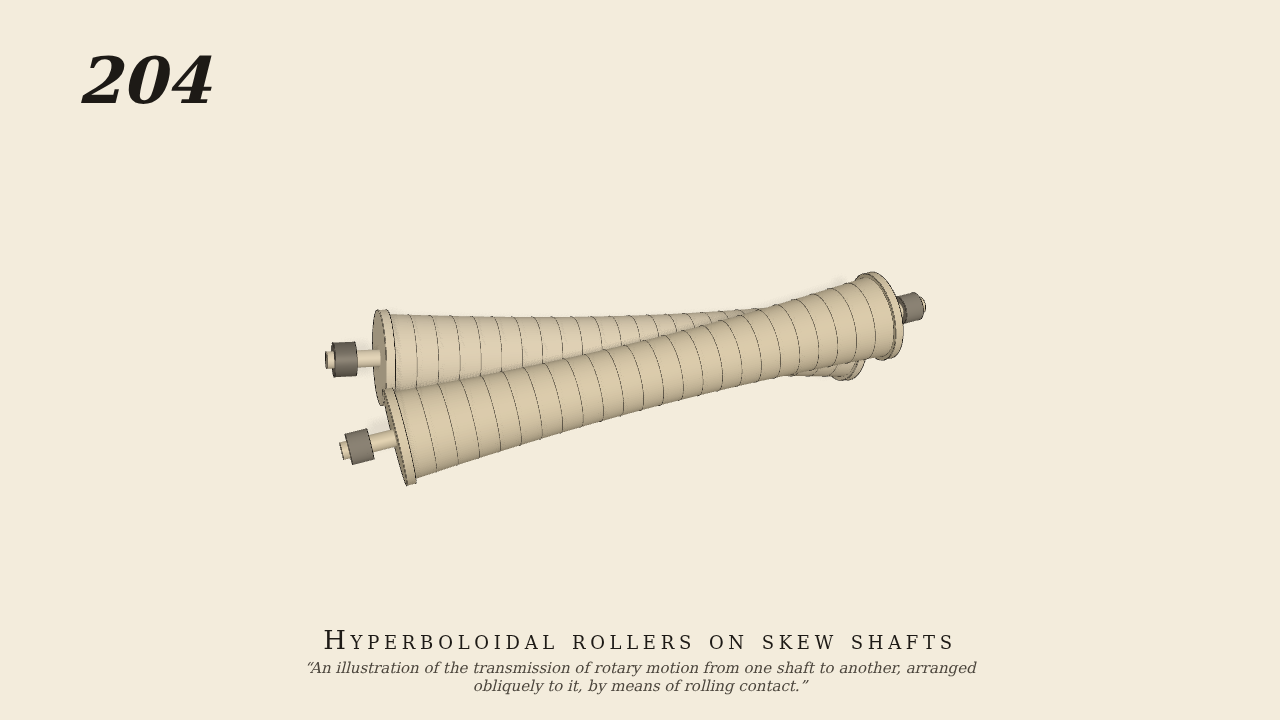
An illustration of the transmission of rotary motion from one shaft to another, arranged obliquely to it, by means of rolling contact.
Only the input is driven; every other part of this model moves by physics (MuJoCo), and its ratios are measured. Run it live, change its parameters, or switch the friction off to see the output stop.
- Modelled as
- As in the plate, two equal hour-glass rollers (hyperboloids of revolution) sit on shafts that neither meet nor lie parallel: 4 cm apart in depth, each slanted 6 deg the opposite way, so they cross at 12 deg. Each roller is the solid swept by the horizontal line midway between the shafts as it turns round its shaft: throat radius 2, 2.54 at the ends, 30 long. They touch along that whole straight line. Each roller is 24 convex frustum slices (96-gon lofts). The back roller's bearings slide in depth on a spring (2000 N/m) that presses it on the front roller, which is the only driven joint (30 rpm).
- Measured
- Over 1-5.5 s the back roller turns -0.9538 times the front (expected -0.979, tol 0.03). The press bearing holds at the touching position (0.001-0.003 cm). Max penetration 0.00 mm after 1 s.
- Notes
- Across the line the surfaces roll (-1), but along it they slide endwise at 0.21 of the rolling speed, as skew rollers must. That sliding friction has a moment about each shaft; with Coulomb friction along the slip, the balance gives -0.979. At friction 0.2 the sim comes 2.6% under that; higher friction loses more (0.8 gives about -0.88), so the rollers are taken as smooth metal.
Film (MP4) · Still (PNG) · Spec (YAML) · Model (MJCF)