A mode of obtaining two different speeds on the same shaft from…
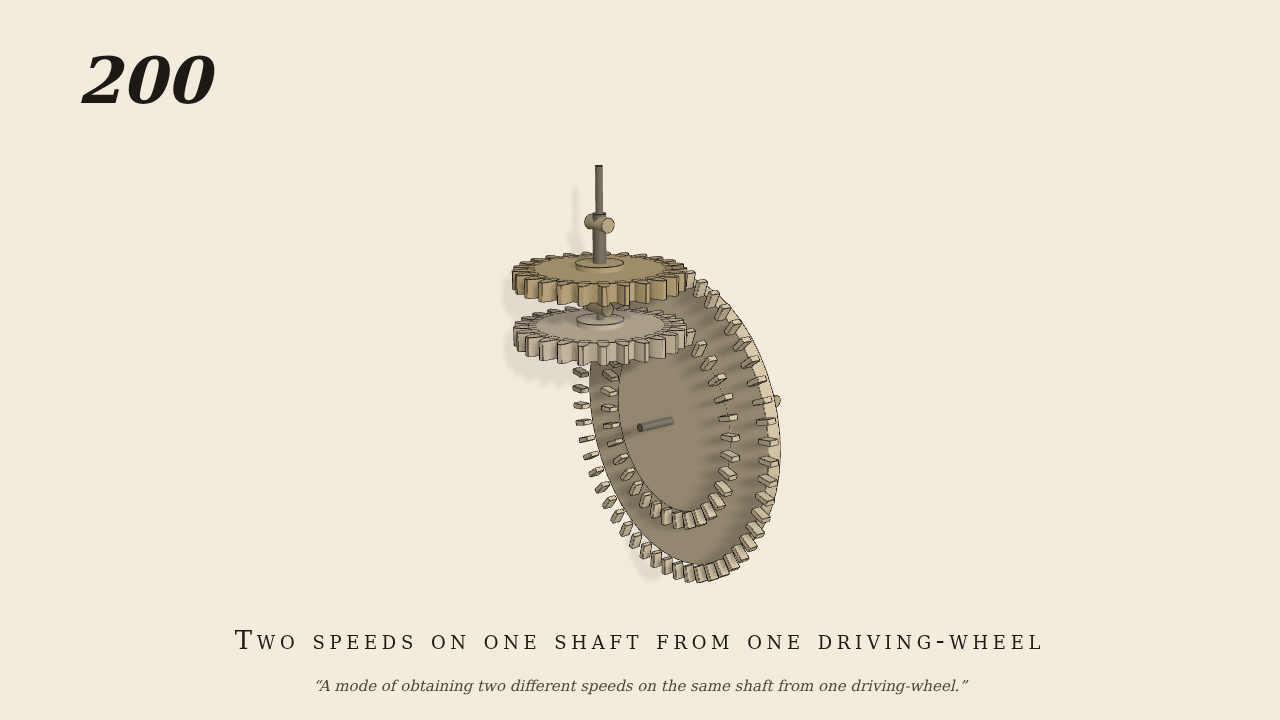
A mode of obtaining two different speeds on the same shaft from one driving-wheel.
Only the input is driven; every other part of this model moves by physics (MuJoCo), and its ratios are measured. Run it live, change its parameters, or switch the friction off to see the output stop.
- Modelled as
- The driving-wheel (the only driven joint, 12 rpm) is a face-wheel on a horizontal shaft with two concentric rows of thin teeth standing out of its face, 34 on the inner row and 52 on the outer (No. 26's crown-wheel teeth). Over its top runs one upright line of shaft: a 25-tooth pinion keyed to the shaft gears with the inner row, and a second 25-tooth pinion on a sleeve that turns loose round the same shaft gears with the outer row. Each row's teeth are spaced to the pinion's pitch where the pinion's teeth cross them.
- Measured
- Over 1-5.5 s the shaft turns 1.3588 times the driving-wheel (34/25 = 1.36) and the sleeve 2.0800 times (52/25 = 2.08), both the same way round, with no slip. Max penetration 0.05 mm (0.00 mm after 1 s).
- Notes
- The rows carry 34 and 52 teeth rather than No. 26's 36: with 36 the teeth meet the pinion at a smaller pitch than its own, and a driving face-wheel jams after two teeth. The bearings are drawn only.
Film (MP4) · Still (PNG) · Spec (YAML) · Model (MJCF)