A continual rotation of the pinion (obtained through the irregular…
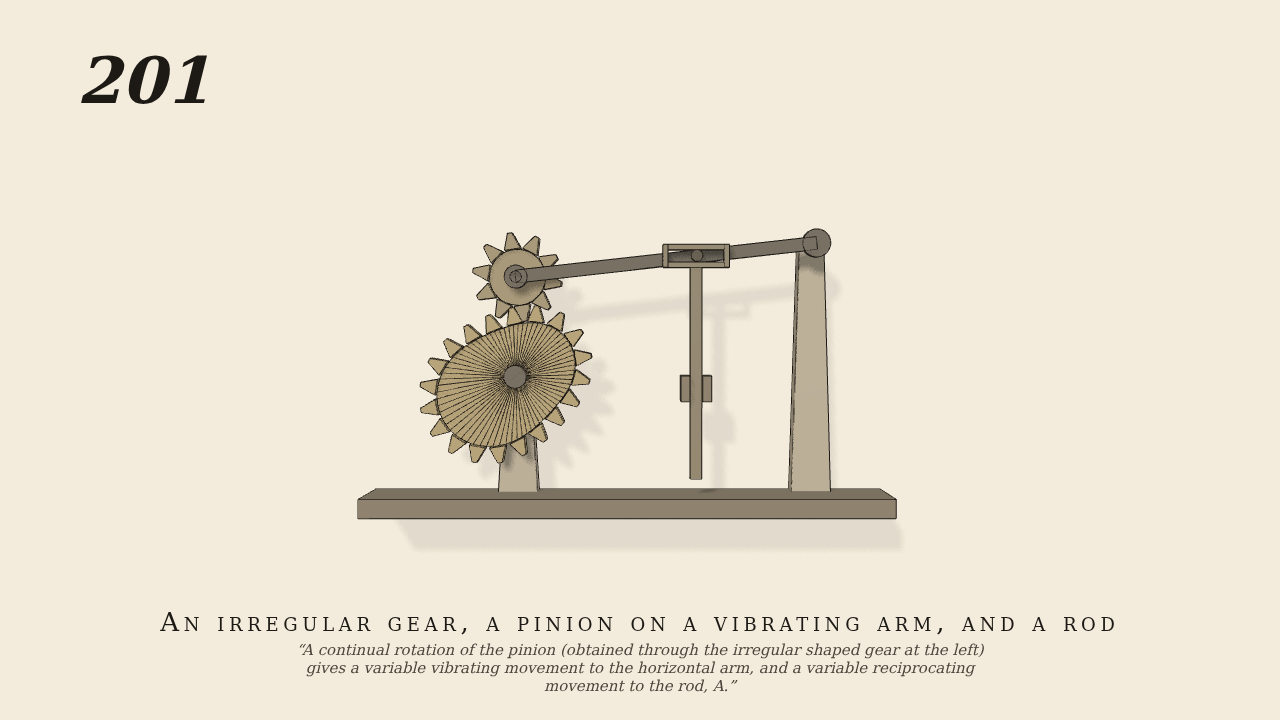
A continual rotation of the pinion (obtained through the irregular shaped gear at the left) gives a variable vibrating movement to the horizontal arm, and a variable reciprocating movement to the rod, A.
Only the input is driven; every other part of this model moves by physics (MuJoCo), and its ratios are measured. Run it live, change its parameters, or switch the friction off to see the output stop.
- Modelled as
- The irregular gear G at the left (the only driven joint, 8 rpm) has 20 teeth on a two-lobed pitch curve (No. 196's wheel). A 10-tooth pinion turns on a pin at the left end of a horizontal arm pivoted on the standard to the right and rests on G by weight, so G turns it continually while G's radius under it lifts and lets down the arm. A pin on the arm works in a horizontal slot in the head of rod A, which slides upright in a guide and rises and falls with the arm.
- Measured
- Over 1-8.5 s (a whole turn of G) the pinion turns -1.9962 times G (-20/10), its speed varying -2.467 to -1.544 in twelfths of a turn. The arm swings 0 to 0.121 rad (3.5 deg amplitude) and rod A between -1.21 and -0.03 cm, all as the rolling kinematics predict. Max penetration 0.04 mm after 1 s.
- Notes
- G's shaft, the pivot and A's guide are drawn only; the pinion stays in mesh by gravity.
Film (MP4) · Still (PNG) · Spec (YAML) · Model (MJCF)