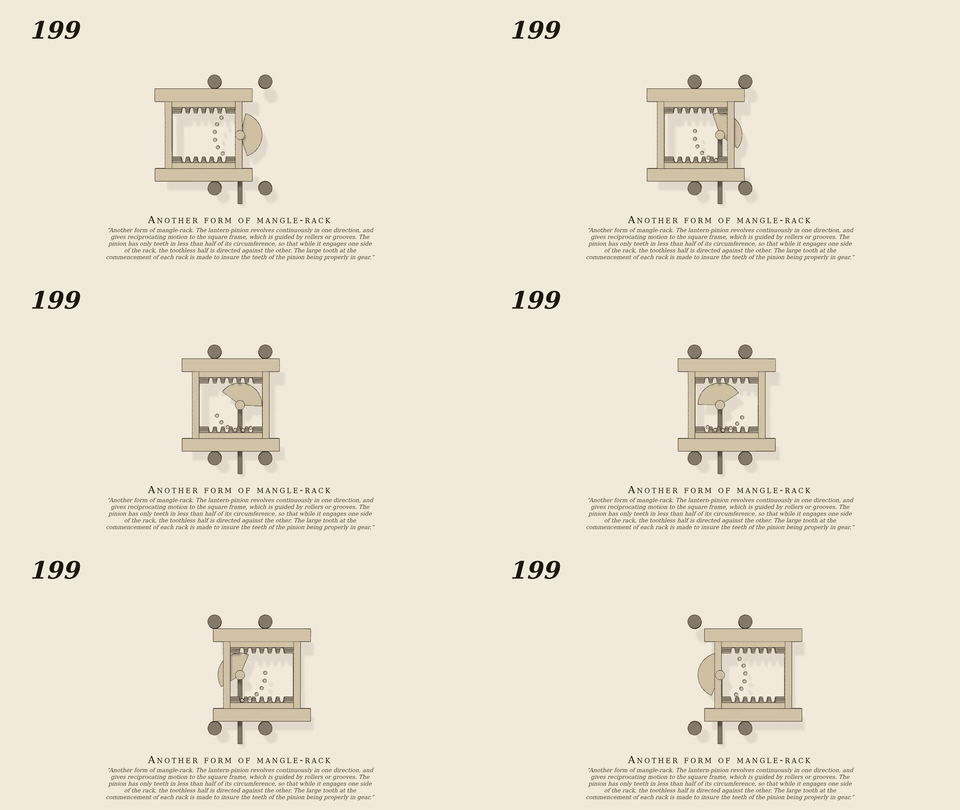
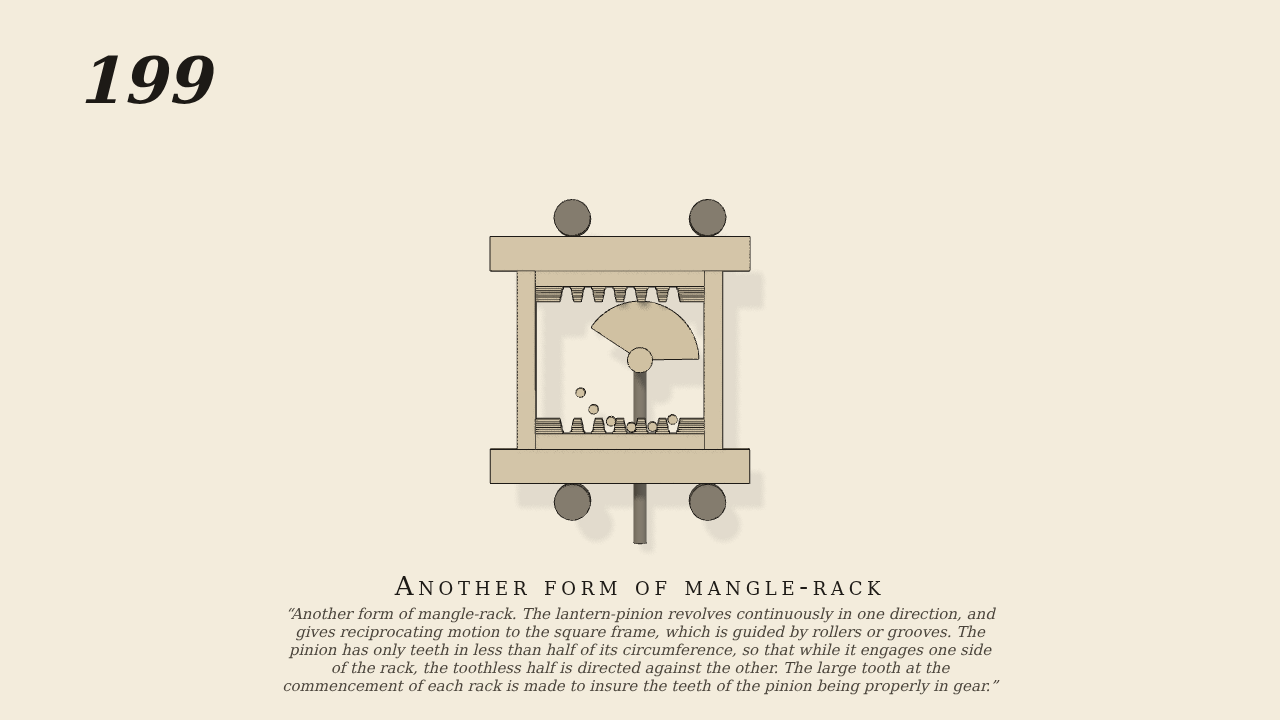
Another form of mangle-rack
Another form of mangle-rack. The lantern-pinion revolves continuously in one direction, and gives reciprocating motion to the square frame, which is guided by rollers or grooves. The pinion has only teeth in less than half of its circumference, so that while it engages one side of the rack, the toothless half is directed against the other. The large tooth at the commencement of each rack is made to insure the teeth of the pinion being properly in gear.
Only the input is driven; every other part of this model moves by physics (MuJoCo), and its ratios are measured. Run it live, change its parameters, or switch the friction off to see the output stop.
- Modelled as
- A square frame slides along x between rollers; inside its opening an upper rack hangs teeth down and a lower rack stands teeth up. A lantern pinion on a fixed shaft between them has 6 round pins (r 0.4) at 18 deg pitch on a circle of radius 6, over 90 deg of its circumference; the rest is plain. Only the pinion is driven, at 5 rpm. While the pins pass the bottom they drive the frame one way through the lower rack, then the plain side faces it and the pins pass the top and drive it back through the upper rack, with a short dwell between when no pin is in either rack and roller friction (frictionloss 1.5) holds the frame. The rack spaces are generated in gen199.py as the sweep of the pins over the ideal motion (0.05 clearance, teeth stacked in 7 slabs); the material beyond the first space of each rack is the large first tooth.
- Measured
- Ratio +0.0599 and -0.0600 m/rad (expect +-0.06) through the two strokes; stroke 0.1567 m on both turns (kinematic 0.1715: the pins pick up about 7 deg late at each stroke), so the frame stays in register; penetration 0.005 mm.
- Notes
- Two turns are simulated; the second repeats the first. kv 6 so roller friction does not slow the pinion (kv x speed 3.1 under the cap 6).
Film (MP4) · GIF · Still (PNG) · Spec (YAML) · Model (MJCF)