A modification of 197. In this the pinion revolves, but does not…
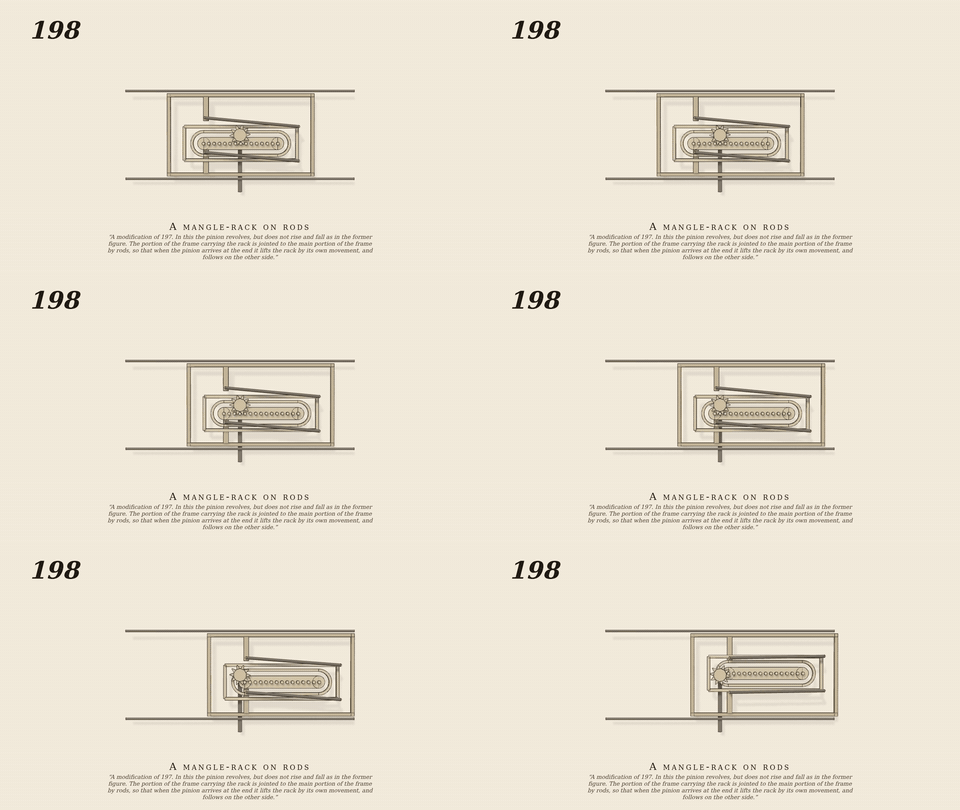
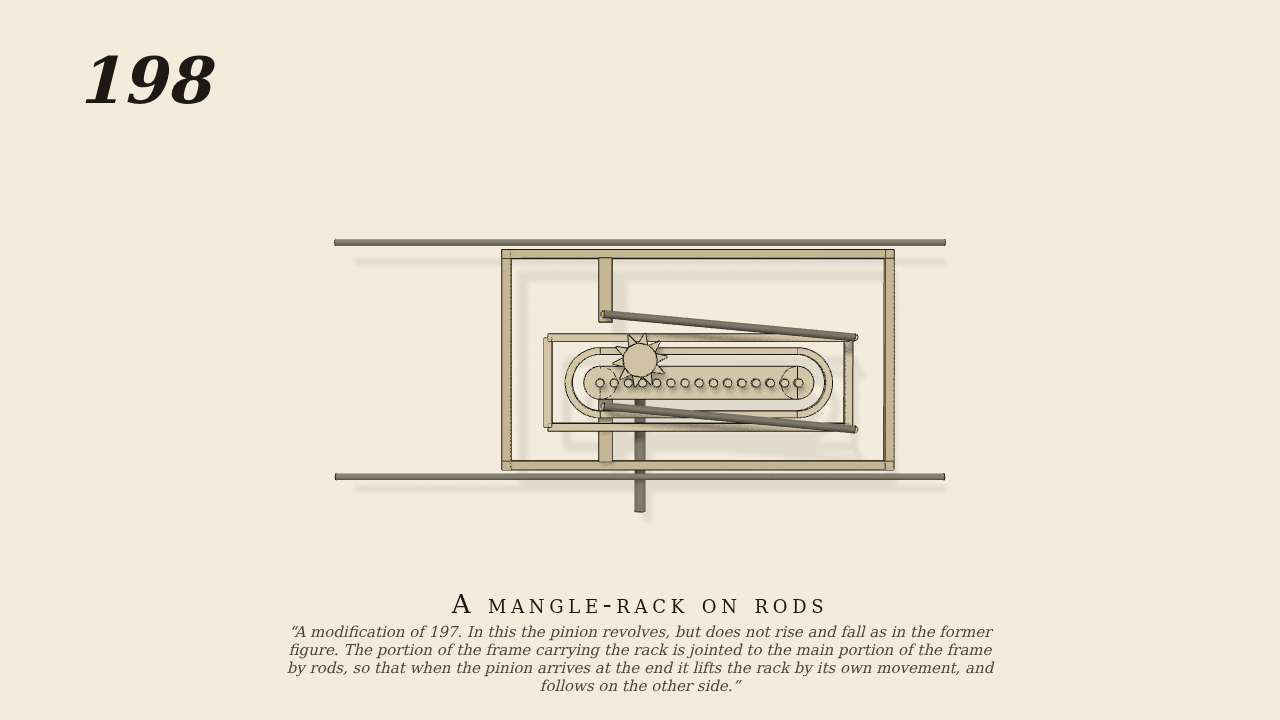
A modification of 197. In this the pinion revolves, but does not rise and fall as in the former figure. The portion of the frame carrying the rack is jointed to the main portion of the frame by rods, so that when the pinion arrives at the end it lifts the rack by its own movement, and follows on the other side.
Only the input is driven; every other part of this model moves by physics (MuJoCo), and its ratios are measured. Run it live, change its parameters, or switch the friction off to see the output stop.
- Modelled as
- No. 197 rack (15 pins at pitch 1.257, with the groove of tracks, island and end guides) on a rack plate hung from the main square frame by two equal parallel rods 22 long, so the plate stays level and can rise and fall 4 relative to the frame, which slides along x on guides. A 10-tooth pinion (pitch radius 2) turns on a fixed shaft, its follower in the groove. Only the pinion is driven, at 10 rpm. At one end the pinion lifts the plate by its own movement round the end pin and drives the frame back from underneath; at the other end the plate drops back under the follower.
- Measured
- Forward 0.0200 m/rad, return -0.0200 m/rad (expect +-0.02); rods swing 0..0.18 rad, amplitude 5.26 deg (expect asin(2/22) = 5.2 deg), so the plate lifts 4 cm; penetration 0.02 mm.
- Notes
- Brown draws the two rods pivoted at opposite ends; here both pivot at the same end (a parallelogram) so the rack stays level. Brown draws a toothed loop; this uses the 197 pin rack.
Film (MP4) · GIF · Still (PNG) · Spec (YAML) · Model (MJCF)