What is called a “mangle-rack.” A continuous rotation of the…
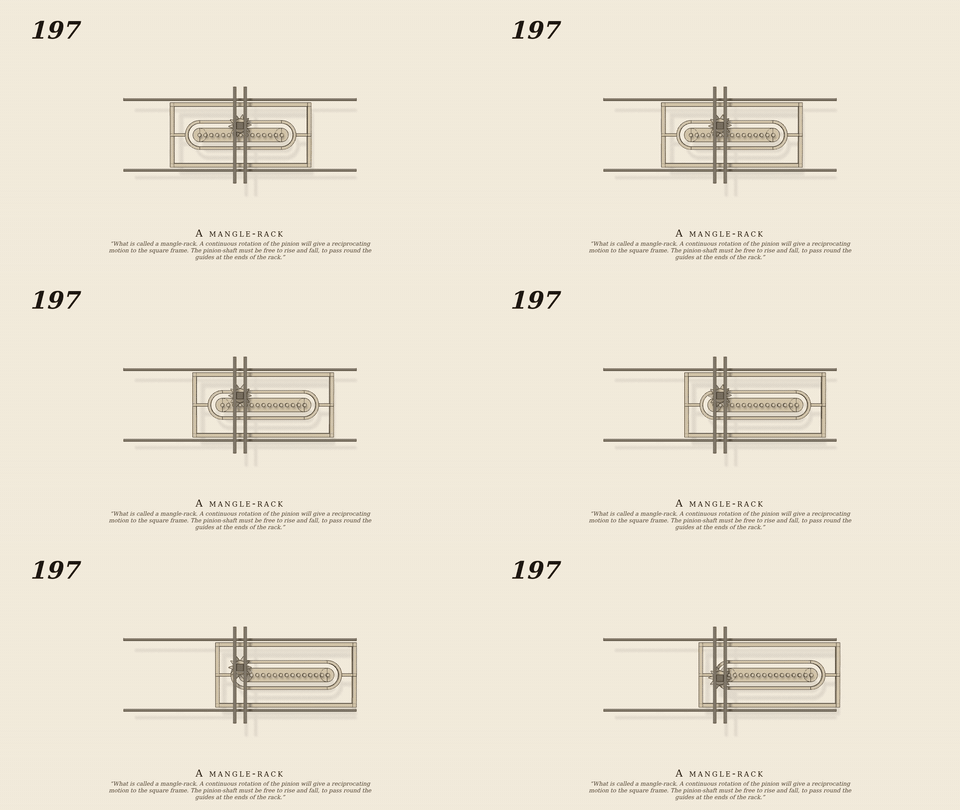
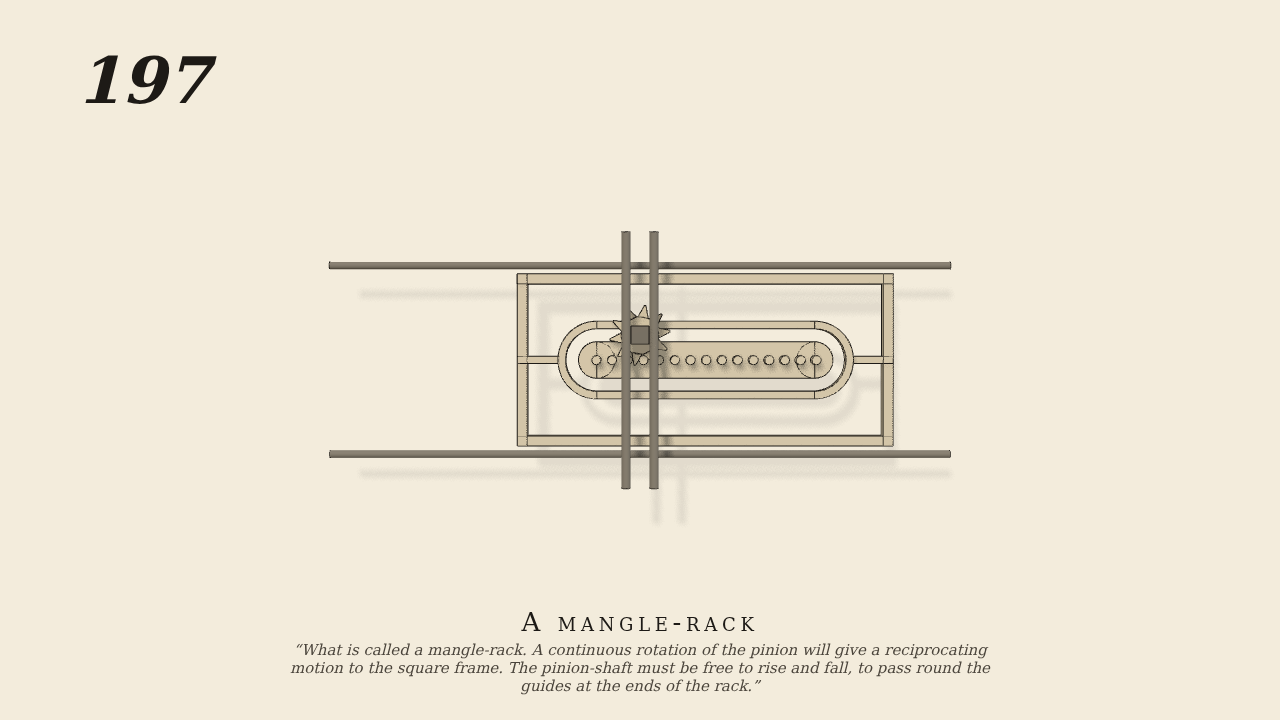
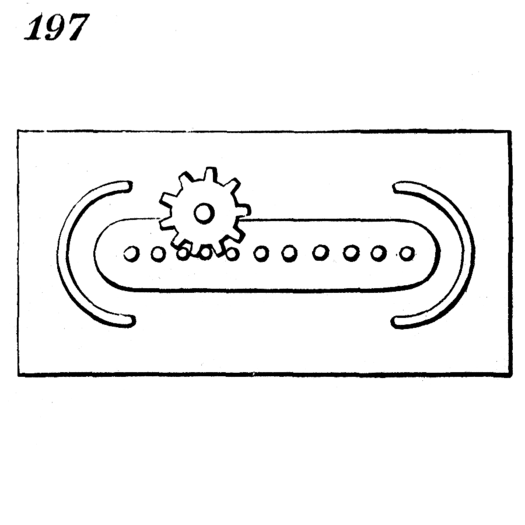
What is called a “mangle-rack.” A continuous rotation of the pinion will give a reciprocating motion to the square frame. The pinion-shaft must be free to rise and fall, to pass round the guides at the ends of the rack. This motion may be modified as follows:—If the square frame be fixed, and the pinion be fixed upon a shaft made with a universal joint, the end of the shaft will describe a line, similar to that shown in the drawing, around the rack.
Only the input is driven; every other part of this model moves by physics (MuJoCo), and its ratios are measured. Run it live, change its parameters, or switch the friction off to see the output stop.
- Modelled as
- A square frame on two horizontal guide slides carries a straight row of 15 pins (pitch 1.257) worked by a 10-tooth pinion (pitch radius 2). The pinion shaft runs in a carriage on a vertical slide, free to rise and fall; a groove round the pin row (an island between the tracks with round ends and outer guides round the ends) keeps the pinion in gear, so it gears on top of the row, passes round the end pins and gears underneath, reversing the frame. Only the pinion is driven, at 10 rpm.
- Measured
- Forward 0.0200 m/rad (expect 0.02) over 0.5-3.7 s, return -0.0201 m/rad over 8.2-14.6 s; the carriage drops 4.03 cm passing round the end; penetration 0.01 mm.
- Notes
- The pinion starts with a space over the middle pin. Rack length and pin count chosen to fit the plate.
Film (MP4) · GIF · Still (PNG) · Spec (YAML) · Model (MJCF)