Contrivance for uncoupling engines
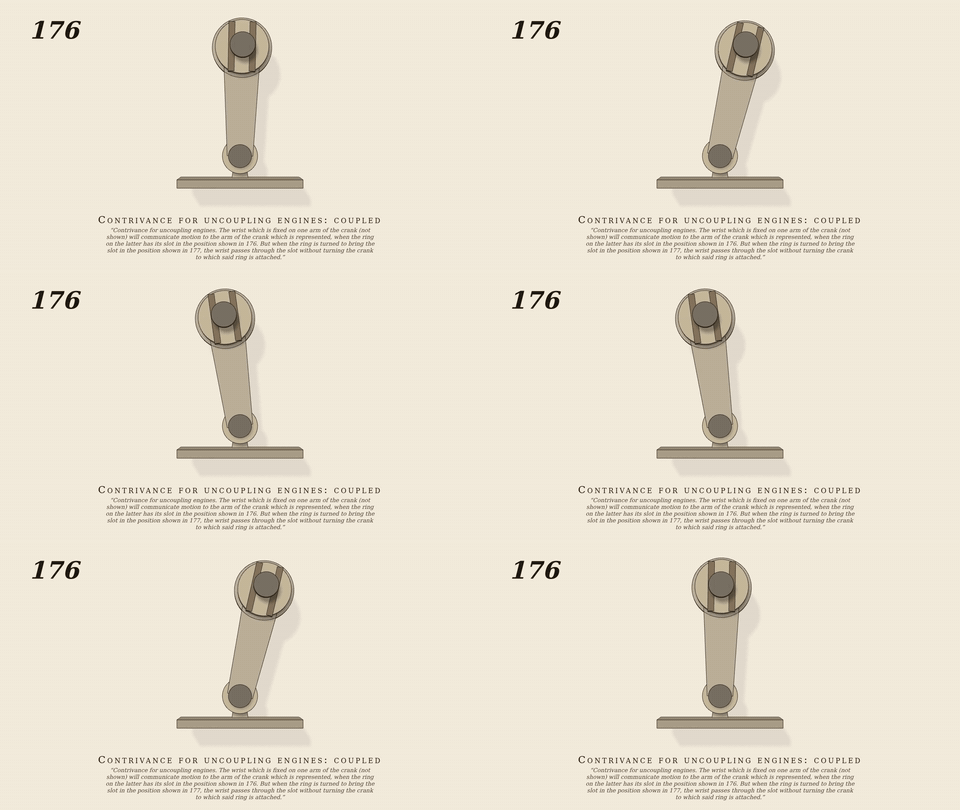
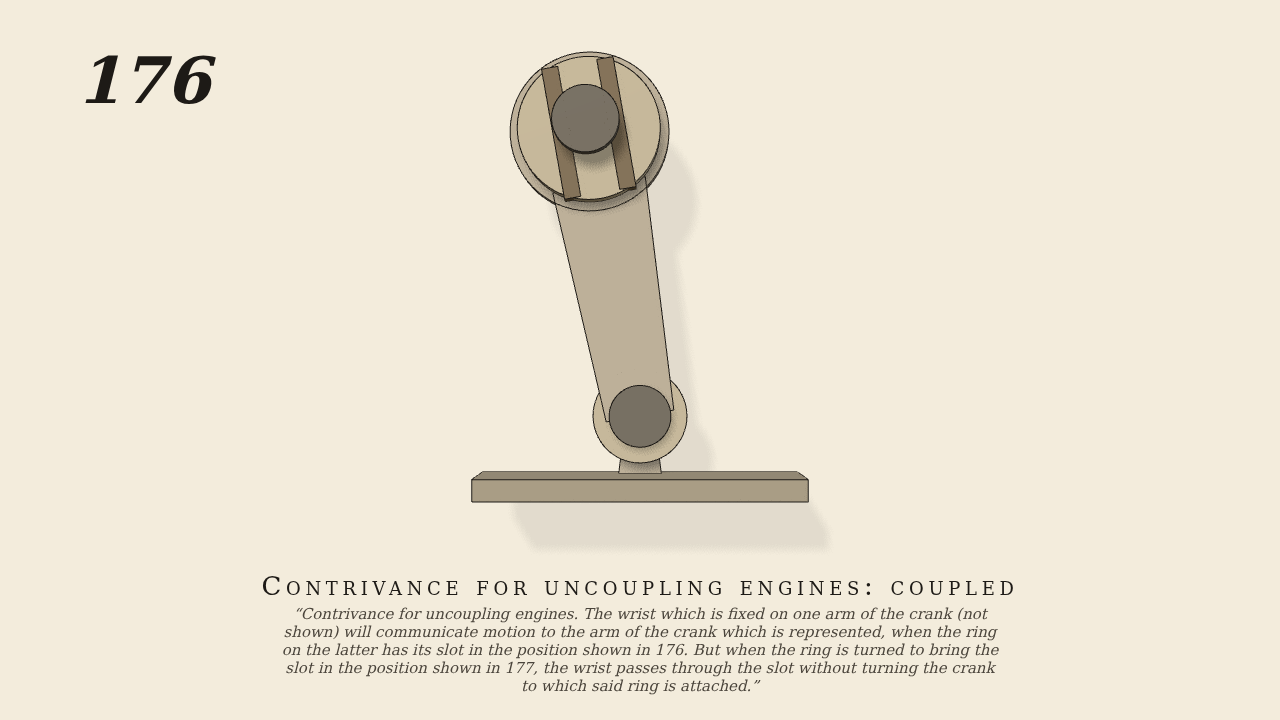
176 and 177. Contrivance for uncoupling engines. The wrist which is fixed on one arm of the crank (not shown) will communicate motion to the arm of the crank which is represented, when the ring on the latter has its slot in the position shown in 176. But when the ring is turned to bring the slot in the position shown in 177, the wrist passes through the slot without turning the crank to which said ring is attached.
Only the input is driven; every other part of this model moves by physics (MuJoCo), and its ratios are measured. Run it live, change its parameters, or switch the friction off to see the output stop.
- Modelled as
- The wrist (a 2 cm pin, the one driven joint, a slide moving 4 cm either way, a quarter turn a second) runs in the slot of a ring in the head of a crank arm that hangs on a pivot 16 cm below. The slot lies across the wrist's path, so its walls are pushed (real contact, 0.08 cm clearance). The ring is held by a stiff joint spring. No gravity. gen176.py.
- Measured
- The arm follows the wrist at -6.234 rad/m in three windows (r2 1.000; 1/16 cm = -6.25), swinging 14 degrees each way. Penetration 0.
- Notes
- Reading of the figure: only the slot position differs between 176 and 177, so the ring is fixed by a stiff spring and the two movements differ by how it is drawn. The arm is damped so that it stops with the wrist instead of coasting.
Film (MP4) · GIF · Still (PNG) · Spec (YAML) · Model (MJCF)