A drum or cylinder having an endless spiral groove extending all…
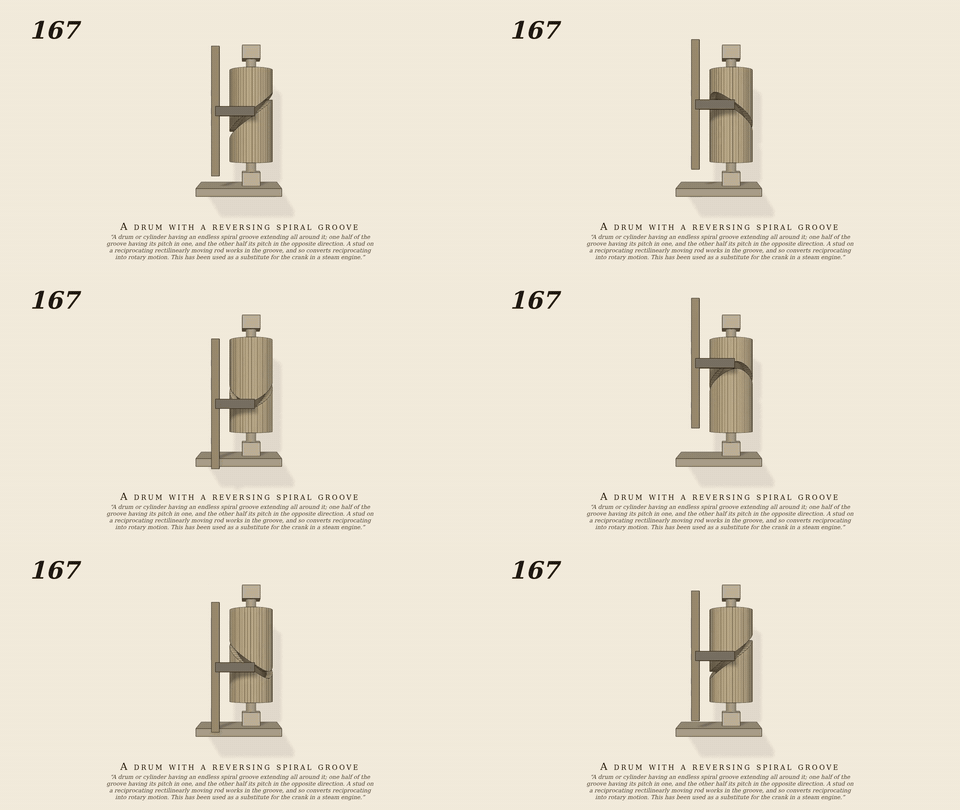
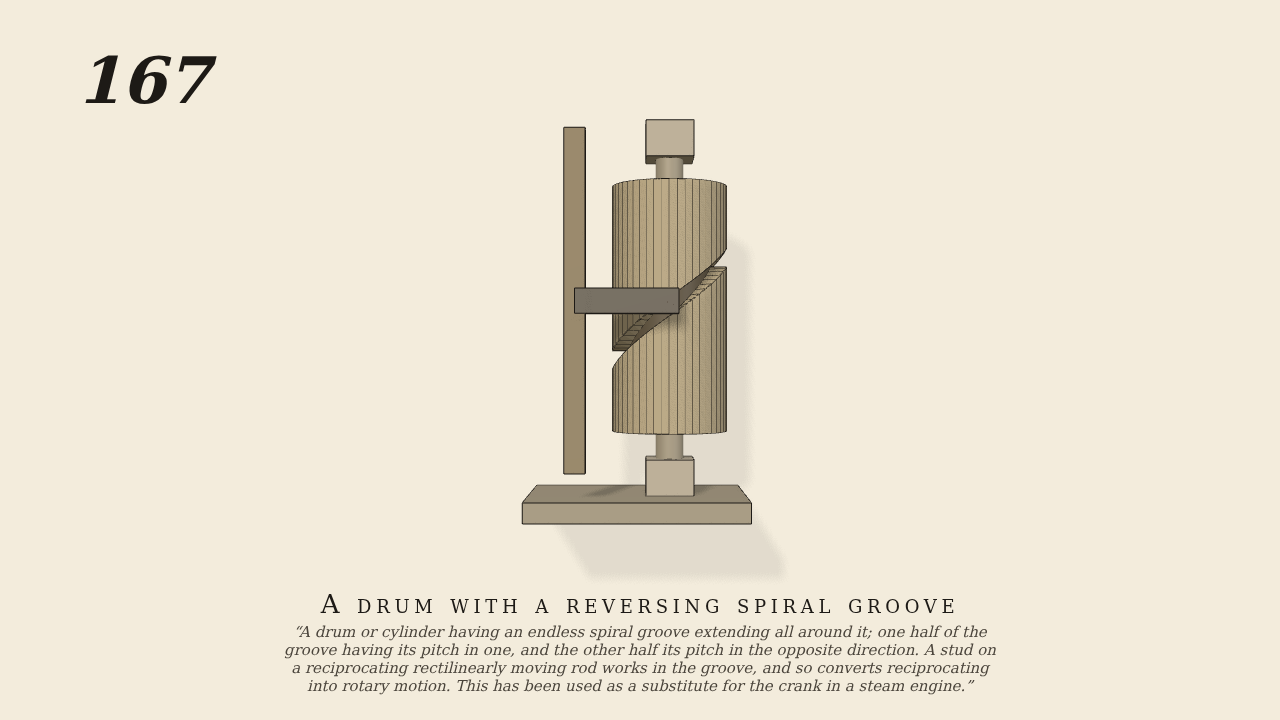
A drum or cylinder having an endless spiral groove extending all around it; one half of the groove having its pitch in one, and the other half its pitch in the opposite direction. A stud on a reciprocating rectilinearly moving rod works in the groove, and so converts reciprocating into rotary motion. This has been used as a substitute for the crank in a steam engine.
Only the input is driven; every other part of this model moves by physics (MuJoCo), and its ratios are measured. Run it live, change its parameters, or switch the friction off to see the output stop.
- Modelled as
- A vertical drum (radius 2.9 cm) has one endless groove that climbs 2.6 cm for half a turn and falls 2.6 cm for the other half (a rounded triangle wave), cut between two ridges that are real contact (convex segments, 24 per half turn each side). A stud on a rod that slides up and down (the one driven joint, a 3.0 cm swing at 0.4 Hz) works in the groove. The drum is turned only by the groove walls; its inertia carries it over the turns. No gravity. gen167.py.
- Measured
- The drum goes round and round one way: mean 2.40 rad/s (22.9 rev/min, one turn per up-and-down stroke of the rod), turning forward 87% of the time. It follows the rod at -48.3 / +45.3 / -48.3 rad/m through the groove middle (kinematic 47.9); rod stroke +-2.86 cm; penetration 0.04 mm.
- Notes
- Reading of the figure: the groove is a rounded triangle wave and the rod swings sinusoidally a little more (15%) than the groove rises, and the drum is heavy enough (2.5 kg) to coast through the turns, where the groove is level and the stud has no lever; the drum stands in for the flywheel. Lock-in depends on these (a heavier swing or a lighter drum lets it rock back); the figure shows the drum and one stud only.
Film (MP4) · GIF · Still (PNG) · Spec (YAML) · Model (MJCF)