The rotation of the disk carrying the crank pin gives a to-and-fro…
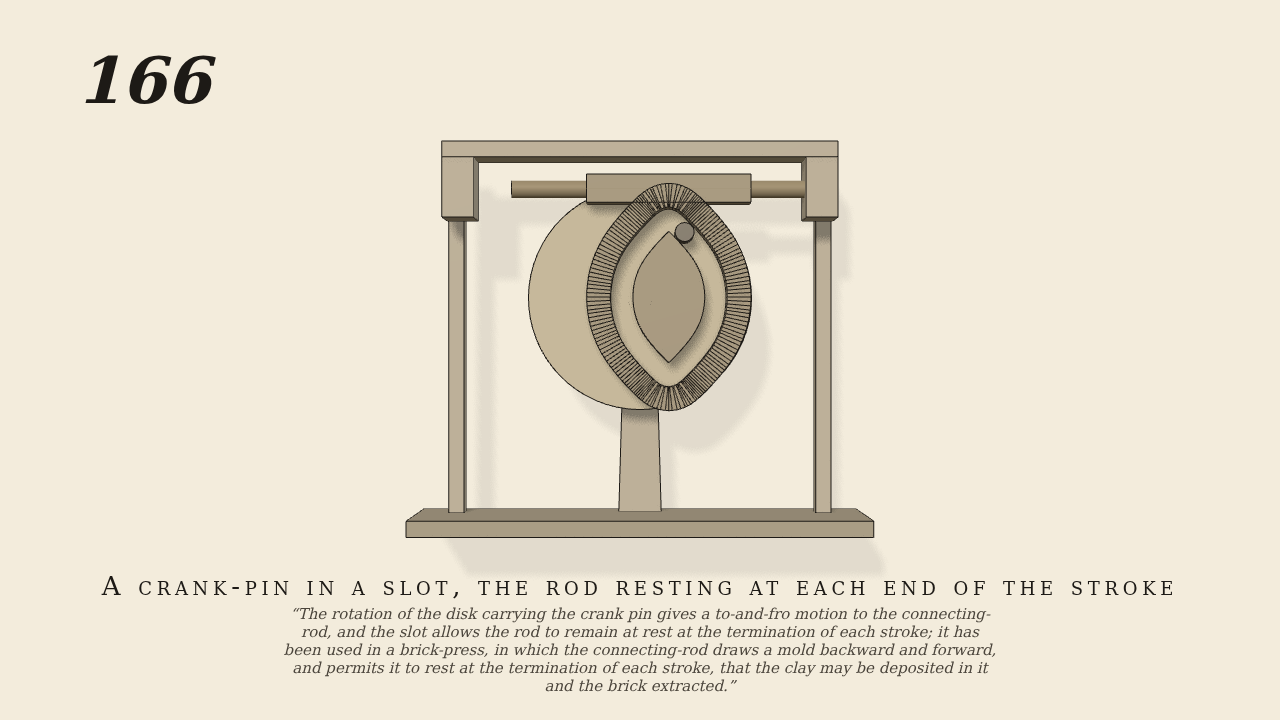
The rotation of the disk carrying the crank pin gives a to-and-fro motion to the connecting-rod, and the slot allows the rod to remain at rest at the termination of each stroke; it has been used in a brick-press, in which the connecting-rod draws a mold backward and forward, and permits it to rest at the termination of each stroke, that the clay may be deposited in it and the brick extracted.
Only the input is driven; every other part of this model moves by physics (MuJoCo), and its ratios are measured. Run it live, change its parameters, or switch the friction off to see the output stop.
- Modelled as
- The disk (the one driven joint, 20 rpm, clockwise) carries a crank-pin 5 cm from its centre. The pin works by real contact in an endless slot (1.44 cm wide) cut in the connecting-rod, which slides to and fro 4 cm in fixed guides. The slot is the path of the pin in the rod frame when the rod rests for 60 degrees of the turn at each end of its stroke (where the slot is an arc about the shaft) and goes between by a cycloidal stroke. No gravity (a plan). gen166.py.
- Measured
- The rod falls, rises and falls through the middle of its stroke at -0.0367, +0.0367, -0.0364 m/rad (kinematic +-0.0374, r2 0.993) and stands still at the ends: -0.0004..+0.0006 m/rad while the disk turns on (limit 0.0008). Travel 4.3 cm, penetration 0.02 mm.
- Notes
- The first try placed the rests at the top and bottom of the pin circle, where the arc cannot hold the rod; the rod ran away. The rests belong where the pin is at the end of its throw (3 and 9 o clock), where the arc faces the stroke. A little viscous drag on the rod (2 N s/m) steadies it through the middle of the stroke where the slot walls are tangent.
Film (MP4) · GIF · Still (PNG) · Spec (YAML) · Model (MJCF)