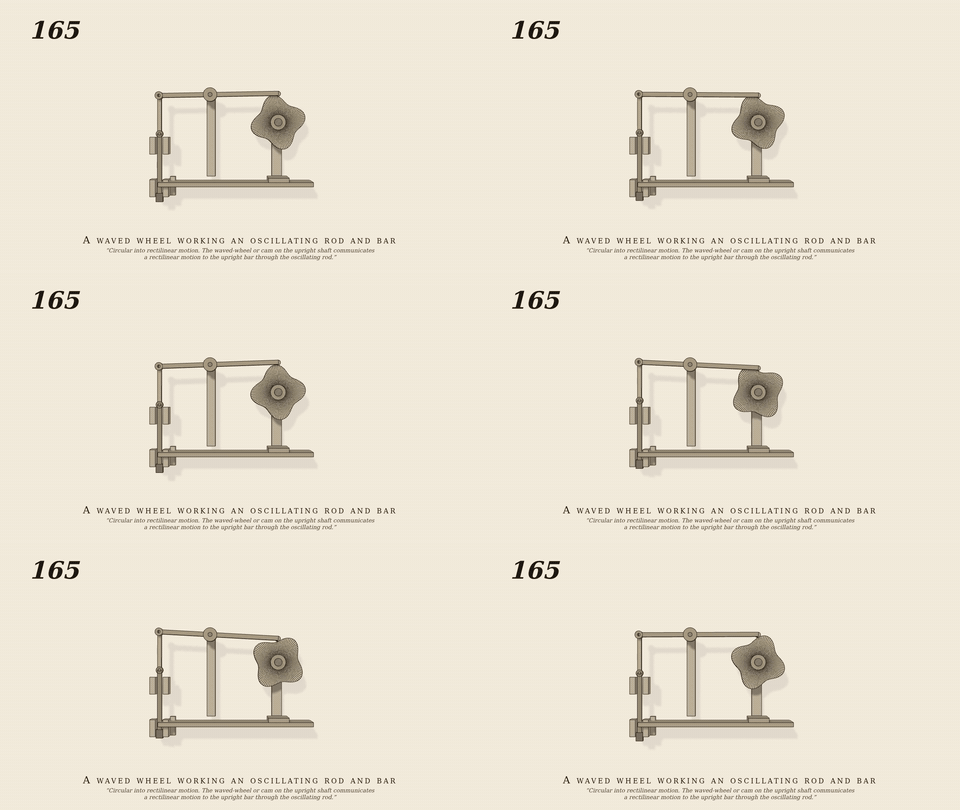
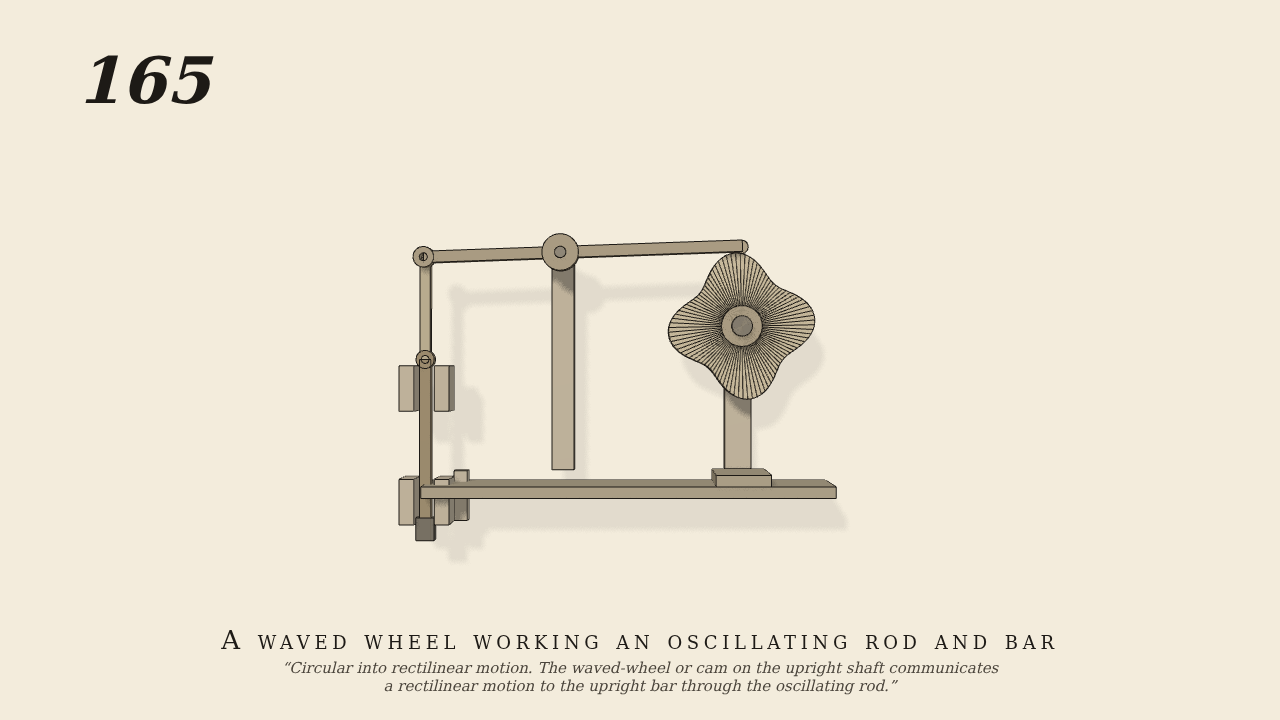
Circular into rectilinear motion
Circular into rectilinear motion. The waved-wheel or cam on the upright shaft communicates a rectilinear motion to the upright bar through the oscillating rod.
Only the input is driven; every other part of this model moves by physics (MuJoCo), and its ratios are measured. Run it live, change its parameters, or switch the friction off to see the output stop.
- Modelled as
- A waved wheel (r = 5.6 + 0.9 cos 4(phi - 20 deg), 96 wedges) is turned on its shaft at 15 rpm (the one driven joint). The oscillating rod (16 cm from its pivot to a 0.6 cm roller) rests on it, pressed down by a spring at the pivot (0.6 N m/rad); it rises and falls about 6 degrees four times a turn by real contact. A 9 cm link from the rod 12 cm arm works the upright bar in its guides. Gravity on. gen165.py.
- Measured
- The bar follows the wheel at +0.0258, -0.0254, +0.0259, -0.0254 m/rad in the steepest rises and falls (kinematic +0.0263, -0.0257, r2 0.9997), travelling -0.49..+0.86 cm. Penetration 0.02 mm.
- Notes
- The rod angle is found for each wheel angle by letting the roller down on the rim until it first touches. The first try (waves 1.4 cm, pressure angle 47 degrees) stalled the wheel on the steep flanks; 0.9 cm waves run clean.
Film (MP4) · GIF · Still (PNG) · Spec (YAML) · Model (MJCF)