A knee-lever, differing slightly from the toggle-joint shown in…
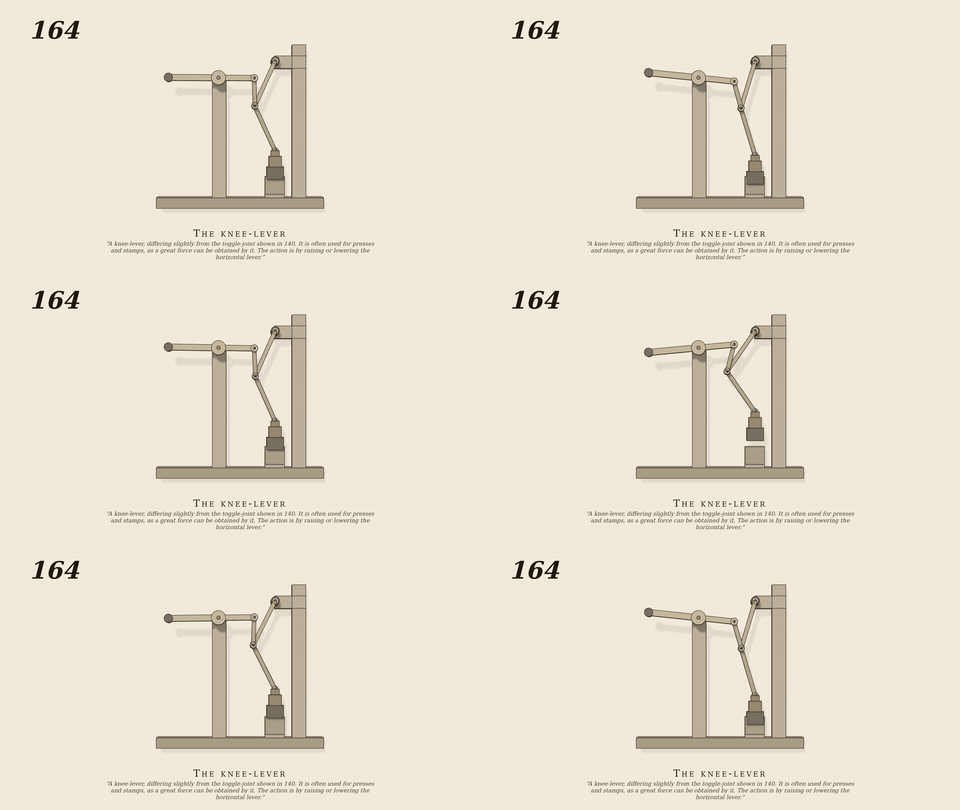
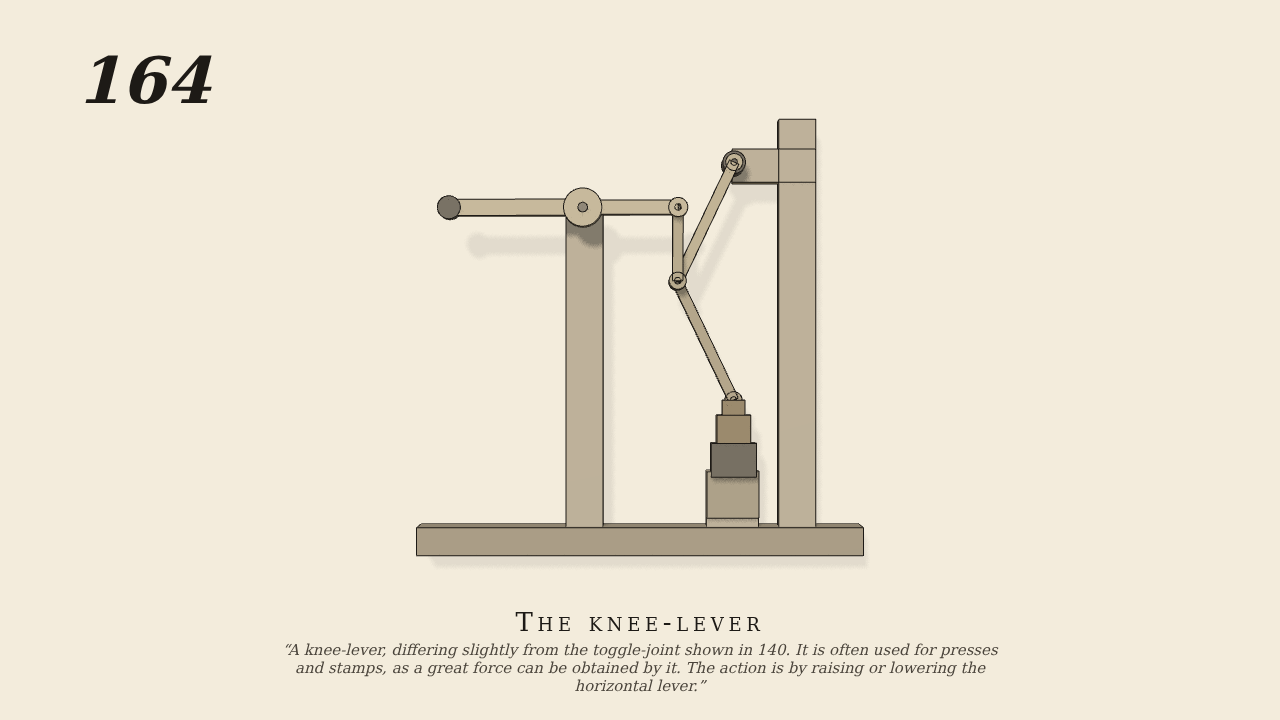
A knee-lever, differing slightly from the toggle-joint shown in 140. It is often used for presses and stamps, as a great force can be obtained by it. The action is by raising or lowering the horizontal lever.
Only the input is driven; every other part of this model moves by physics (MuJoCo), and its ratios are measured. Run it live, change its parameters, or switch the friction off to see the output stop.
- Modelled as
- A knee of two 14 cm links hangs from a pin at the top of the pillar; the lower link pushes the plunger down its guide. A 7.6 cm upright link joins the knee, from above, to the horizontal lever on the left post. The lever (the one driven joint, swung by the hand 0.1 rad each way, 0.2 swings a second) turns clockwise, the link pushes the knee towards the line of the knee, and the plunger goes down. Gravity on. gen164.py (from 140, with the link above the knee: below it, the link and the upper link would be in line).
- Measured
- The plunger follows the lever at -0.142, -0.135, -0.276, -0.236, -0.136 and -0.153 m/rad in six windows (the gear of the knee grows as it straightens), each within 8 percent of the kinematics (r2 0.996 or more). The plunger travels -1.7 to +2.4 cm; the lever swings 6.2 degrees.
- Notes
- The first sketch had the connecting link below the knee: the link and the upper link came in line at the start and the lever jammed after 3 degrees. Moved above the knee.
Film (MP4) · GIF · Still (PNG) · Spec (YAML) · Model (MJCF)