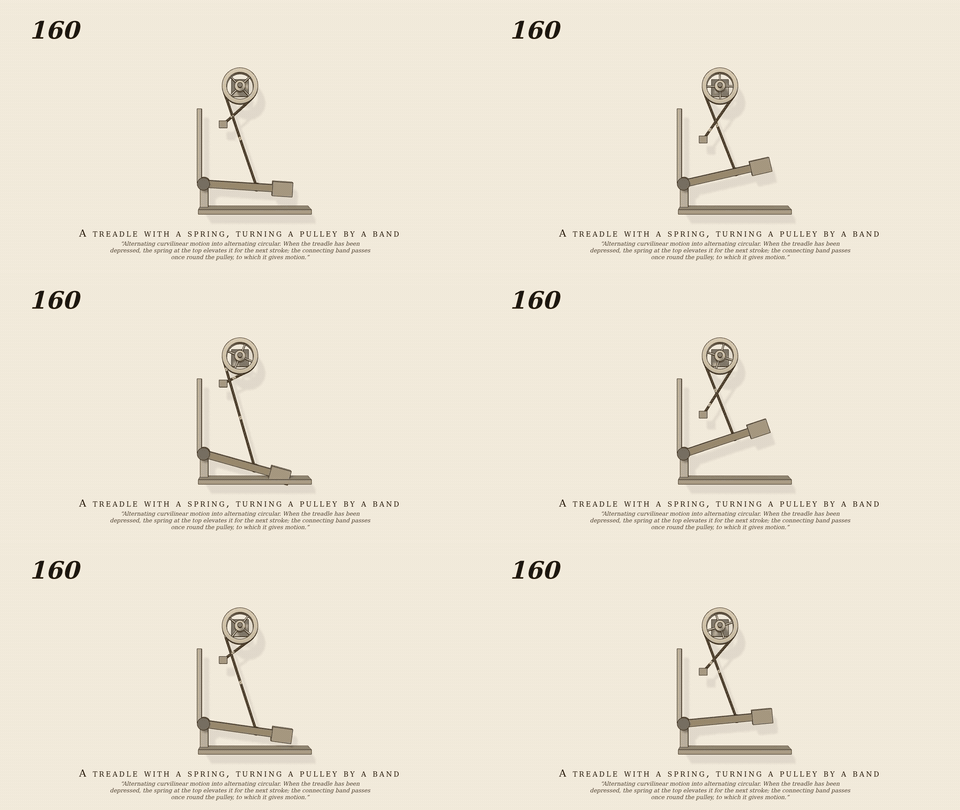
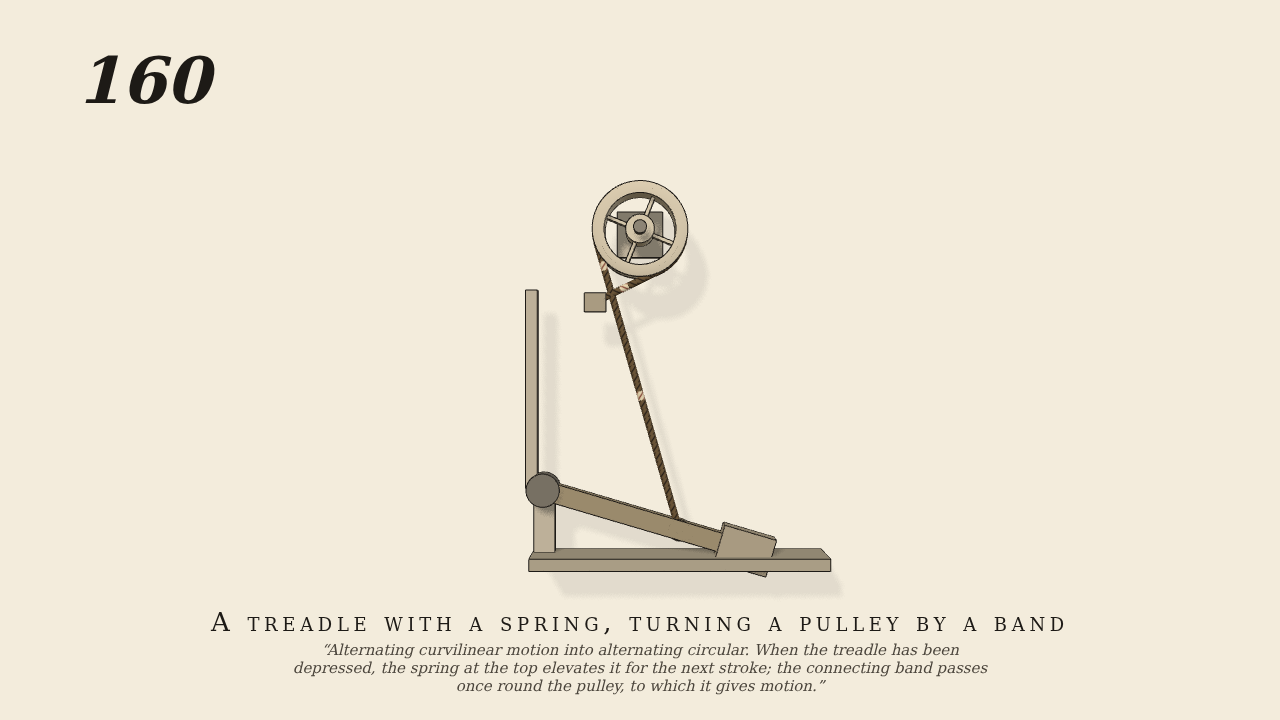
Alternating curvilinear motion into alternating circular
Alternating curvilinear motion into alternating circular. When the treadle has been depressed, the spring at the top elevates it for the next stroke; the connecting band passes once round the pulley, to which it gives motion.
Only the input is driven; every other part of this model moves by physics (MuJoCo), and its ratios are measured. Run it live, change its parameters, or switch the friction off to see the output stop.
- Modelled as
- The treadle (a lever hinged at the left, swung +-18 degrees twice in four seconds by a stiff drive: the foot, the one driven joint) has a real band (a link-chain cord, 0.6 cm) tied to its eye. The band runs up to the 3.5 cm pulley, round it, and down to a spring: a block on a slide with a 30 N/m spring (free 12 cm below, so it holds the band at 2-5 N whatever the stroke). Nothing but the band grip turns the pulley, to and fro as the treadle goes down and up. A plan: gravity off. gen160.py.
- Measured
- The pulley follows the treadle at -2.84, -2.86, -2.87 rad/rad (r2 0.9997) in three windows, swinging -0.46..1.32 rad for the treadle -0.38..0.31; the spring block travels 8 cm. Penetration 0.2 mm.
- Notes
- The band is a chain of links lying on the pulley by real contact and friction (0.5); it is pretensioned 2 N. The pulley turns the other way to the treadle (the band goes round its left). The treadle holds its swing: the drive is a velocity servo (kv 60).
Film (MP4) · GIF · Still (PNG) · Spec (YAML) · Model (MJCF)