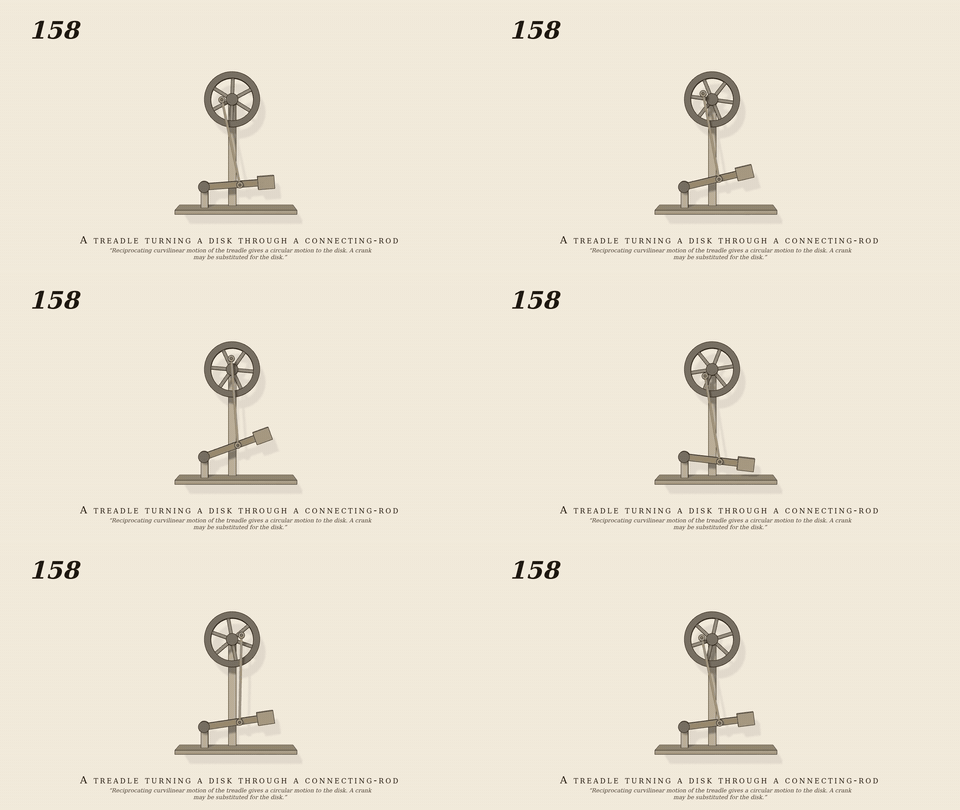
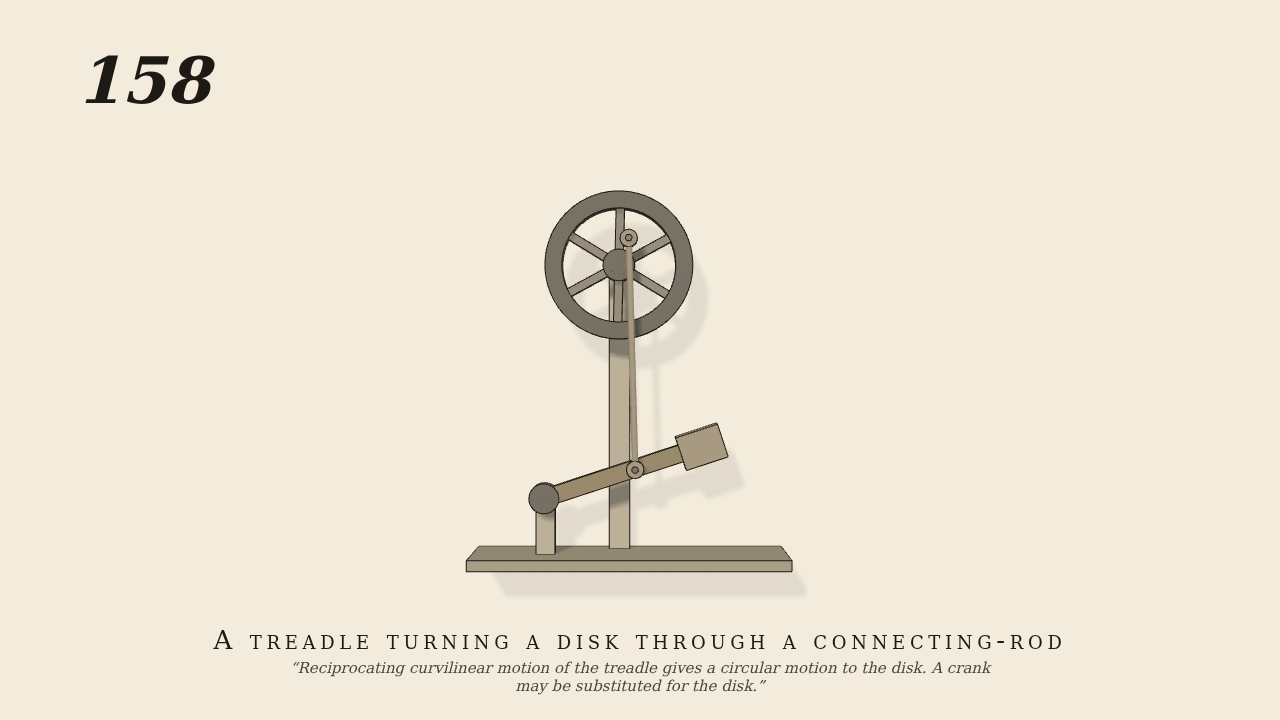
Reciprocating curvilinear motion of the treadle gives a circular…
Reciprocating curvilinear motion of the treadle gives a circular motion to the disk. A crank may be substituted for the disk.
Only the input is driven; every other part of this model moves by physics (MuJoCo), and its ratios are measured. Run it live, change its parameters, or switch the friction off to see the output stop.
- Modelled as
- The treadle (a lever pivoted at the left and rocked to and fro: the one driven joint, a soft drive swinging it +-17.7 degrees twice in four seconds) carries a 21.5 cm connecting-rod to the crank-pin of a weighted flywheel (7 cm, crank 2.5 cm). Both ends of the rod are real pin joints; the four-bar turns the disk right round once to each swing of the treadle, and the dead points (rod in line with the crank) are passed by the weight of the wheel. A plan: gravity off. gen158.py.
- Measured
- The disk advances 3.1416 rad (half a turn) per beat of the treadle over 10 beats, and never runs back (net 39.5 rad forward in 12 s). The treadle follows the disk at 0.2560 rad/rad (kinematic 0.2557, r2 0.996) in five windows. Treadle swing +-16.1 deg to the dead points. Penetration 0.
- Notes
- The drive is soft (torque cap 3 N cm) so the treadle may lag at the dead points and the wheel carries it through; the treadle swing is set 10 percent over the four-bar range for that. The wheel starts from rest with the treadle at mid-swing and so always turns clockwise.
Film (MP4) · GIF · Still (PNG) · Spec (YAML) · Model (MJCF)