A modification of the movement last described
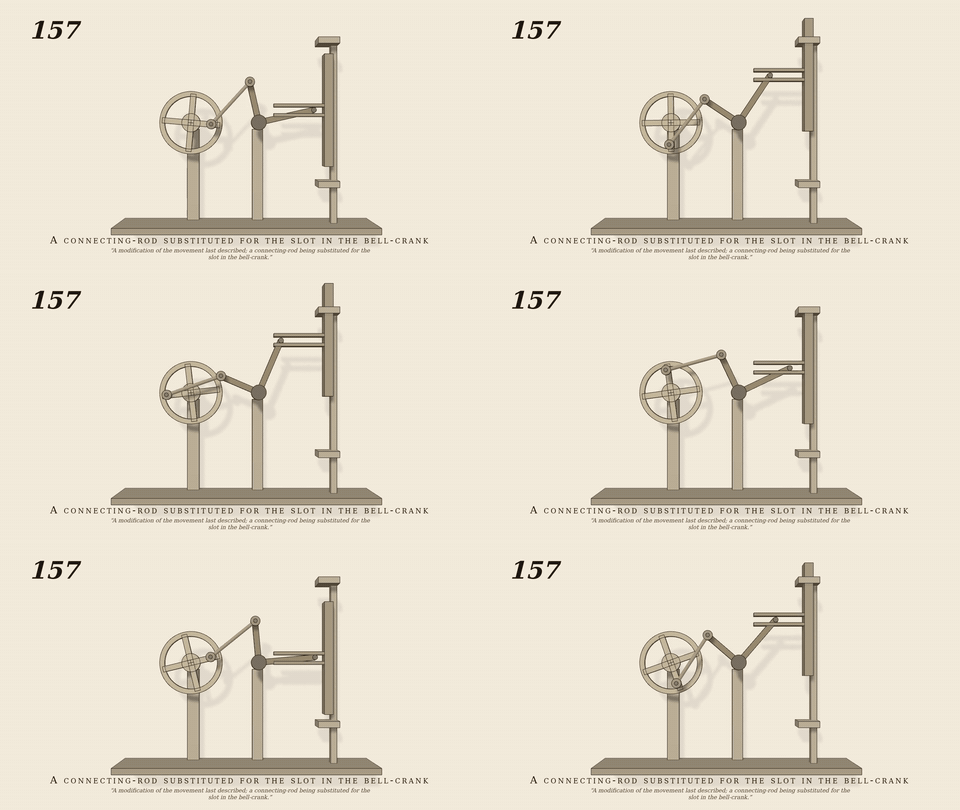
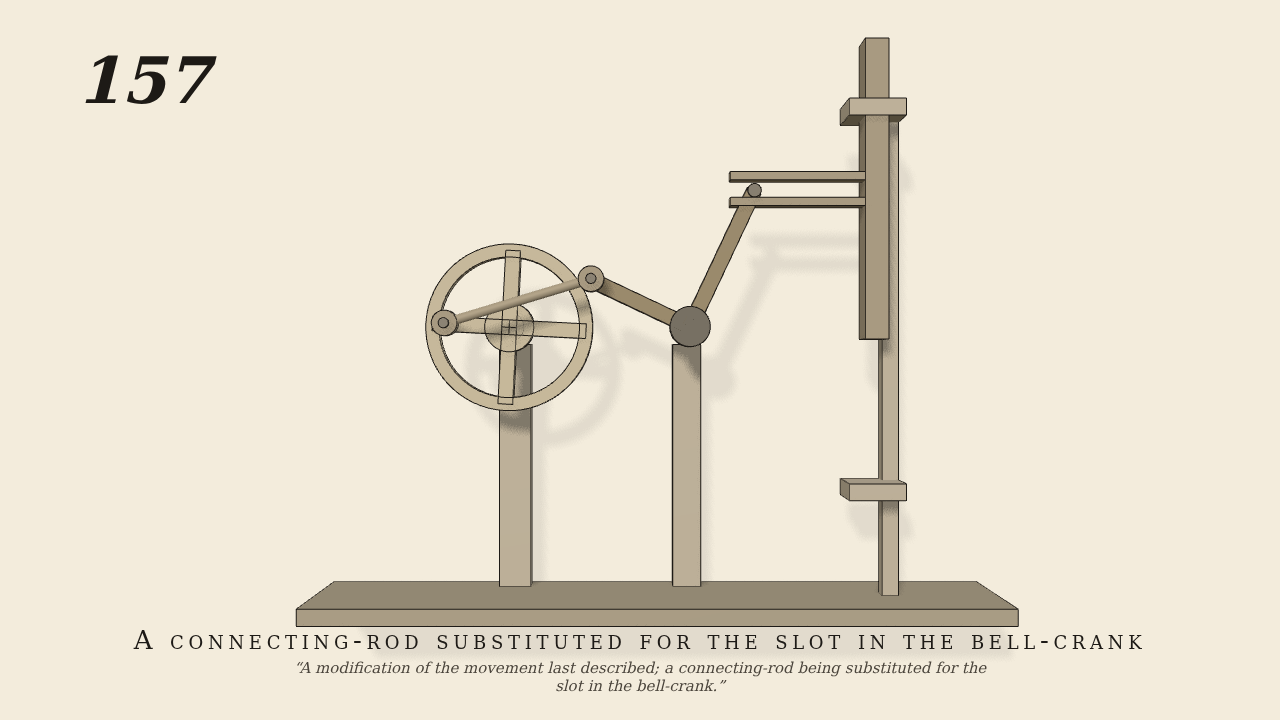
A modification of the movement last described; a connecting-rod being substituted for the slot in the bell-crank.
Only the input is driven; every other part of this model moves by physics (MuJoCo), and its ratios are measured. Run it live, change its parameters, or switch the friction off to see the output stop.
- Modelled as
- No. 156 with a connecting-rod (9 cm, a pin at each end) in place of the slot: the disk (the one driven joint, 12 rev/min) carries the crank-pin 3.5 cm out; the rod carries it to the end of arm 1 (6.5 cm) of a bell-crank pivoted 11 cm away (a crank-and-rocker: the disk turns right round, the bell-crank rocks through 66 degrees); arm 2 (9 cm, a right angle from arm 1) has a pin in the slot across a sliding bar, which goes up and down 7.9 cm. The loop is closed by two real pin joints: gen157.py.
- Measured
- Bell-crank follows the disk (0.5284 per rad on the forward swing, expect 0.5274, r2 0.999; -0.4691 on the return, expect -0.4688, r2 0.982) and the bar follows the bell-crank (-0.0706 m per rad, expect -0.0704, r2 0.992; -0.0711 on the return); bell-crank -1.014..0.131 rad, bar -1.3..6.9 cm. Penetration 0.01 mm.
- Notes
- The crank-pin end of the rod is a hinge on the disk, the other end a pin joint to arm 1 (the equality pin_t); the bell-crank and the bar are free (arm 2 pin and slot rails are the two contact classes); a plan movement (gravity off).
Film (MP4) · GIF · Still (PNG) · Spec (YAML) · Model (MJCF)