A modification of 158, a cord and pulley being substituted for the…
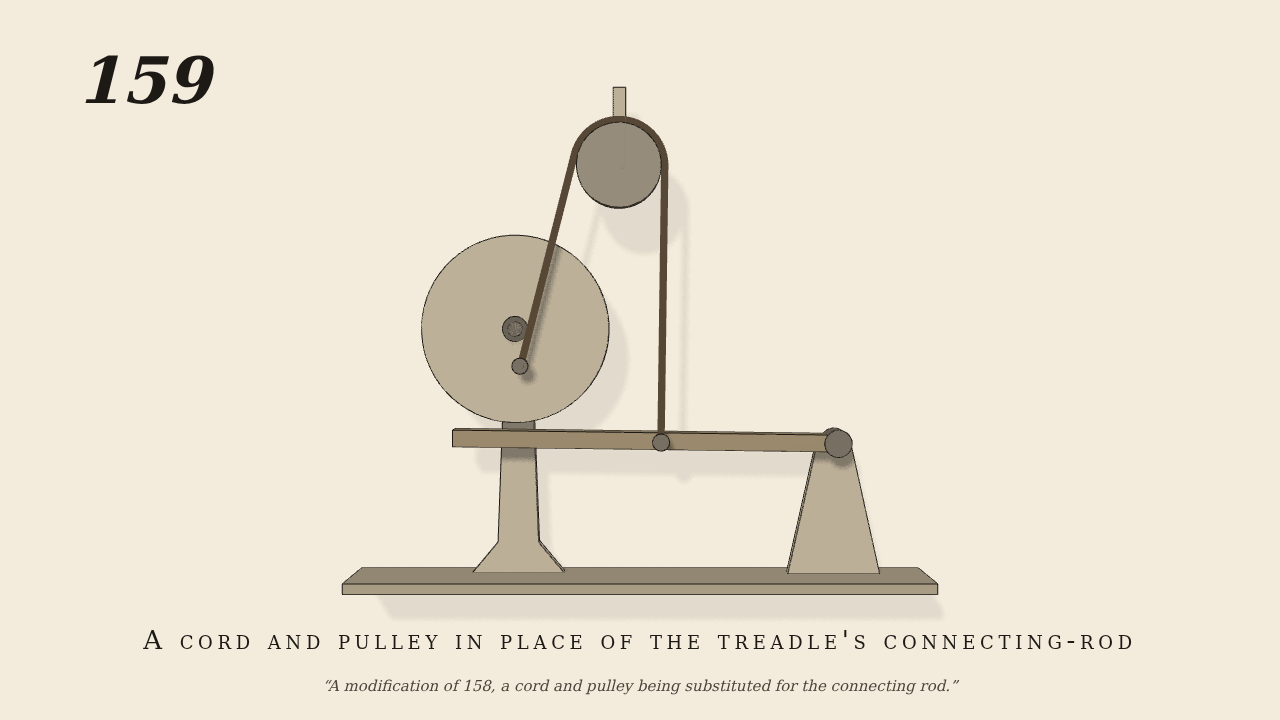
A modification of 158, a cord and pulley being substituted for the connecting rod.
Only the input is driven; every other part of this model moves by physics (MuJoCo), and its ratios are measured. Run it live, change its parameters, or switch the friction off to see the output stop.
- Modelled as
- Brown's elevation, gravity on. The flywheel turns on its standard at the left with a crank-pin 3.6 cm from its shaft; a cord (a MuJoCo tendon, tension only) runs from the crank-pin up over a guide pulley hung above, and down to the treadle, which is pivoted on its standard at the right and hangs on the cord by its own weight. The one driven input is the foot on the treadle (driver feet, timed by the wheel): it presses the treadle down through the half-turn in which the crank-pin comes up toward the pulley and lets it rise for the other half, when the pin draws the cord back and lifts the treadle; the flywheel carries the wheel over both dead points. The wheel works against a light viscous load. gen159b.py.
- Measured
- Started at rest, the wheel turns one way only (back-run 0.00 rad, net 114.6 rad in 15 s), half a turn to each down or up stroke of the treadle (advance 3.1416 per beat), and keeps turning above 5 rad/s on average (8.8 rad/s at the end). Treadle swings -11 to +14 deg. Penetration under 1.5 mm. With the cord cut (tendon limit and stiffness off), the wheel stands (net -1.9 rad against 32.2, mean 0.37 against 6.44 rad/s in the test window).
- Notes
- The foot is an operator who times the stroke from the wheel's position (press-only, half a turn on, half off) rather than a free-running treadle stroke: a cord only pulls, and a clock-swung treadle loses step. The pulley's hanger and the standards are drawn in; the cord is drawn as a round cord (rope section round).
Film (MP4) · Still (PNG) · Spec (YAML) · Model (MJCF)