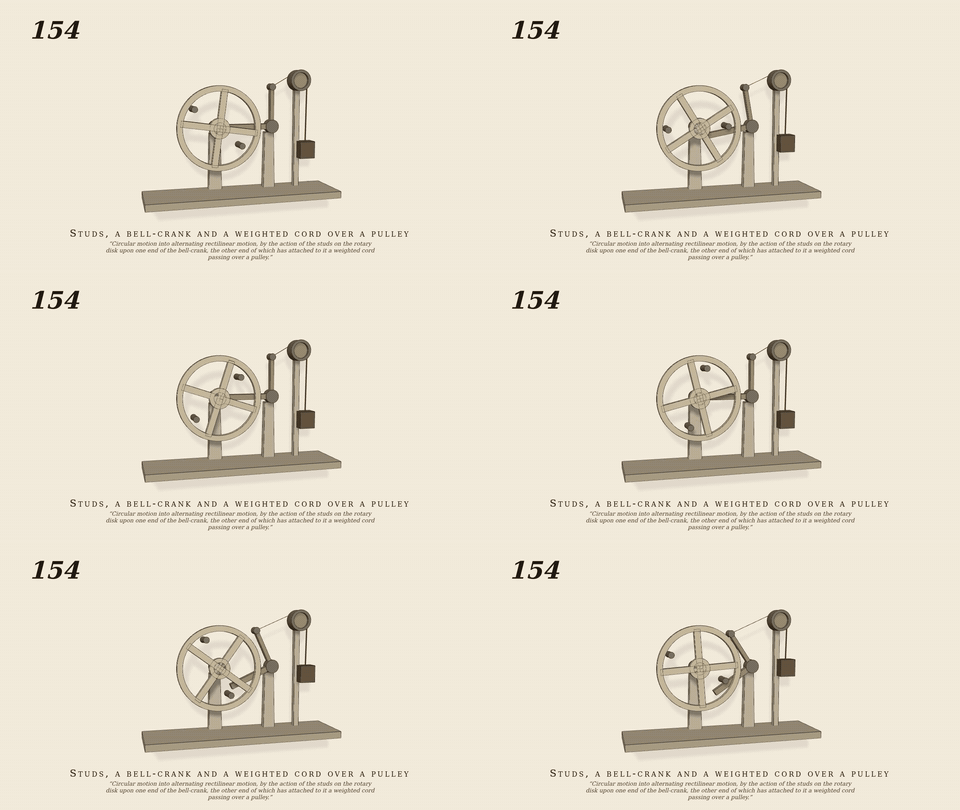
Circular motion into alternating rectilinear motion, by the action…
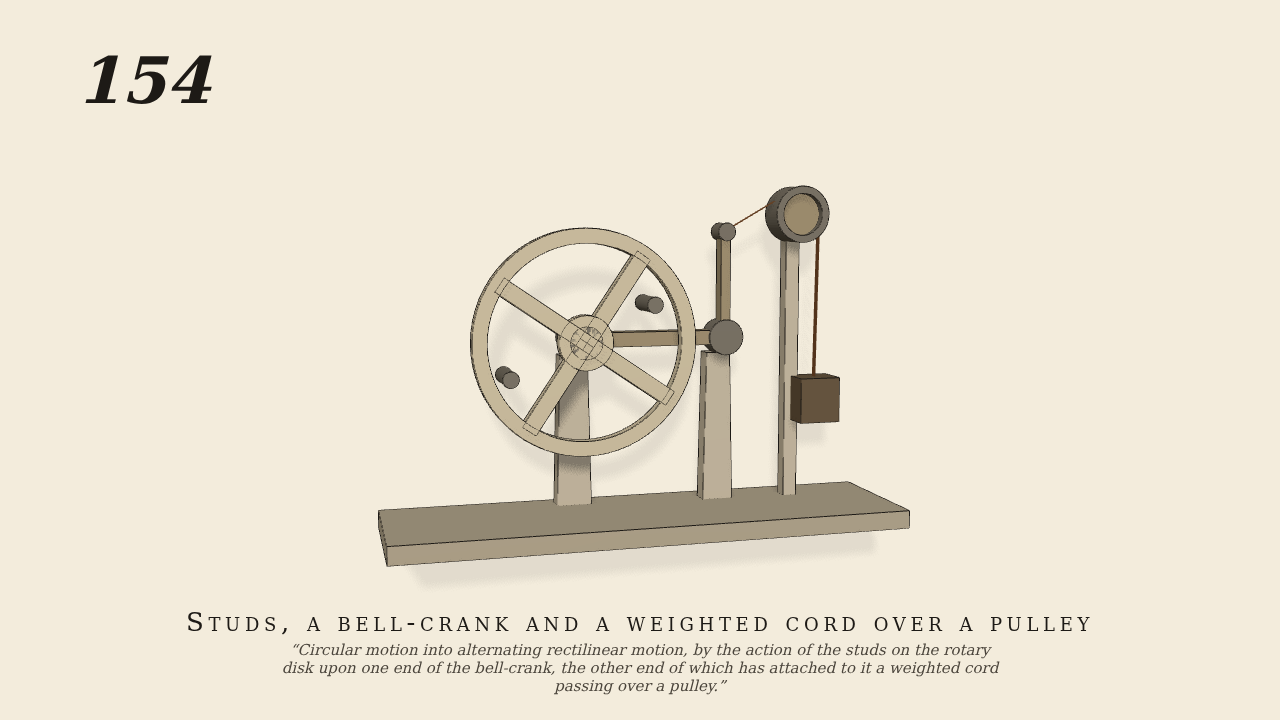
Circular motion into alternating rectilinear motion, by the action of the studs on the rotary disk upon one end of the bell-crank, the other end of which has attached to it a weighted cord passing over a pulley.
Only the input is driven; every other part of this model moves by physics (MuJoCo), and its ratios are measured. Run it live, change its parameters, or switch the friction off to see the output stop.
- Modelled as
- A disk (the one driven joint, 20 rev/min) carries two studs 4.5 cm out, behind it, on opposite sides. Each in turn strikes arm 1 of a bell-crank pivoted at the right and swings it through 39 degrees; arm 2 carries a cord that passes over a pulley to a 0.6 kg weight, which the swing raises 4 cm, and which draws the crank back to its stop once the stud has passed: gen154.py.
- Measured
- The weight follows the bell-crank at 0.0597 m per rad (expect 0.0597, r2 1.000) on three successive strokes, rising 4.0 cm twice a turn of the disk (a stroke every 1.5 s). Penetration 0.07 mm.
- Notes
- The cord is a real rope (tension only, over the pulley, a length constraint); the weight falls under gravity and its pull returns the crank to a stop (a joint limit); the studs and arm 1 are plain contact.
Film (MP4) · GIF · Still (PNG) · Spec (YAML) · Model (MJCF)