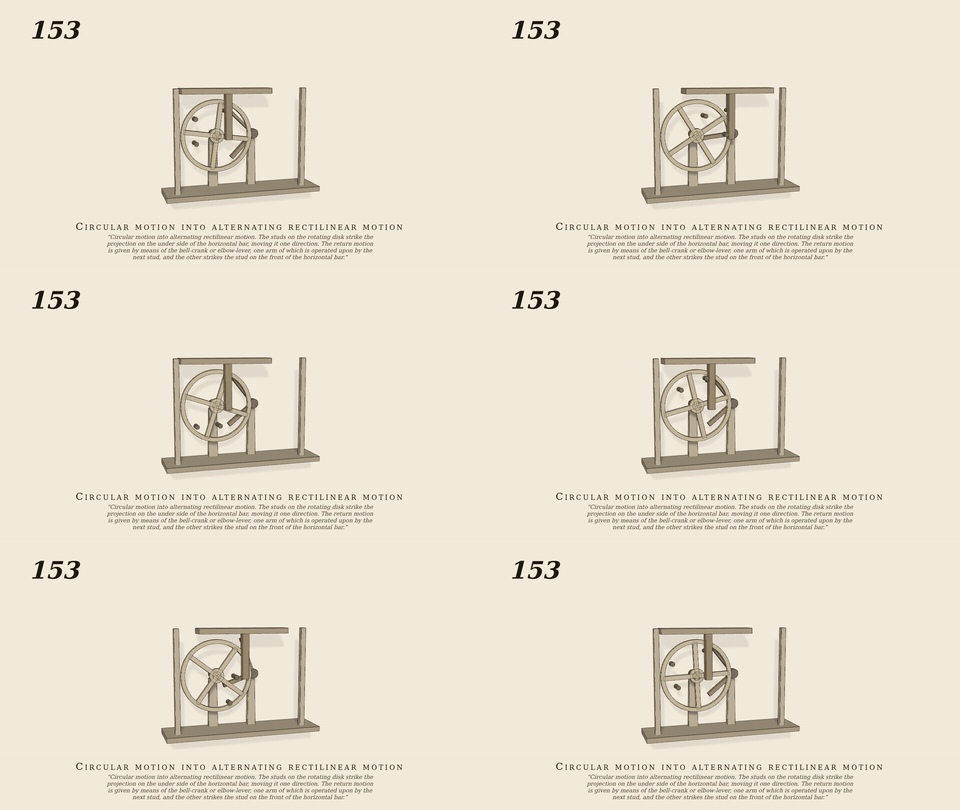
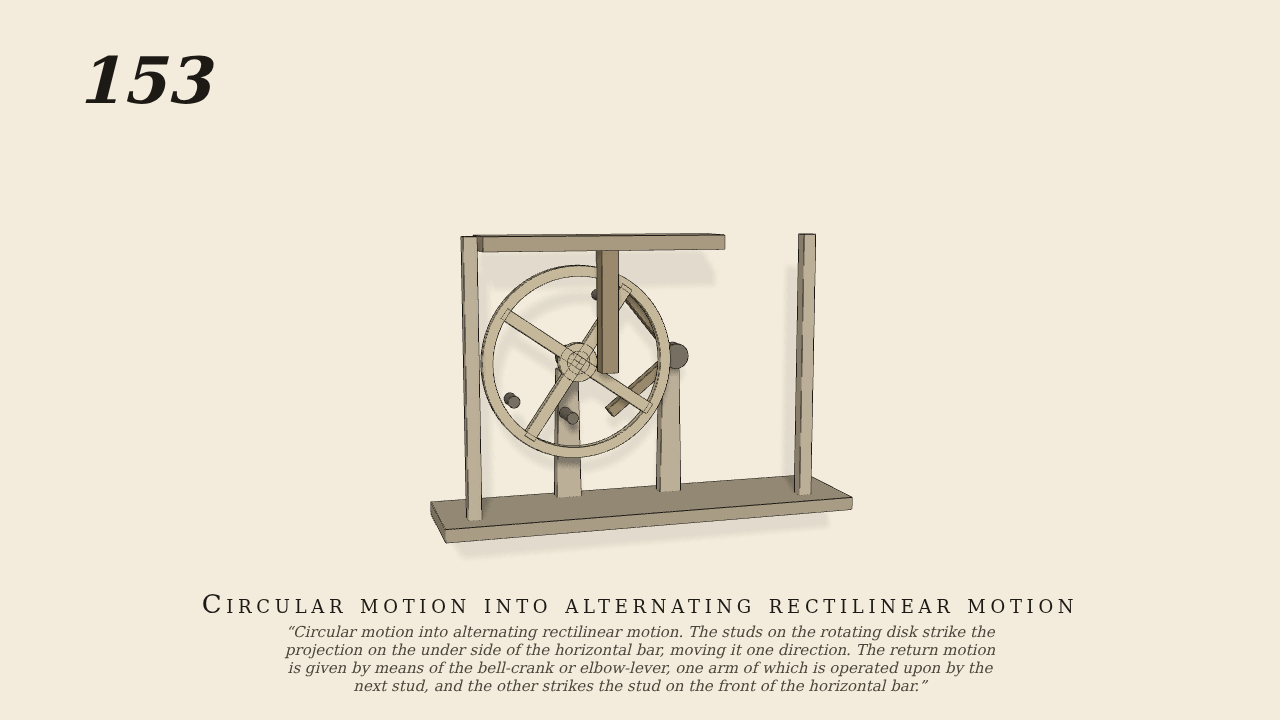
Circular motion into alternating rectilinear motion
Circular motion into alternating rectilinear motion. The studs on the rotating disk strike the projection on the under side of the horizontal bar, moving it one direction. The return motion is given by means of the bell-crank or elbow-lever, one arm of which is operated upon by the next stud, and the other strikes the stud on the front of the horizontal bar.
Only the input is driven; every other part of this model moves by physics (MuJoCo), and its ratios are measured. Run it live, change its parameters, or switch the friction off to see the output stop.
- Modelled as
- A disk (the one driven joint, 20 rev/min) carries a stud in front, 6 cm from its centre, which strikes the projection under the horizontal bar and carries it 4.9 cm to the right, and a second stud behind the disk, 4.5 cm out and 60 degrees after the first, which strikes one arm of a bell-crank pivoted at the right; the other arm of the bell-crank strikes the pin at the back of the bar and sweeps it back over the 5.5 cm of its stroke: gen153.py.
- Measured
- Bar follows the disk at 0.0452 m per rad while the stud pushes it (expect 0.0485, r2 0.997), and follows the bell-crank at 0.0685 m per rad on the return (expect 0.066, r2 0.997), three cycles; the bar goes -0.1 to 4.9 cm once a turn. Penetration 0.10 mm.
- Notes
- The pieces are plain contact (stud 1 and arm 2 one contact class, the lug and the pin on the bar the other); the bar is stopped at the left by a peg (a joint limit), the bell-crank swings between two stops; a plan movement (gravity off).
Film (MP4) · GIF · Still (PNG) · Spec (YAML) · Model (MJCF)