An ellipsograph
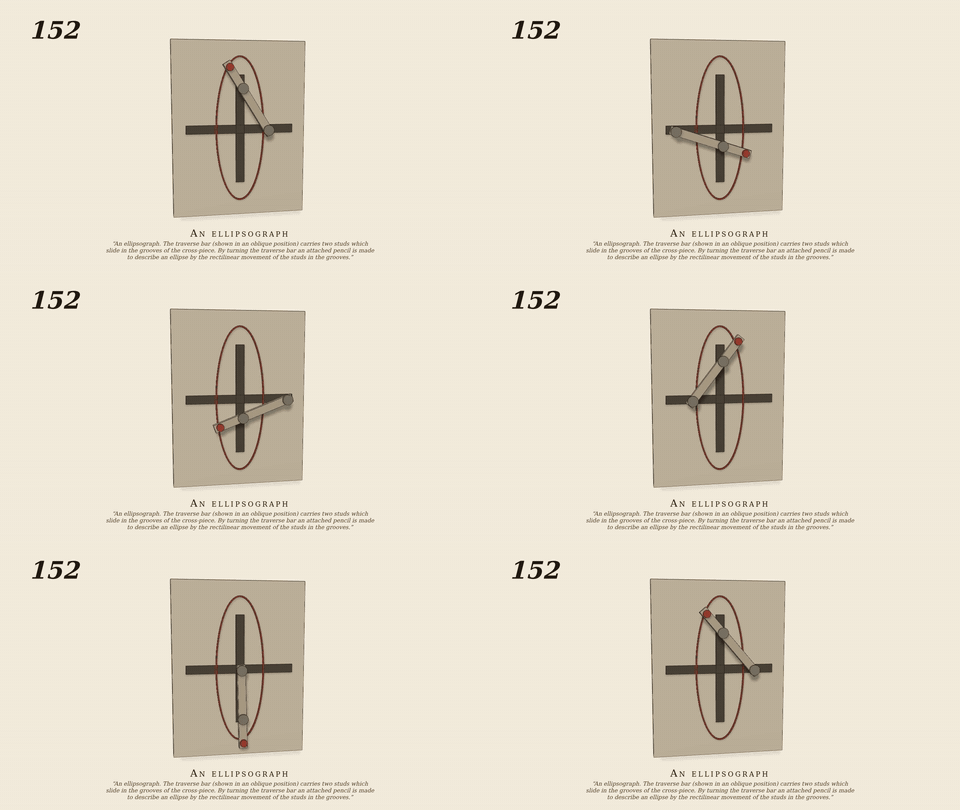
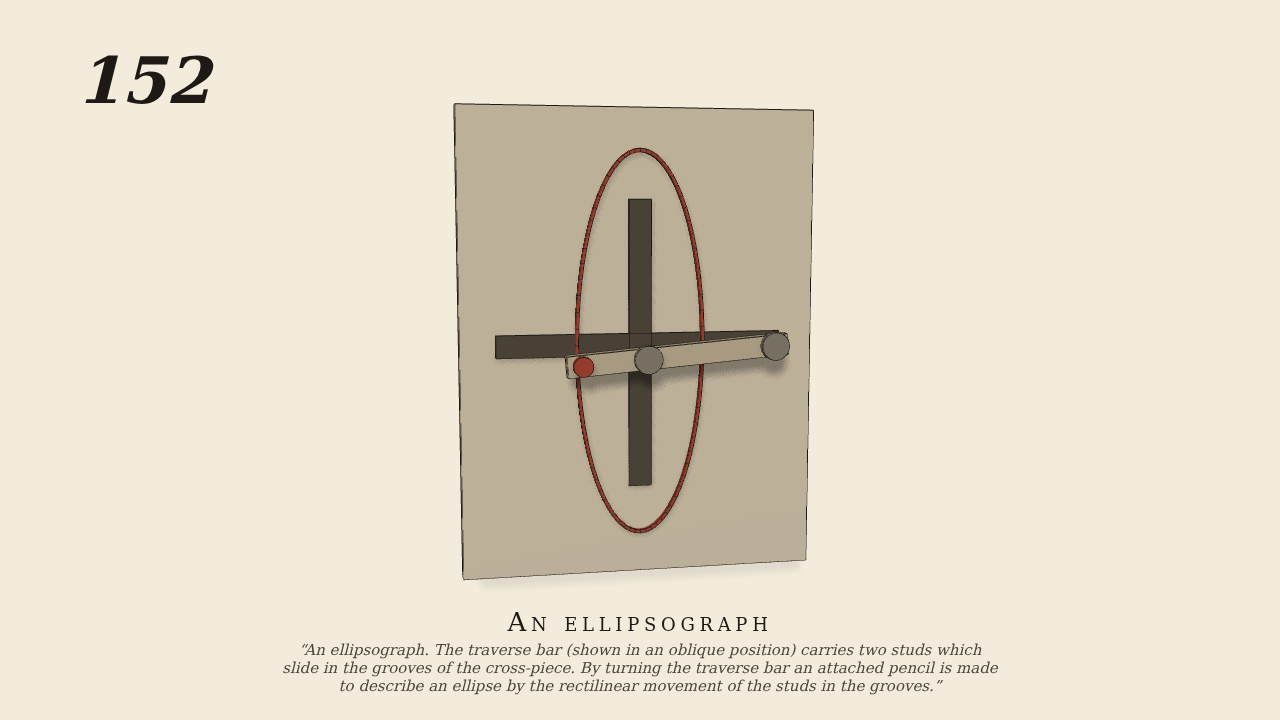
An ellipsograph. The traverse bar (shown in an oblique position) carries two studs which slide in the grooves of the cross-piece. By turning the traverse bar an attached pencil is made to describe an ellipse by the rectilinear movement of the studs in the grooves.
Only the input is driven; every other part of this model moves by physics (MuJoCo), and its ratios are measured. Run it live, change its parameters, or switch the friction off to see the output stop.
- Modelled as
- A traverse bar 8 cm between its two studs turns on the stud A (the one driven joint, 20 rev/min), which runs in the groove along the cross-piece; the stud B is pinned to the bar and runs in the groove at right angles. Turning the bar draws A out and in along one groove and B up and down the other, and a pencil fixed on the bar 1.5 times the way from A to B (12 cm from A) describes an ellipse of semi-axes 4 and 12 cm, inlaid on the board for comparison: gen152.py.
- Measured
- Stud A and stud B follow the bar angle as the sine and cosine of the crank, slopes +-0.0760 m per rad against 0.0784 for the pure windows (r2 0.9991) in six windows over the first three turns; strokes of both studs 16 cm (the full 2x8 cm). Period 3.0 s, no contact.
- Notes
- The studs are slides in the grooves, the bar is hinged on the stud A and closed on the stud B by a pin; a plan movement (gravity off). The pencil is a fixed point on the bar.
Film (MP4) · GIF · Still (PNG) · Spec (YAML) · Model (MJCF)