Continuous circular into continuous but much slower rectilinear motion
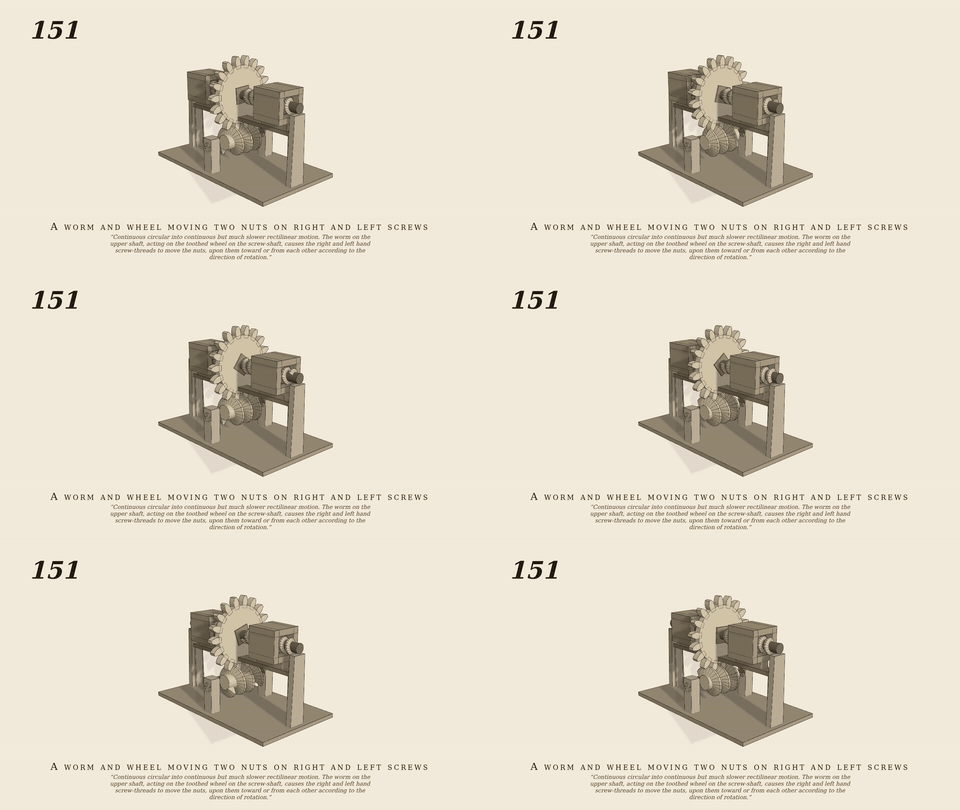
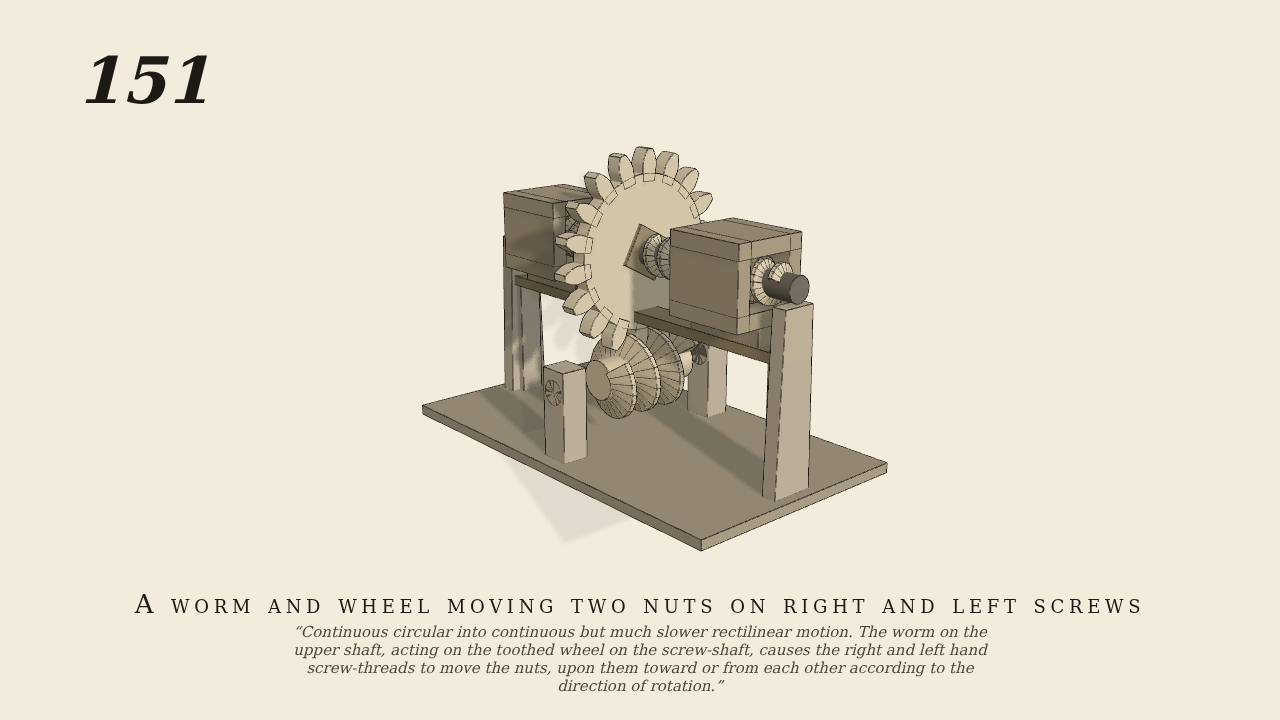
Continuous circular into continuous but much slower rectilinear motion. The worm on the upper shaft, acting on the toothed wheel on the screw-shaft, causes the right and left hand screw-threads to move the nuts, upon them toward or from each other according to the direction of rotation.
Only the input is driven; every other part of this model moves by physics (MuJoCo), and its ratios are measured. Run it live, change its parameters, or switch the friction off to see the output stop.
- Modelled as
- A worm on the upper shaft (the one driven joint, 180 rev/min) turns an 18-tooth wheel that is fast on a screw-shaft; the shaft carries a right-hand thread on one side of the wheel and a left-hand thread on the other, and a nut rides on each, held from turning by the frame. The wheel turns once to 18 turns of the worm, and each nut travels 1.6 cm (the screw pitch) per turn of the wheel, the two moving toward each other (or from each other when the worm is turned back): gen151.py.
- Measured
- Wheel/worm ratio 0.0555 (1/18, slip 0.21%); both nuts follow the wheel at 0.0025 m per rad (expect 0.002546, r2 0.996 to 0.999), travelling 3.1 cm towards each other in 11.5 s. Penetration 0.03 mm.
- Notes
- Gears and threads mesh by real tooth and flank contact (screw thread class 1, nut thread class 2); the nuts are plain slides in the frame, gravity off as in a plan drawing.
Film (MP4) · GIF · Still (PNG) · Spec (YAML) · Model (MJCF)