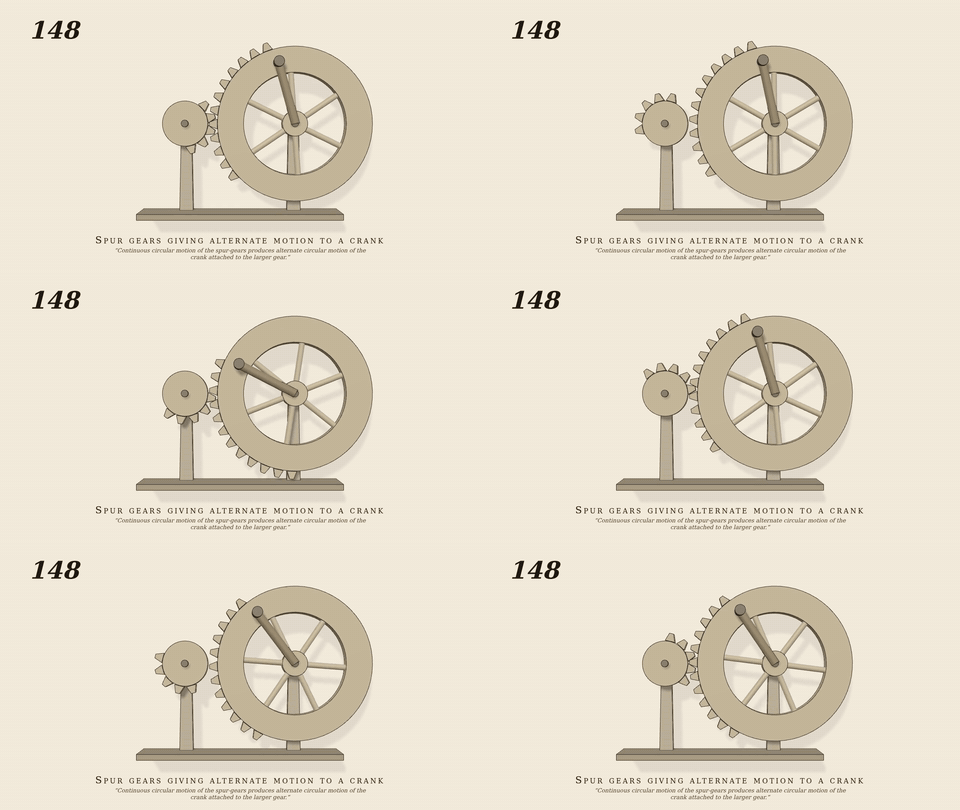
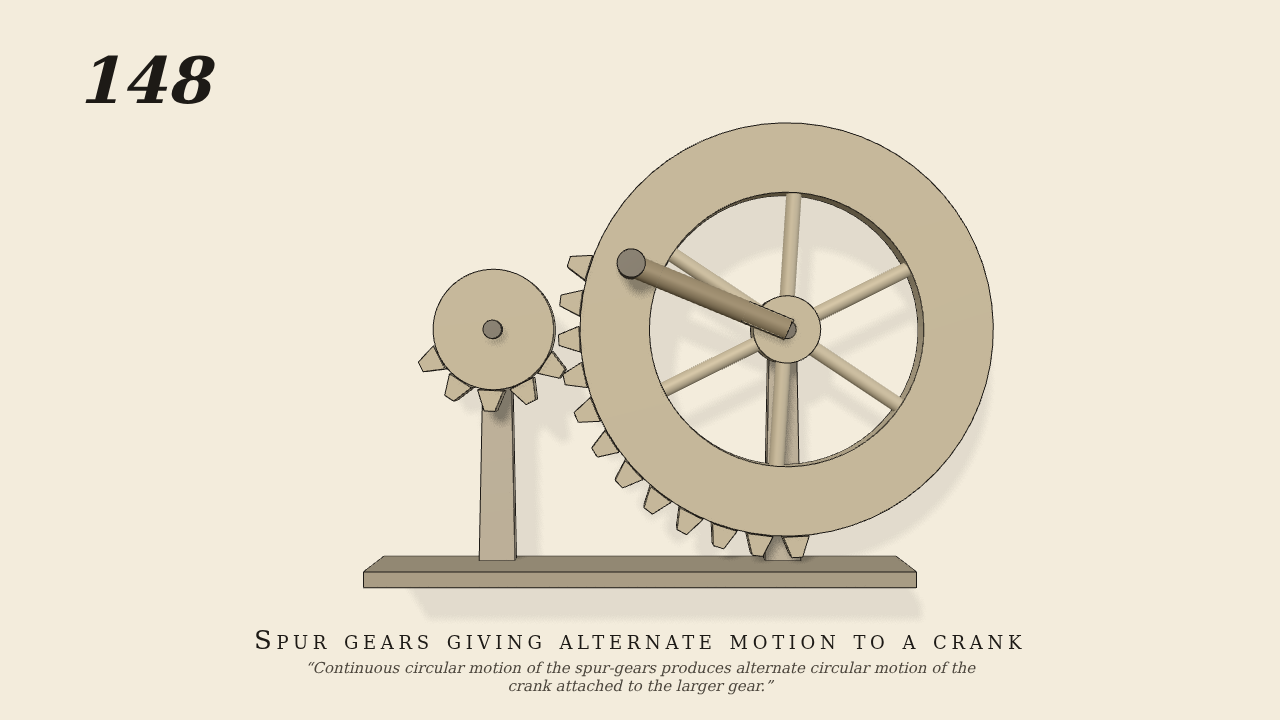
Continuous circular motion of the spur-gears produces alternate…
Continuous circular motion of the spur-gears produces alternate circular motion of the crank attached to the larger gear.
Only the input is driven; every other part of this model moves by physics (MuJoCo), and its ratios are measured. Run it live, change its parameters, or switch the friction off to see the output stop.
- Modelled as
- A pinion (12 tooth spaces, module 0.8, No. 34's straight-flanked teeth) has teeth on 5 of them and is cut to its root circle round the rest; it turns continuously (the one driven joint, 30 rev/min). It gears with a gear three times its size (36 spaces) that has teeth on a sector of its rim only and carries the crank. While the pinion's teeth are in they turn the larger gear forward about 57 degrees; when the last tooth quits, the gear's joint spring (0.5 N m/rad, damped) swings the crank back to its stop, where the next turn's first tooth finds the same space: gen148.py.
- Measured
- While the teeth are in, the crank turns as the gear: slope -0.3317 and -0.3312 rad per rad of the pinion in two turns (expect -1/3, r2 0.9994), and the crank swings 0 to 1.01 rad and back to its stop every turn. Penetration 0.14 mm after the first second (5.6 mm in the start-up).
- Notes
- Without gravity (a plan). The larger gear is moved only by the pinion's teeth and brought back only by the spring; the stop is the joint's own range limit. The crank's swing overshoots the five-tooth pitch angle (0.87 rad) a little as the last tooth leaves.
Film (MP4) · GIF · Still (PNG) · Spec (YAML) · Model (MJCF)