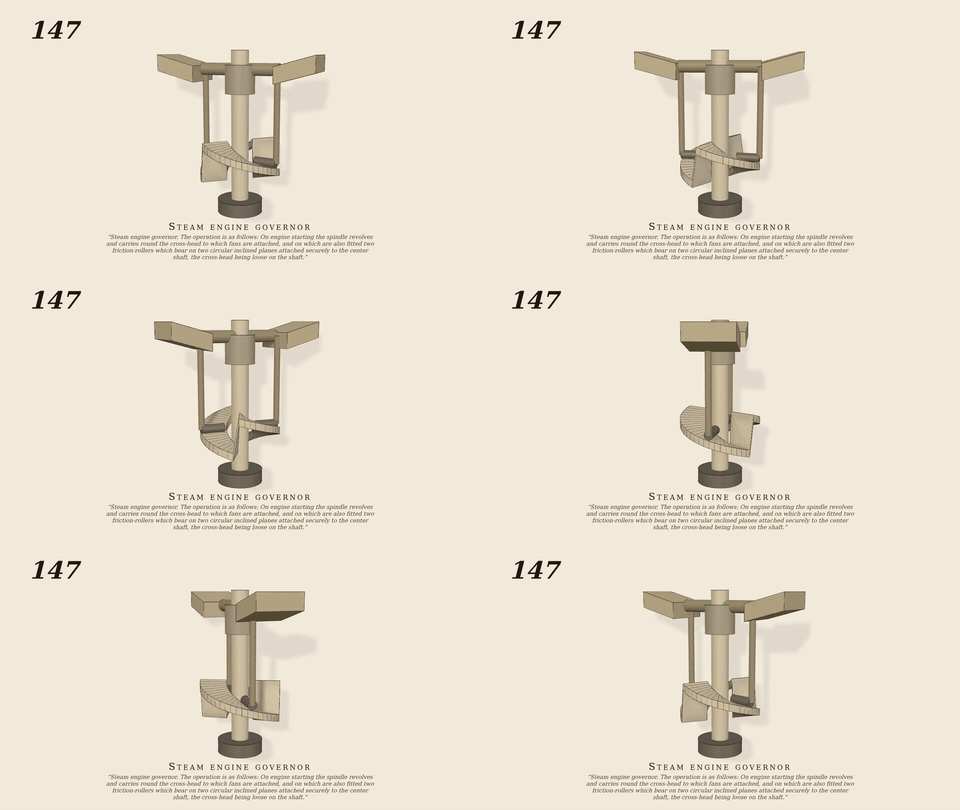
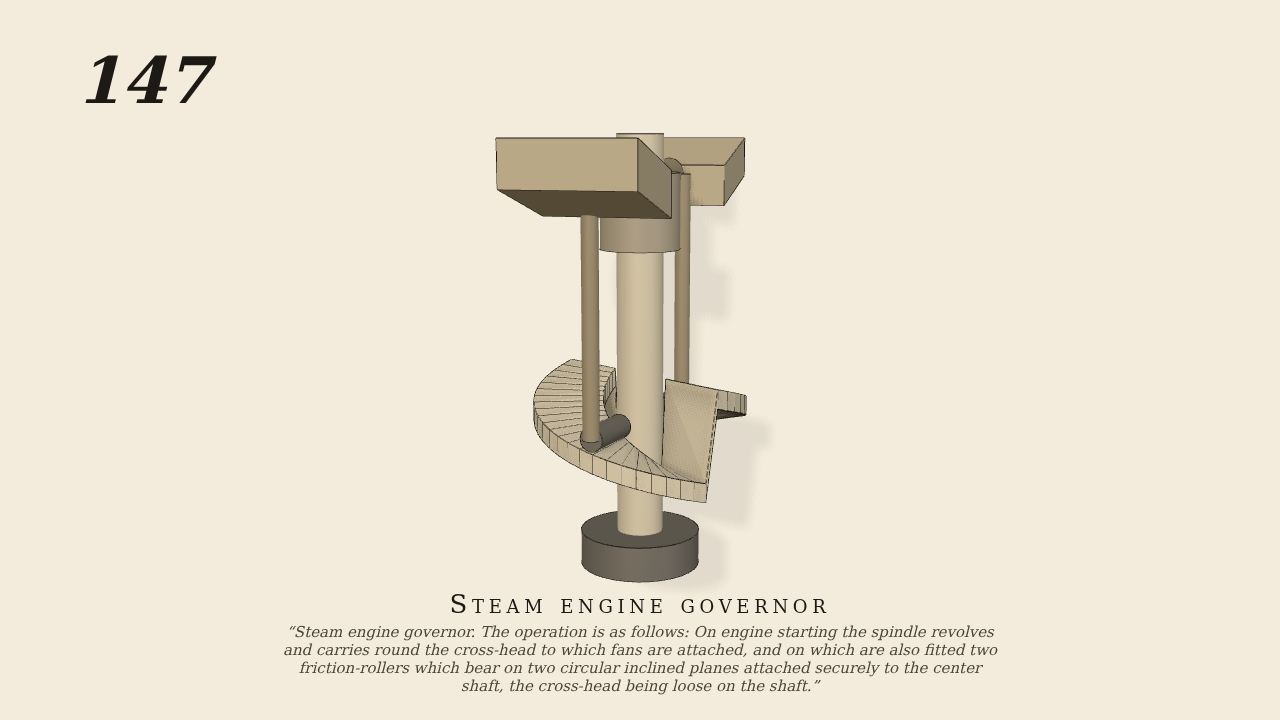
Steam engine governor
Steam engine governor. The operation is as follows:—On engine starting the spindle revolves and carries round the cross-head to which fans are attached, and on which are also fitted two friction-rollers which bear on two circular inclined planes attached securely to the center shaft, the cross-head being loose on the shaft. The cross-head is made heavy, or has a ball or other weight attached, and is driven by the circular inclined planes. As the speed of the center shaft increases, the resistance of the air to the wings tends to retard the rotation of the cross-head; the friction-rollers therefore run up the inclined planes and raise the cross-head, to the upper part of which is connected a lever operating upon the regulating-valve of the engine.
Only the input is driven; every other part of this model moves by physics (MuJoCo), and its ratios are measured. Run it live, change its parameters, or switch the friction off to see the output stop.
- Modelled as
- The centre shaft (the one driven joint, 60 rev/min) carries two circular inclined planes, each rising 4 cm over half a turn. The heavy cross-head (0.3 kg) is loose on the shaft: it can turn on it and slide up it, and carries two rollers that bear on the planes. The air on its fans is a damping on its turning (0.02 N m s) and the valve lever's pull a spring on its rise (70 N/m): gen147.py.
- Measured
- Driven round by the planes against the air's drag, the cross-head lags the shaft by 0.9 rad at first, its rollers run up the planes and it rises 1.26 cm, where it stands (allowed 0.9 to 1.7 cm); it then turns with the shaft at a ratio of 1.0000. Penetration 0.04 mm after the first second.
- Notes
- The air is not simulated: its drag on the fans is a damping on the cross-head's turning, the valve lever's load a spring. A faster shaft raises the cross-head higher (0.8 cm at 20 rev/min, 1.3 at 60, the top of its travel by 90). The rollers rub rather than roll on the planes.
Film (MP4) · GIF · Still (PNG) · Spec (YAML) · Model (MJCF)