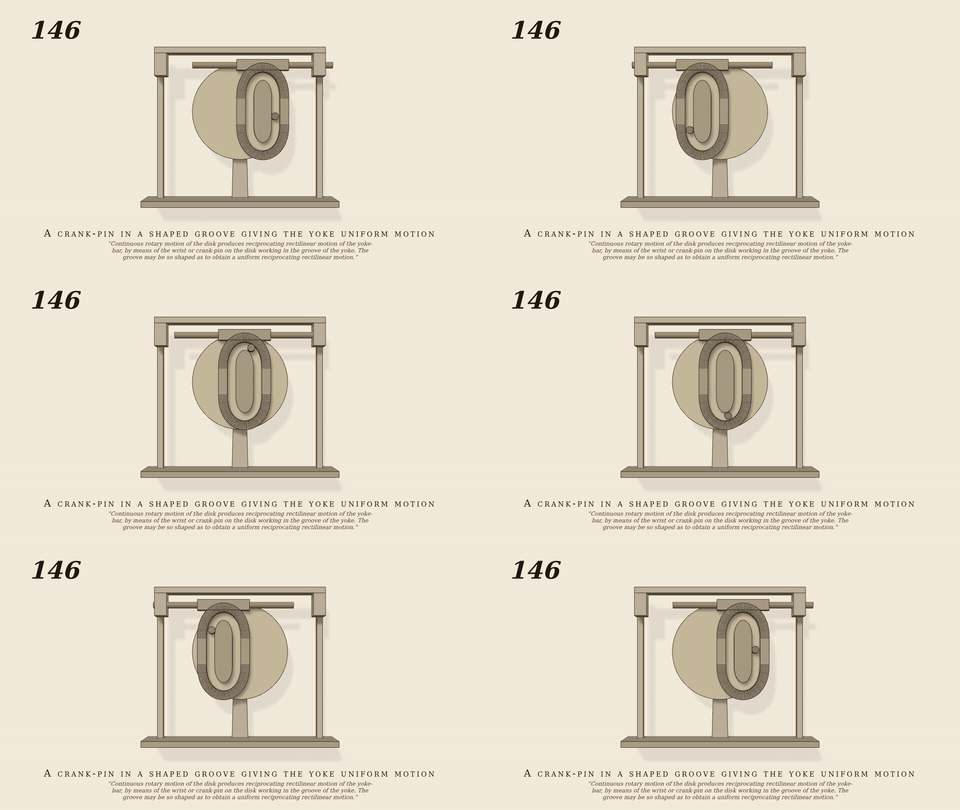
Continuous rotary motion of the disk produces reciprocating…
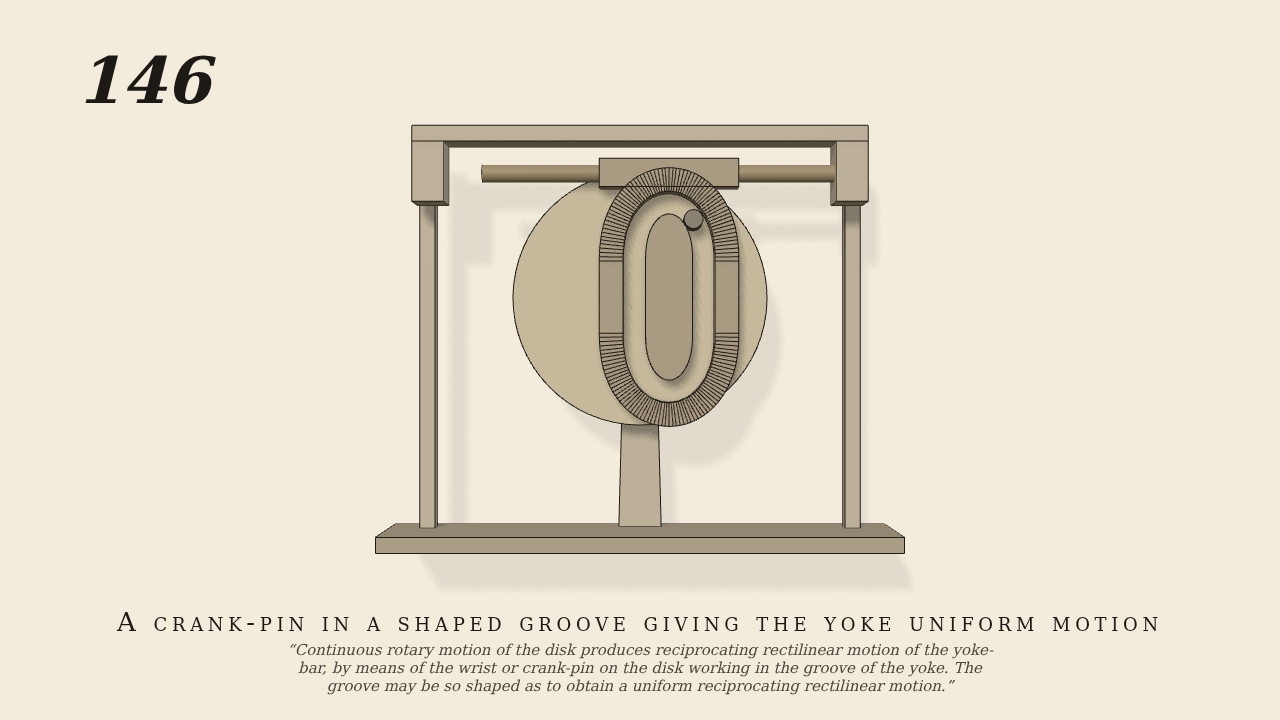
Continuous rotary motion of the disk produces reciprocating rectilinear motion of the yoke-bar, by means of the wrist or crank-pin on the disk working in the groove of the yoke. The groove may be so shaped as to obtain a uniform reciprocating rectilinear motion.
Only the input is driven; every other part of this model moves by physics (MuJoCo), and its ratios are measured. Run it live, change its parameters, or switch the friction off to see the output stop.
- Modelled as
- The disk (the one driven joint, 20 rev/min, clockwise) carries a crank-pin 6 cm from its centre. The pin works by real contact in an endless groove (1.44 cm wide, 1.2 mm clearance a side) cut in the yoke, whose bar slides to and fro 7.8 cm in fixed guides. The groove is the path of the pin in the yoke's own frame when the yoke goes uniformly 3.9 cm each way, with the turns rounded (a plain slot would give the harmonic motion of No. 93): gen146.py.
- Measured
- The yoke-bar follows the disk in a straight line against the angle (slopes -0.0277, +0.0275, -0.0286, +0.0281 cm per degree-equivalent against the ideal 0.0284, r2 1.0000) over the uniform parts of four half-turns, and travels 7.8 cm between its ends. Penetration 0.05 mm.
- Notes
- Without gravity (a plan). The yoke is moved only by the pin pressing on the groove walls; at the two points where the groove runs along the bar it coasts a moment on its own weight, so the check windows keep clear of the turns.
Film (MP4) · GIF · Still (PNG) · Spec (YAML) · Model (MJCF)