Reciprocating curvilinear motion of the beam gives a continuous…
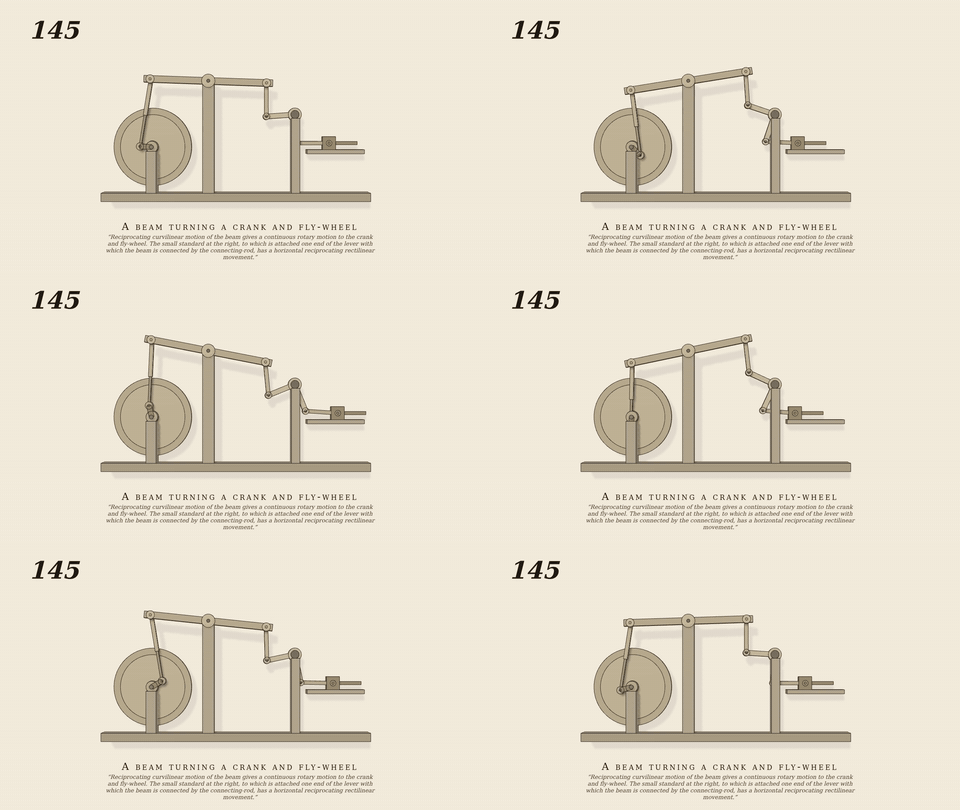
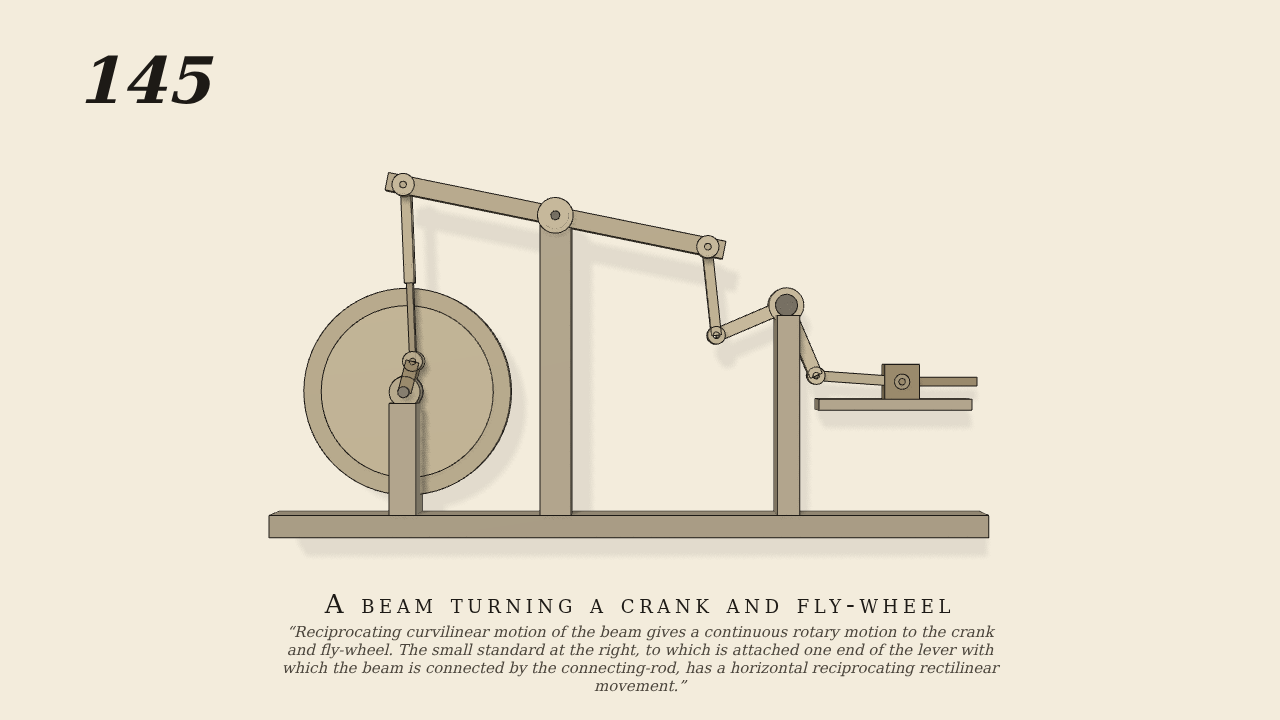
Reciprocating curvilinear motion of the beam gives a continuous rotary motion to the crank and fly-wheel. The small standard at the right, to which is attached one end of the lever with which the beam is connected by the connecting-rod, has a horizontal reciprocating rectilinear movement.
Only the input is driven; every other part of this model moves by physics (MuJoCo), and its ratios are measured. Run it live, change its parameters, or switch the friction off to see the output stop.
- Modelled as
- A beam pivoted at its middle is rocked by a rod from its right end to a lever on the frame; the lever's other arm is joined by a link to a small standard that slides to and fro on the bed. The standard is the one driven joint (3 cm each way, 0.5 strokes a second). The beam's left end works a 16 cm connecting-rod on the pin of a 2.9 cm crank carrying a fly-wheel (9.5 cm radius). The beam's stroke is set 5% beyond the crank's reach and the rod is a sleeve with a stiff spring, so the fly-wheel carries the crank through its dead points without jamming: gen145.py.
- Measured
- The crank and fly-wheel turn clockwise at a mean 3.136 rad/s (29.95 rev/min), 97% of the time faster than 0.3 of the mean, never running back (net 18.8 rad in 6 s). The crank advances 3.186 rad per beat of the beam (expect pi, 1.4% off): one turn to every full stroke of the standard. Penetration 0.00 mm.
- Notes
- Without gravity (a plan). The beam is rocked only through the lever and rod, and the crank is turned only by the connecting-rod. The sleeve spring (the only compliance) takes up 5% of the crank stroke at the dead points; the servo loses a little of the standard stroke at the start, so the standard is allowed a little extra travel.
Film (MP4) · GIF · Still (PNG) · Spec (YAML) · Model (MJCF)