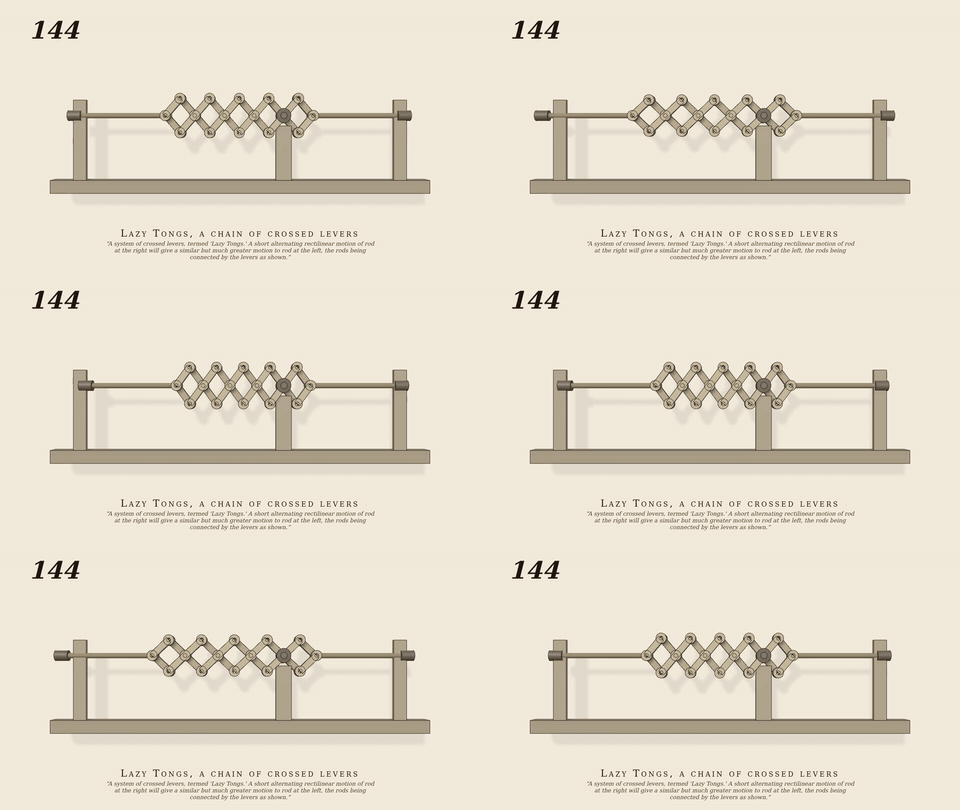
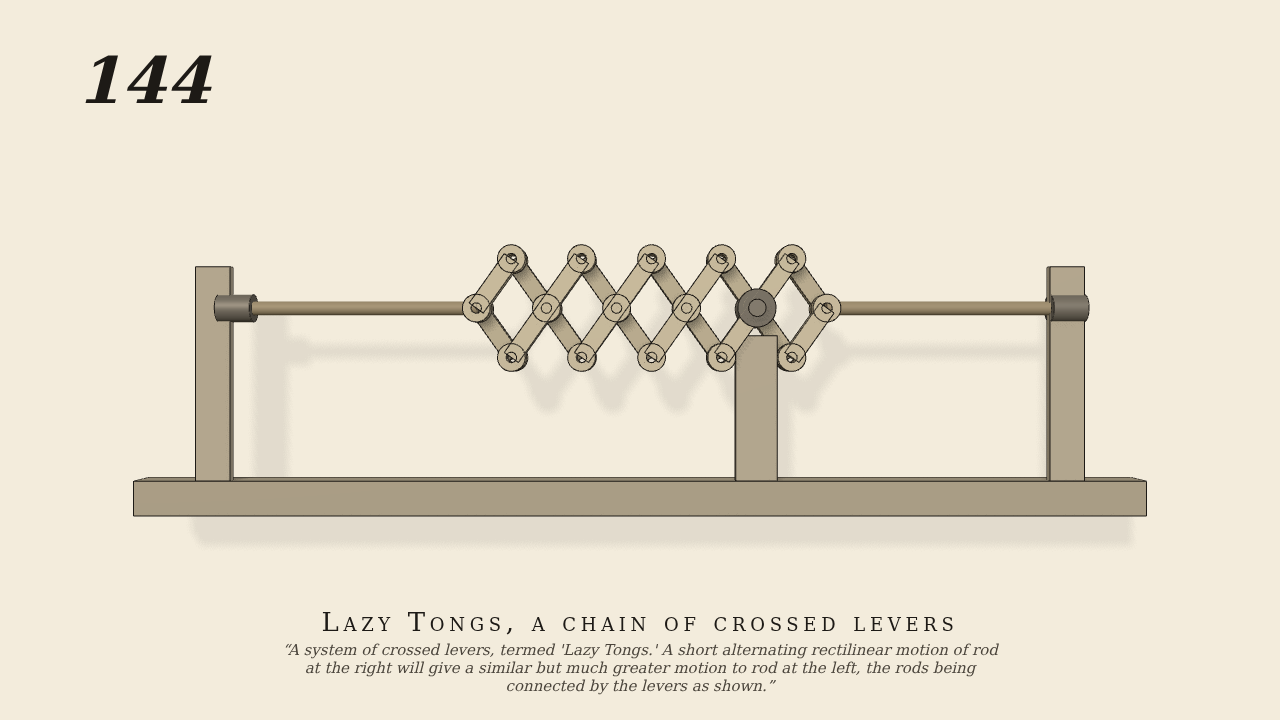
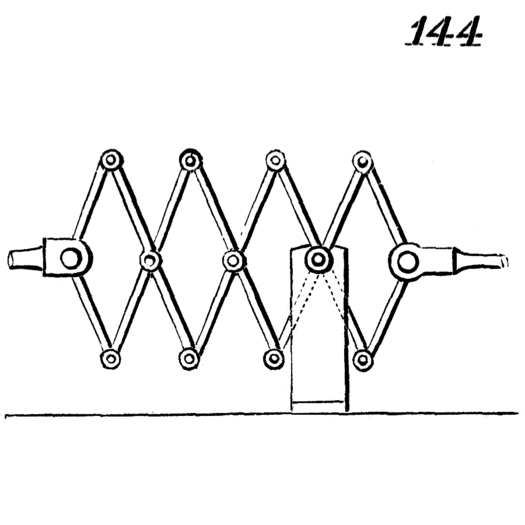
A system of crossed levers, termed “Lazy Tongs.” A short…
A system of crossed levers, termed “Lazy Tongs.” A short alternating rectilinear motion of rod at the right will give a similar but much greater motion to rod at the left. It is frequently used in children’s toys. It has been applied in France to a machine for raising sunken vessels; also applied to ships’ pumps, three-quarters of a century ago.
Only the input is driven; every other part of this model moves by physics (MuJoCo), and its ratios are measured. Run it live, change its parameters, or switch the friction off to see the output stop.
- Modelled as
- Ten levers of 7 cm cross in pairs, each pair pinned at its middle, and the ends are pinned to the next pair: a chain of five cells. The fourth crossing from the left is pinned to the frame; the first crossing is pinned to the rod at the left and the last to the rod at the right. The right rod is the one driven joint (0.6 cm each way, 0.25 strokes a second). With one cell on the right of the fixed crossing and four on the left, the left rod goes four times as far, the other way: gen144.py.
- Measured
- Left rod / right rod slope -3.9956 (expect -4, r2 1.0000) in two windows of 3 s; left rod travel -2.40..+2.40 cm for the right rod -0.60..+0.60 cm. Penetration 0.00 mm.
- Notes
- Without gravity (a plan). The tongs are drawn with the levers in two layers, each pin a real pin; the loops close with one pin per cell. The ratio is exactly the cell count (4 : 1) while the crossings stay on one line.
Film (MP4) · GIF · Still (PNG) · Spec (YAML) · Model (MJCF)