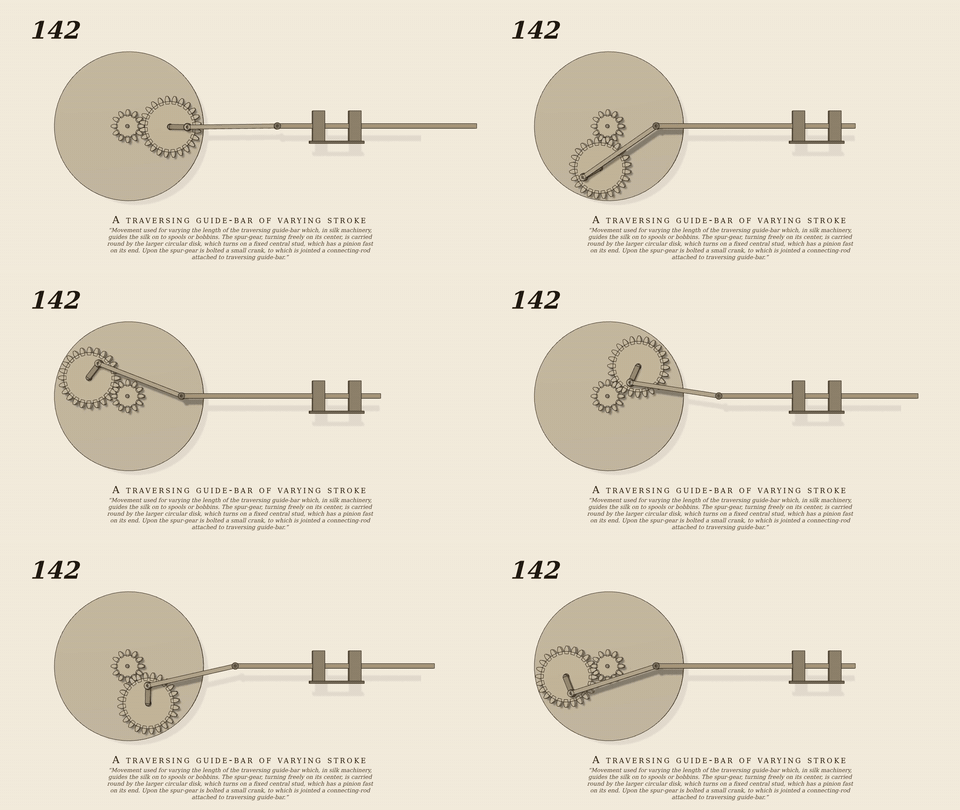
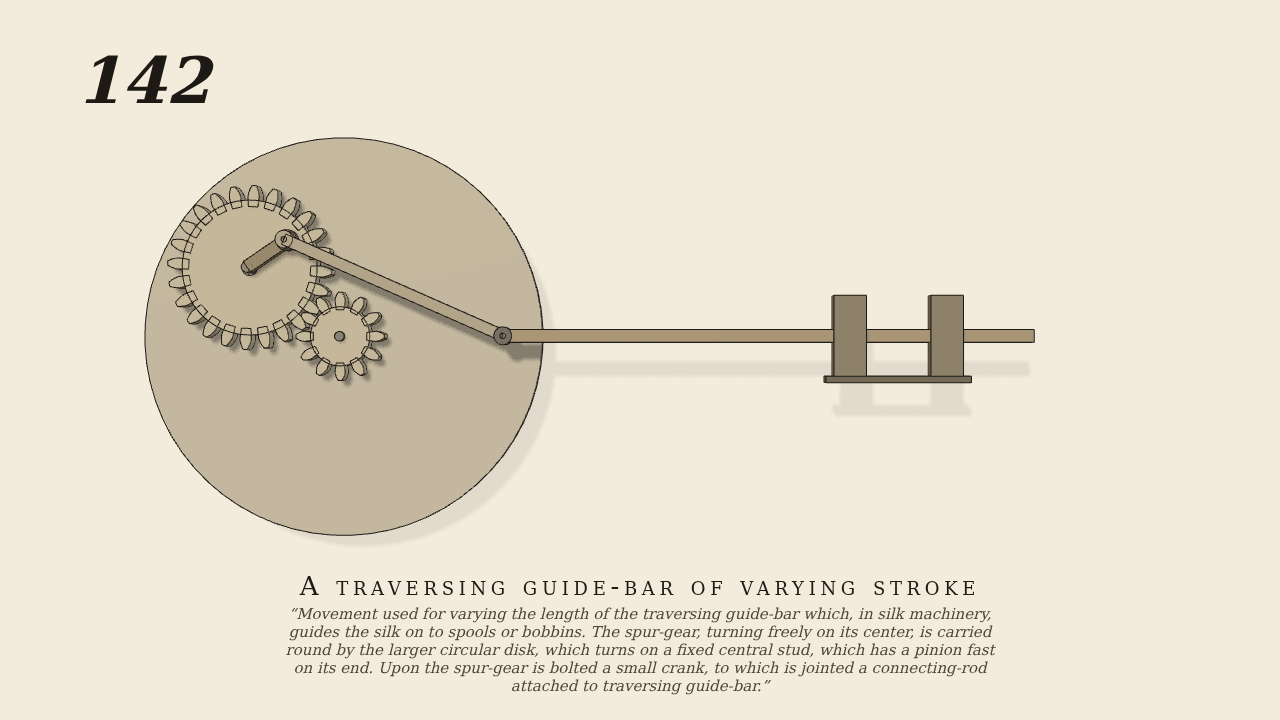
Movement used for varying the length of the traversing guide-bar…
Movement used for varying the length of the traversing guide-bar which, in silk machinery, guides the silk on to spools or bobbins. The spur-gear, turning freely on its center, is carried round by the larger circular disk, which turns on a fixed central stud, which has a pinion fast on its end. Upon the spur-gear is bolted a small crank, to which is jointed a connecting-rod attached to traversing guide-bar. On turning the disk, the spur-gear is made to rotate partly upon its center by means of the fixed pinion, and consequently brings crank nearer to center of disk. If the rotation of disk was continued, the spur-gear would make an entire revolution. During half a revolution the traverse would have been shortened a certain amount at every revolution of disk, according to the size of spur-gear; and during the other half it would have gradually lengthened in the same ratio.
Only the input is driven; every other part of this model moves by physics (MuJoCo), and its ratios are measured. Run it live, change its parameters, or switch the friction off to see the output stop.
- Modelled as
- A 12-tooth pinion (module 0.8) is fast on the fixed stud. The large disc turning on the stud is the one driven joint (15 turns a minute). The 24-tooth spur gear, turning freely on its pin in the disc, gears with the pinion by real involute teeth, so it turns half a turn on its pin for each turn of the disc. A crank 6 cm long is bolted on the spur gear; a connecting rod 30 cm long joins it to the traversing guide-bar, which slides in fixed guides. The crank swings round towards and away from the centre of the disc, so the bar stroke grows from 20.4 to 8.4 cm on each side of its mean and back in two turns of the disc: gen142.py.
- Measured
- Spur gear / disc 0.5001 (expect 0.5, i.e. N1/N2). The bar follows the exact crank-and-rod solution in five windows of 0.7 s spread over the cycle: slopes -0.2490 / +0.1270 / -0.1260 / +0.2543 / -0.2543 m per rad of the disc (expect -0.2448 / +0.1263 / -0.1259 / +0.2530 / -0.2530, r2 0.996 or better); travel -37.33..0.00 cm. Penetration 0.01 mm.
- Notes
- Without gravity (a plan). The disc is driven through a gentle servo, and runs about 0.15 s behind the commanded speed at start-up, so the windows are timed from that lag. The sums of the two sine terms give the bar speed per radian, which changes sign twice a turn.
Film (MP4) · GIF · Still (PNG) · Spec (YAML) · Model (MJCF)