Endless-band saw
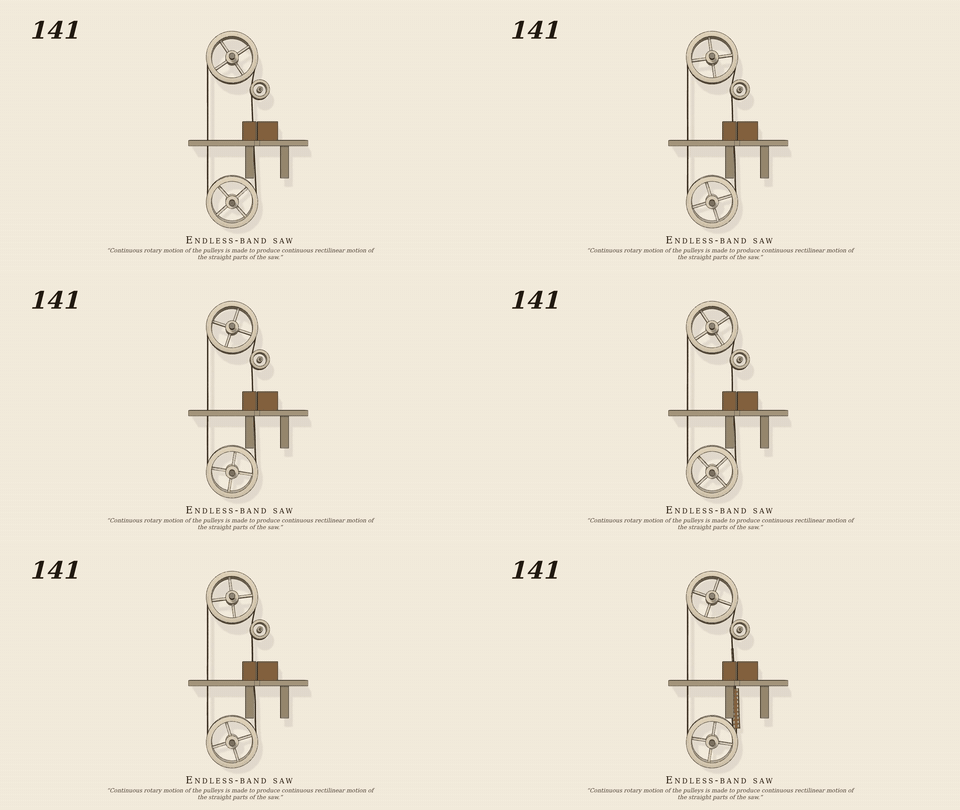
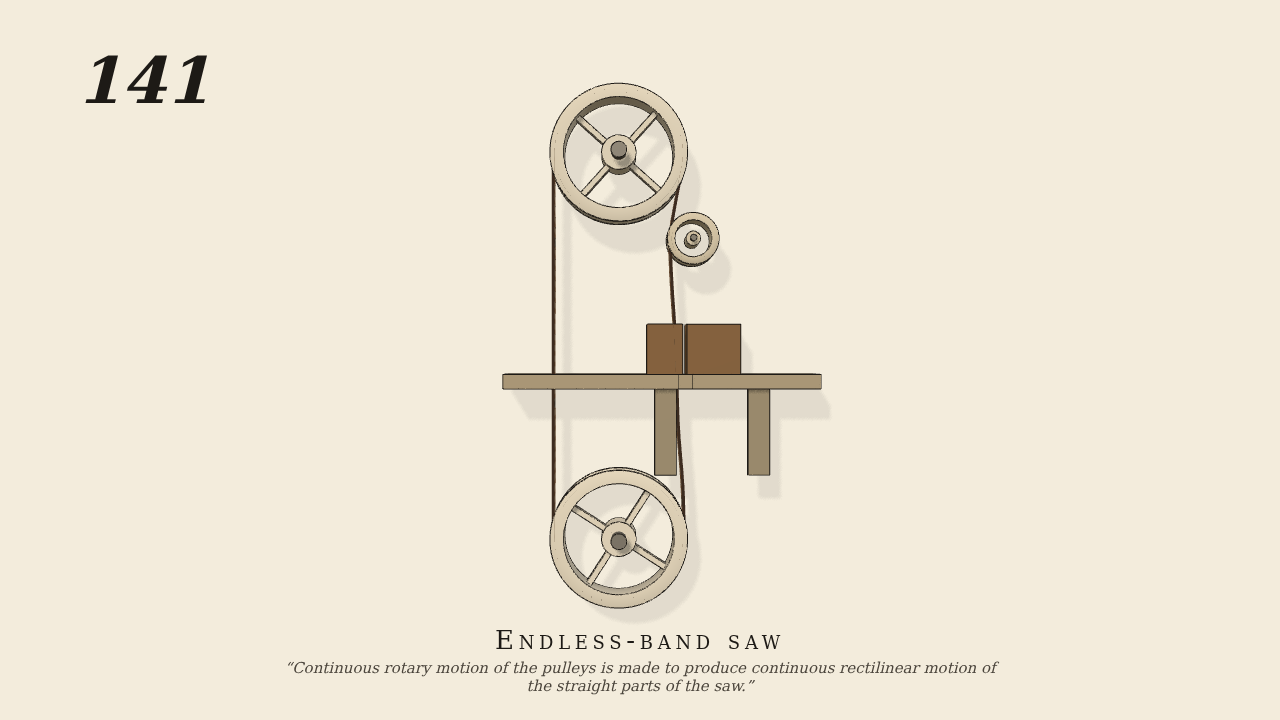
Endless-band saw. Continuous rotary motion of the pulleys is made to produce continuous rectilinear motion of the straight parts of the saw.
Only the input is driven; every other part of this model moves by physics (MuJoCo), and its ratios are measured. Run it live, change its parameters, or switch the friction off to see the output stop.
- Modelled as
- Two equal pulleys (radius 9 cm) one above the other carry a closed band of 110 elastic links. The upper pulley is the one driven joint (30 turns a minute); the lower is turned by the band alone against a light bearing brake. The two straight runs travel in straight lines at the rim speed. A small roller (radius 3 cm) pressed 2 cm into the back of the right-hand run is turned by the band alone and measures its speed; the table and the work are only drawn: gen141.py.
- Measured
- Lower pulley / upper pulley 0.9983 (expect 1.0); speed roller / upper pulley -2.940 (expect -2.90, the rim-speed ratio of the two radii), r2 1.000 over 2 s; band radial deviation and lateral walk within limits; penetration 0.00 mm. The capstan friction model gives 0.9985 and -2.873.
- Notes
- Without gravity (a plan). The band is a friction belt (0.6), pretension 4 N; the roller is the only thing to read the straight run, since it is turned by the band and nothing else.
Film (MP4) · GIF · Still (PNG) · Spec (YAML) · Model (MJCF)