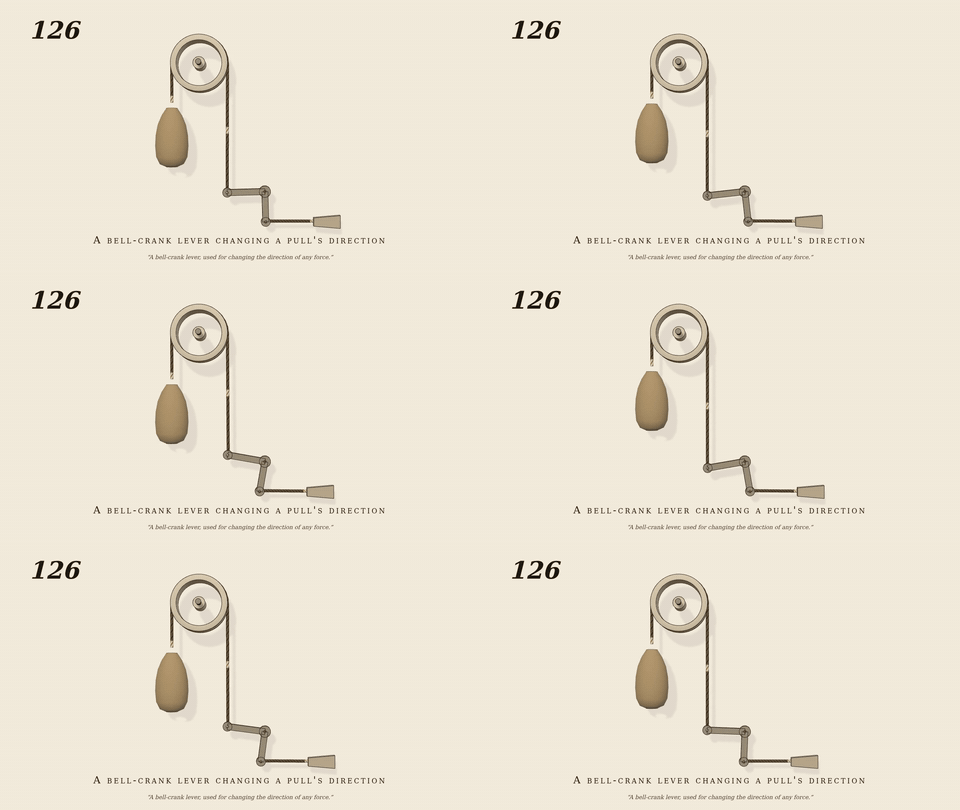
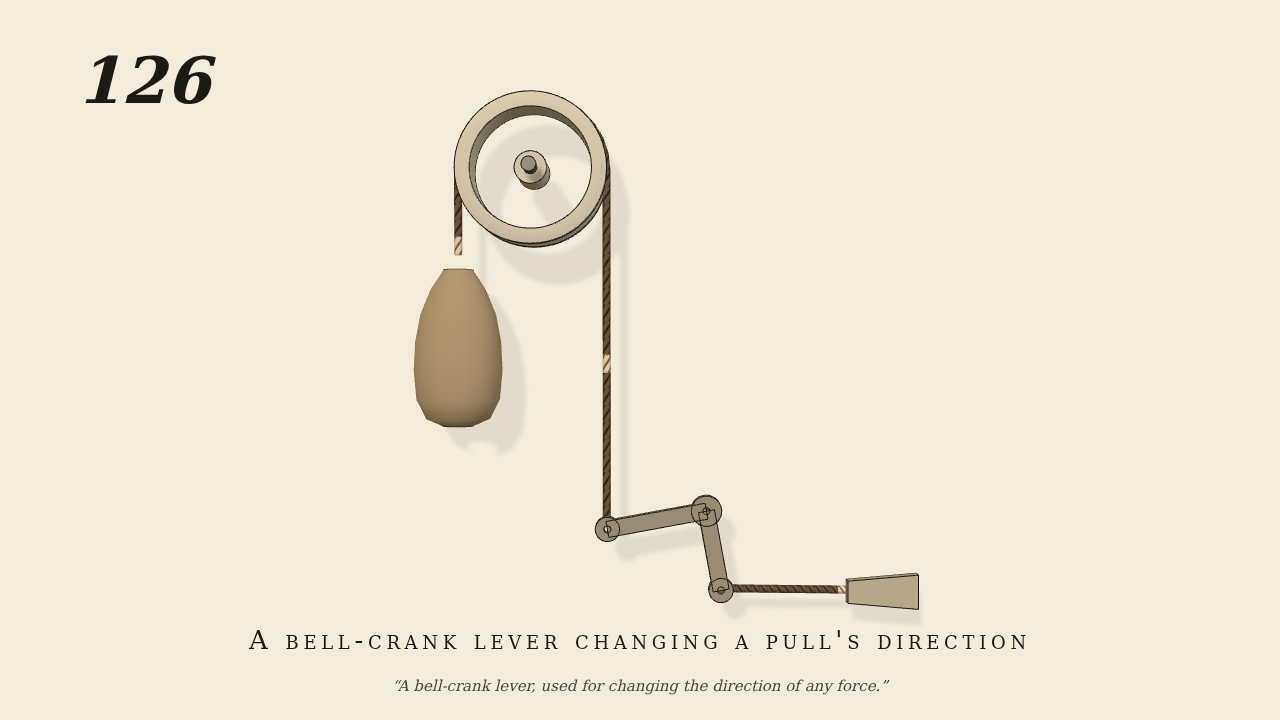
A bell-crank lever, used for changing the direction of any force
A bell-crank lever, used for changing the direction of any force.
Only the input is driven; every other part of this model moves by physics (MuJoCo), and its ratios are measured. Run it live, change its parameters, or switch the friction off to see the output stop.
- Modelled as
- A horizontal hand slide pulls a rope to the lower eye of a bell-crank, a lever with arms of 10 cm (horizontal) and 8 cm (down) on a fixed pivot. The upper eye hauls a second rope up over a friction pulley (radius 7 cm) to a 2 kg weight. The hand slide is the only driven joint, swinging +-1.5 cm at 0.5 Hz; the weight hangs under gravity and the pulley is turned by the rope alone. Both ropes are real cords (stiffness 40000, damping 12). gen126.py.
- Measured
- Weight rise against the hand pull: slope 1.277 (arm ratio 10/8 = 1.25, the rope stretch under the load adds about 2%), r2 0.9987. Weight -1.9 to +2.2 cm, hand -1.6 to +1.5 cm, penetration 0.48 mm.
- Notes
- The pull is turned from horizontal to vertical and magnified by the ratio of the arms; the weight comes back down by itself when the hand lets go.
Film (MP4) · GIF · Still (PNG) · Spec (YAML) · Model (MJCF)