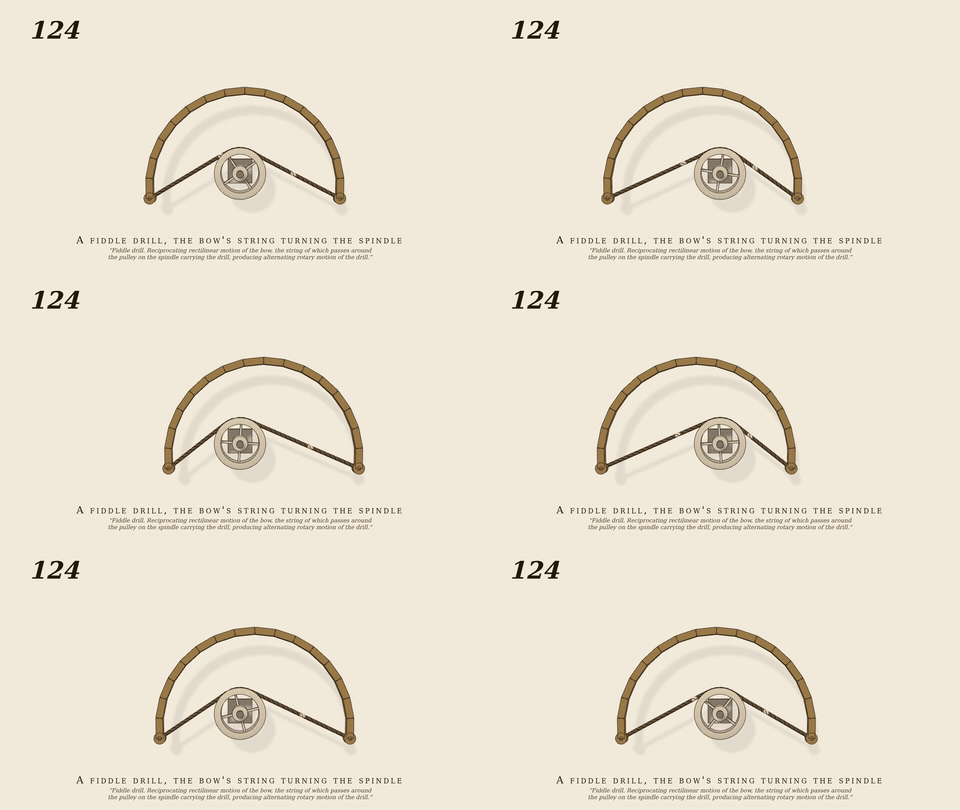
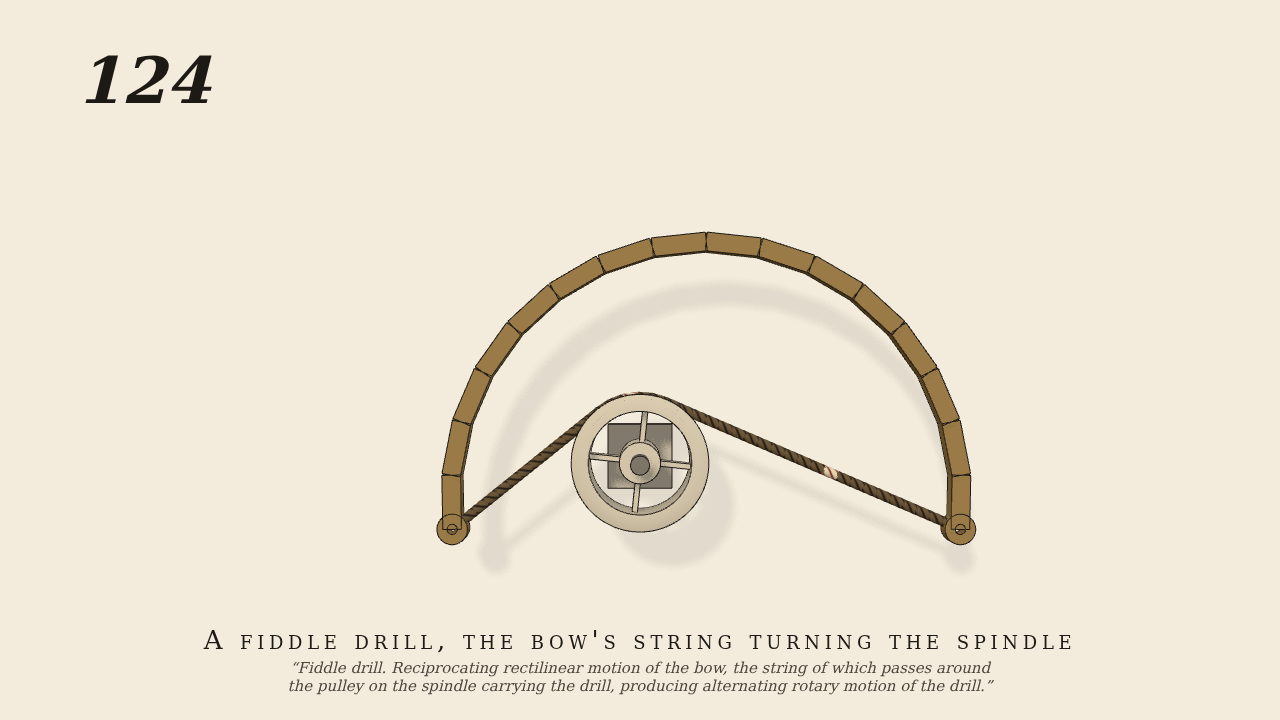
Fiddle drill
Fiddle drill. Reciprocating rectilinear motion of the bow, the string of which passes around the pulley on the spindle carrying the drill, producing alternating rotary motion of the drill.
Only the input is driven; every other part of this model moves by physics (MuJoCo), and its ratios are measured. Run it live, change its parameters, or switch the friction off to see the output stop.
- Modelled as
- A bow worked to and fro in the line of its string (the one driven joint, a hand schedule of 4 cm each way at 0.5 Hz). The string is a real cord of 40 links, tied to the two ends of the bow and passing over the 3.5 cm pulley of the spindle; nothing but the string grip turns the spindle (friction 0.5, pretension 2 N). The spindle axis points at the viewer. No gravity (a plan). gen124.py.
- Measured
- Spindle against bow slope 22.7 rad/m (r2 0.99998); the inextensible-string solution at the left span is 22.9 (1/3.8 cm less the slope of the string at the pulley). The spindle turns +0.89/-0.92 rad (about 51 degrees each way) for 4 cm of bow, repeating every stroke with a drift under 0.002 rad a cycle.
- Notes
- The string wraps only about 40 degrees of the pulley here, so a tight string (2 N) and a friction of 0.5 are enough; the spindle follows the bow without slip. The bow is a rigid arc, so the string is the only elastic part.
Film (MP4) · GIF · Still (PNG) · Spec (YAML) · Model (MJCF)