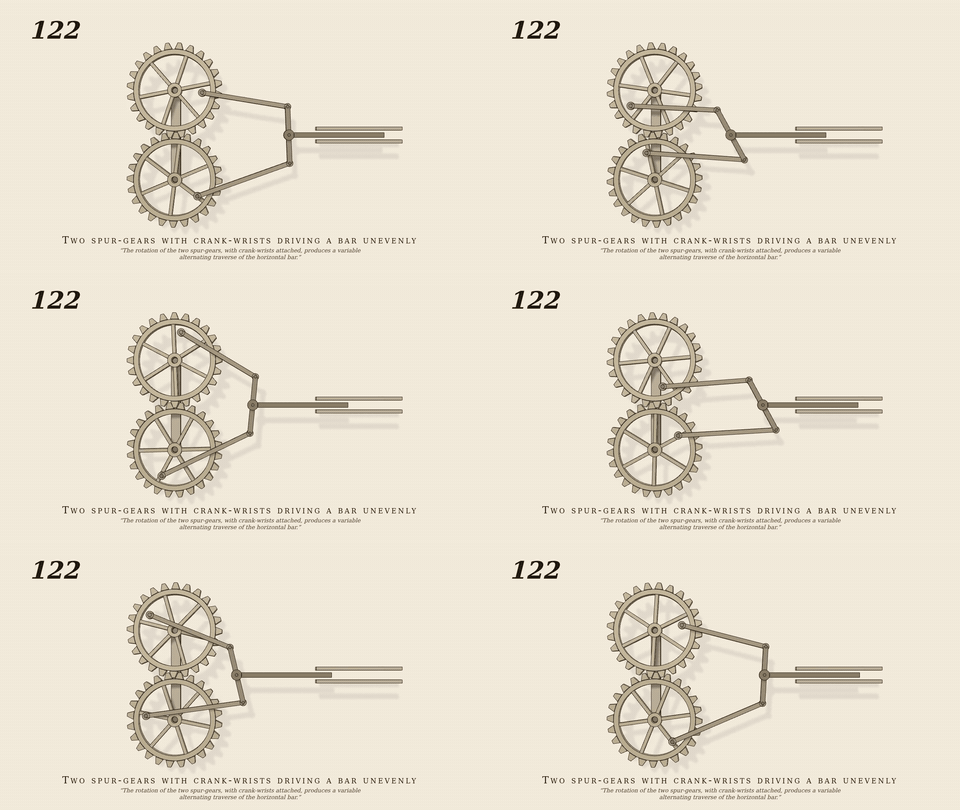
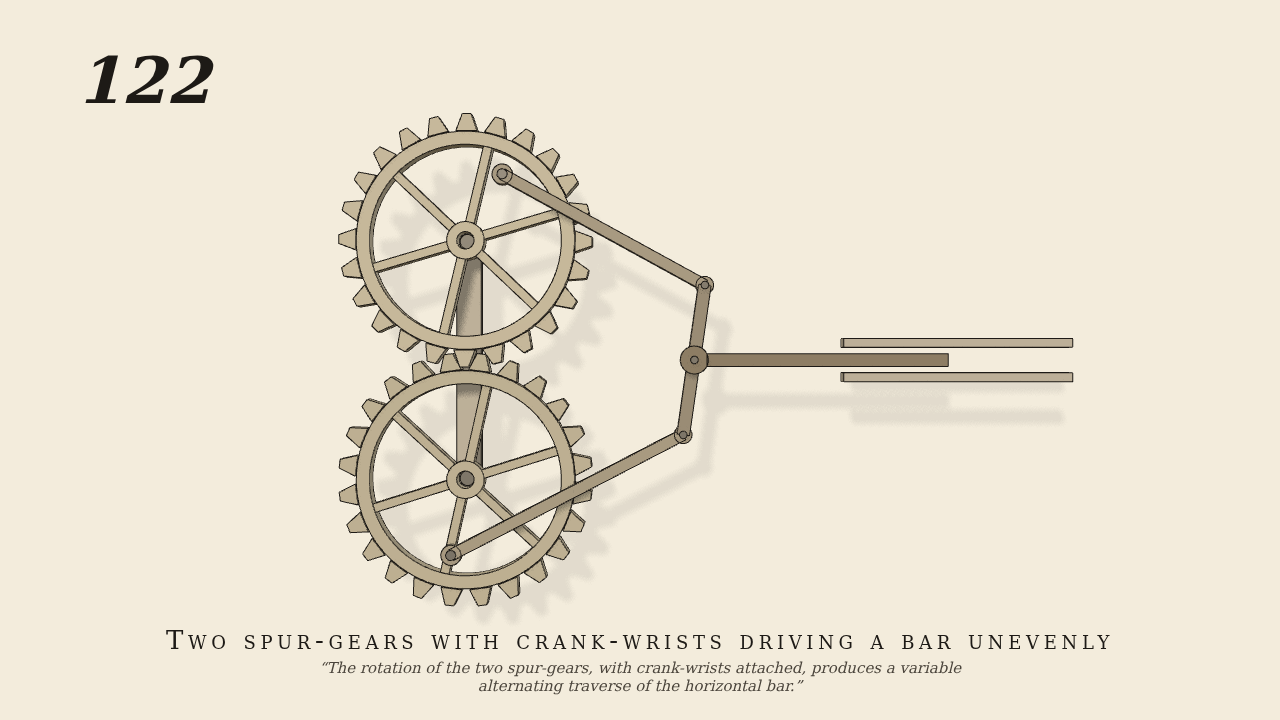
The rotation of the two spur-gears, with crank-wrists attached,…
The rotation of the two spur-gears, with crank-wrists attached, produces a variable alternating traverse of the horizontal bar.
Only the input is driven; every other part of this model moves by physics (MuJoCo), and its ratios are measured. Run it live, change its parameters, or switch the friction off to see the output stop.
- Modelled as
- Two equal 24-tooth spur-gears (module 0.8) in mesh; the upper is the only driven joint (20 rpm), the lower is turned the other way by its teeth. Each has a crank-wrist 6 cm out (90 and 130 degrees from the top at the start); a rod from each wrist is pinned to an end of a 12 cm link whose middle is pinned to the horizontal bar, which slides in a guide. No gravity (a plan). gen122.py.
- Measured
- The bar slope against the upper gear is -0.0523, -0.0442, +0.0285, +0.0613 m/rad at 70-110, 130-170, 230-270 and 300-340 degrees of the second turn (linkage kinematics -0.0517, -0.0438, +0.0288, +0.0603). Stroke -10.73 to +0.85 cm (11.6 cm), fast one way and slow the other. Lower gear follows the upper at -1.0. Penetration 0.09 mm.
- Notes
- The traverse is the two cranks averaged through the link, so it is not a sine and the speed reverses and changes between the two ends. The velocity driver lags 6 degrees at start, so the checks use the second turn.
Film (MP4) · GIF · Still (PNG) · Spec (YAML) · Model (MJCF)