Alternating rectilinear motion of the rod attached to the…
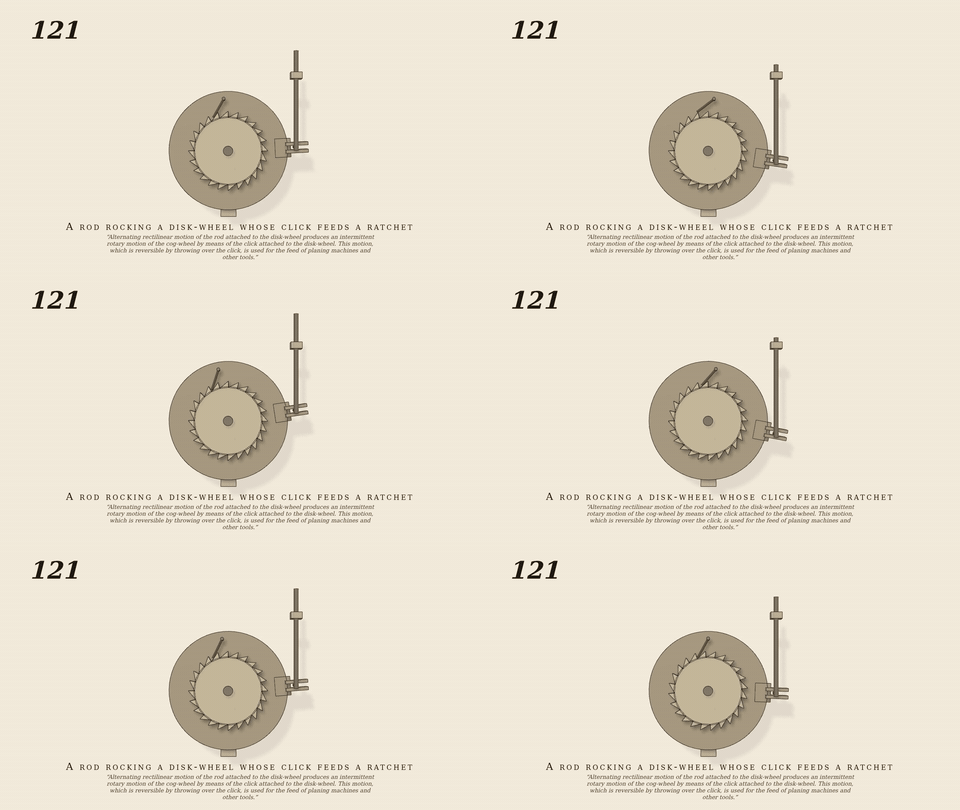
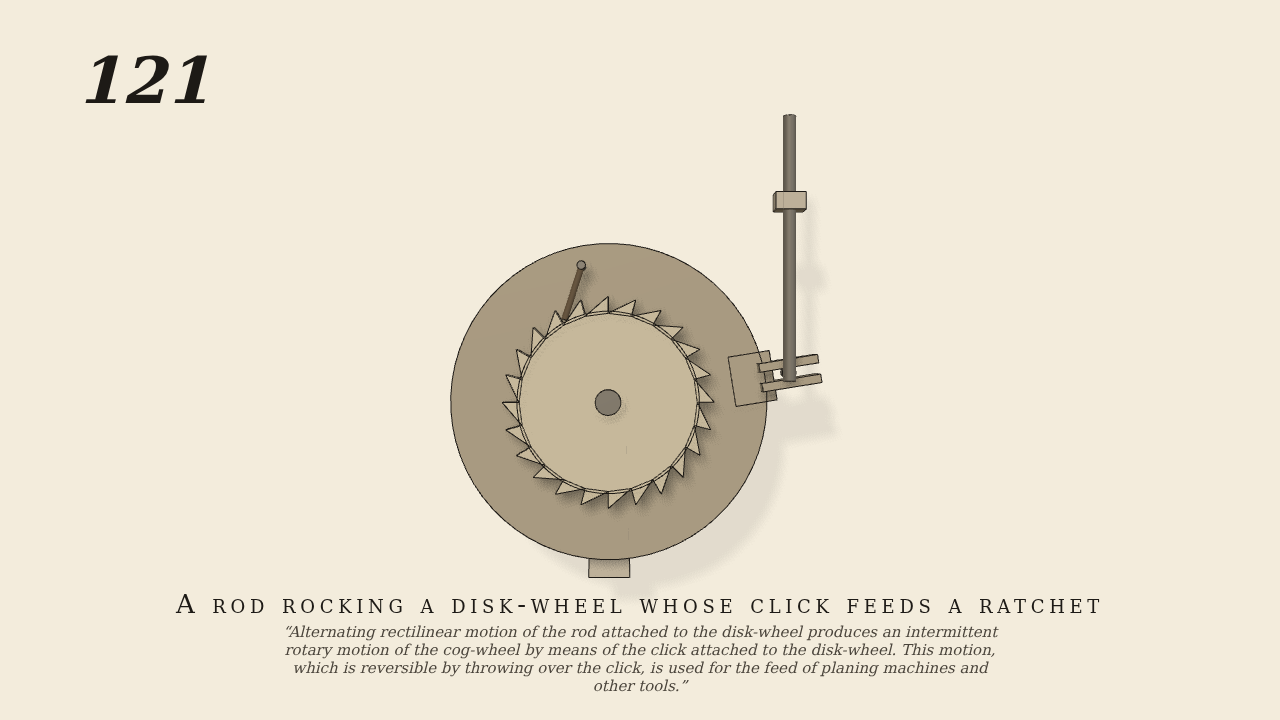
Alternating rectilinear motion of the rod attached to the disk-wheel produces an intermittent rotary motion of the cog-wheel by means of the click attached to the disk-wheel. This motion, which is reversible by throwing over the click, is used for the feed of planing machines and other tools.
Only the input is driven; every other part of this model moves by physics (MuJoCo), and its ratios are measured. Run it live, change its parameters, or switch the friction off to see the output stop.
- Modelled as
- The 24-tooth cog-wheel A turns on a fixed shaft; the disk-wheel D turns loose on it. The rod C, slid up and down 1.6 cm each way by hand (the only driven joint, a swinging slide at 0.5 Hz), has a pin working in a slot at D rim 8.5 cm out, so D rocks about 11 degrees each way. The click B is pinned to D and sprung onto A teeth: it pushes a tooth round on the way up and rides over the next on the way back; A bearing friction holds it. gen121.py.
- Measured
- A advances 0.1307 rad per beat of the rod over 8 beats (ideal half a pitch, 0.1309): one tooth a double stroke. D follows the rod at 11.43 rad/m (r2 0.9999; pin radius gives 11.76 before the arc). The click clicks 5 times. Penetration 0.74 mm peak, 0.22 mm after 1 s.
- Notes
- Throwing the click over to reverse the feed is not modelled (it is the mirror arrangement). The rod is a swinging slide (hand), as in No. 6.
Film (MP4) · GIF · Still (PNG) · Spec (YAML) · Model (MJCF)