Intended as a substitute for the crank
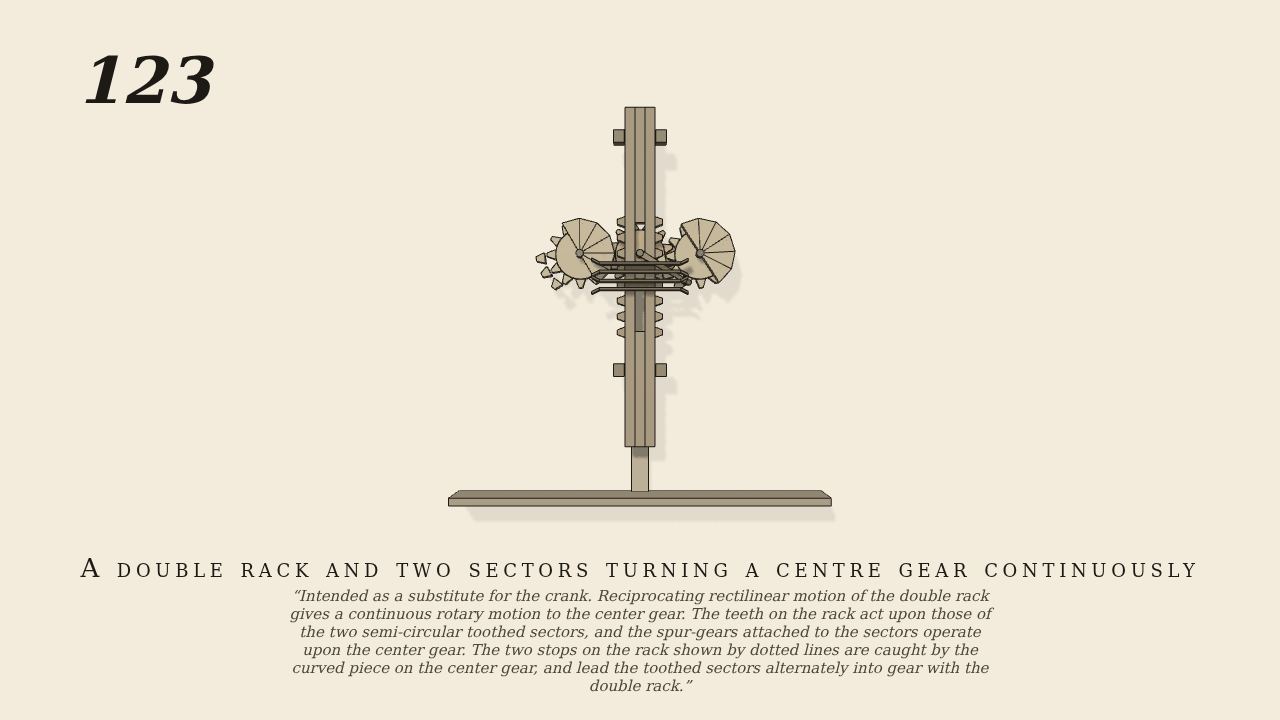
Intended as a substitute for the crank. Reciprocating rectilinear motion of the double rack gives a continuous rotary motion to the center gear. The teeth on the rack act upon those of the two semi-circular toothed sectors, and the spur-gears attached to the sectors operate upon the center gear. The two stops on the rack shown by dotted lines are caught by the curved piece on the center gear, and lead the toothed sectors alternately into gear with the double rack.
Only the input is driven; every other part of this model moves by physics (MuJoCo), and its ratios are measured. Run it live, change its parameters, or switch the friction off to see the output stop.
- Modelled as
- Brown's elevation laid flat (gravity off: a plan of the machine on its bench). An upright double rack (a bar with teeth on both edges, module 0.8) is the one driven part, slid up and down by the hand. Two semicircular sectors (pitch radius 6.4), S1 on the left and S2 on the right, each carry a 12-tooth spur behind it geared with the centre gear C, which turns behind the rack between them, its shaft through a slot in the bar. On the up stroke the rack's left teeth turn S1, on the down stroke its right teeth turn S2, both the same way, and their spurs turn C the same way on each stroke while the other sector's blank half faces the rack. Near each end of the stroke the two stops on the rack (pairs of jaws, flared mouths) catch the pin on C's arm (the curved piece), carry C over the reversal (45 degrees either side) and lead the other sector into gear. The hand feels the machine (driver feet timed by C's position): it pushes the rack up through the half-turn of C that goes with the up stroke and down through the other. C works against a light viscous load. gen123c.py.
- Measured
- Started at rest, C turns one way only (back-run 0.00 rad, 53.7 rad in 8 s), half a turn to each stroke of the rack (advance 3.1416 per beat), and keeps turning above 4 rad/s on average (about 7 rad/s). Mid-stroke C follows the rack at 0.159 rad/cm (sector pitch circle: 0.156). Rack stroke +-7.7 cm. Penetration under 1 mm. With the sectors and their spurs out of contact, the hand works the rack and C stands.
- Notes
- Only the 3 teeth of each sector that come into mesh are cut (Brown draws the whole semicircle toothed); the stops are long jaws across the bar, in front of it rather than dotted behind, so as to catch the pin through 45 degrees either side of each reversal; the hand times its push from C's position rather than on a clock (a clock-swung rack stalls C short of the stops' dead point, see STATUS); gravity off.
Film (MP4) · Still (PNG) · Spec (YAML) · Model (MJCF)