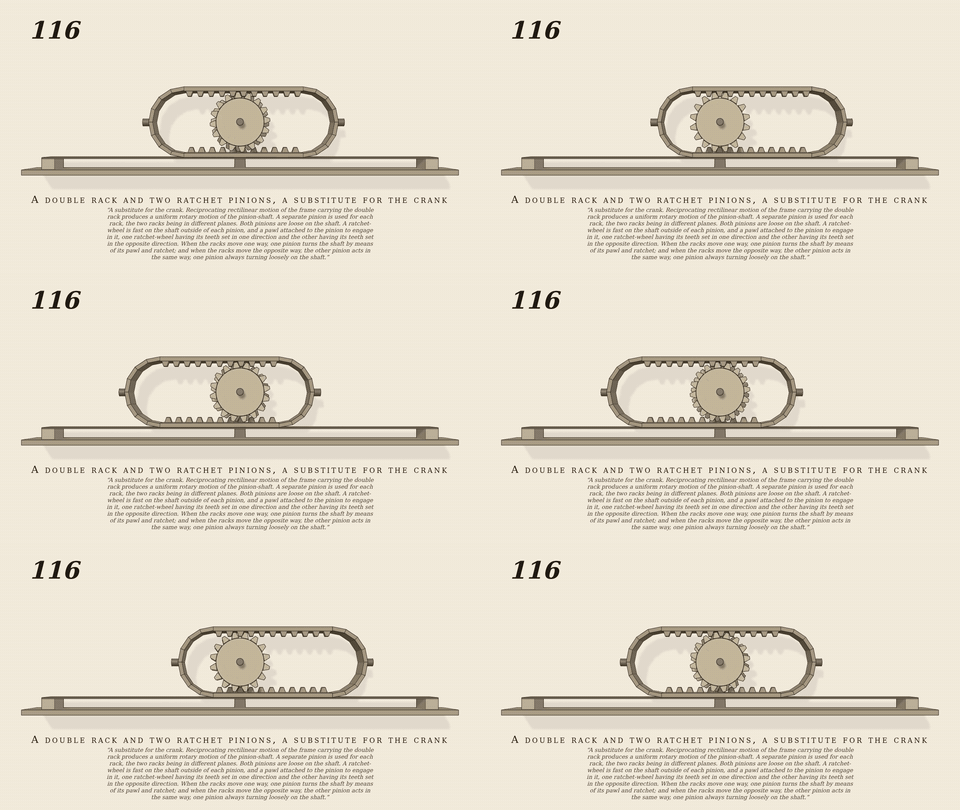
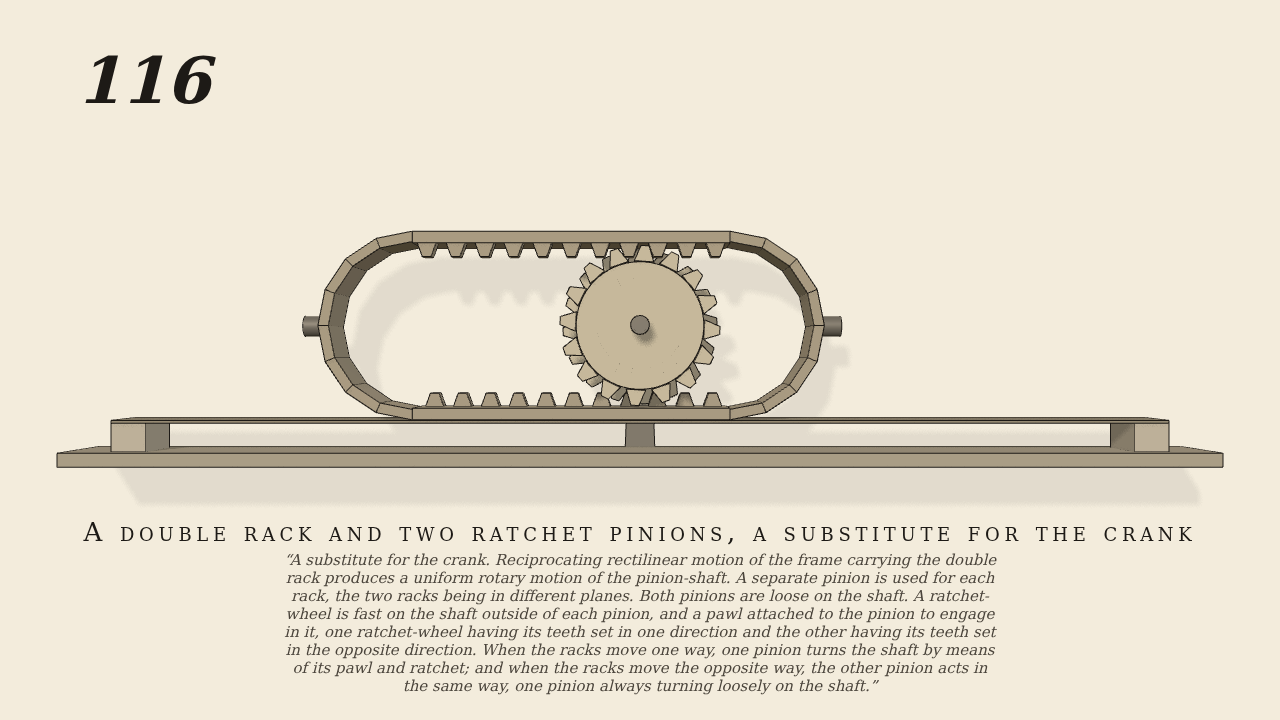
A substitute for the crank
A substitute for the crank. Reciprocating rectilinear motion of the frame carrying the double rack produces a uniform rotary motion of the pinion-shaft. A separate pinion is used for each rack, the two racks being in different planes. Both pinions are loose on the shaft. A ratchet-wheel is fast on the shaft outside of each pinion, and a pawl attached to the pinion to engage in it, one ratchet-wheel having its teeth set in one direction and the other having its teeth set in the opposite direction. When the racks move one way, one pinion turns the shaft by means of its pawl and ratchet; and when the racks move the opposite way, the other pinion acts in the same way, one pinion always turning loosely on the shaft
Only the input is driven; every other part of this model moves by physics (MuJoCo), and its ratios are measured. Run it live, change its parameters, or switch the friction off to see the output stop.
- Modelled as
- Oval frame with double rack in two planes; a loose pinion for each rack, each with a pawl that engages a ratchet-wheel fast on the shaft. The frame is driven to and fro, the only driver.
- Measured
- Shaft follows the frame at 100/R = 15.62 rad/m on every stroke (measured 15.618, r2 0.9999); the shaft only advances (0 to 10.0 rad in 9.5 s); penetration 0.14 mm.
- Notes
- Pinions turn opposite ways so both ratchets drive the shaft clockwise (Brown: set in opposite directions). Shaft frictionloss holds it while an idle pawl slides back.
Film (MP4) · GIF · Still (PNG) · Spec (YAML) · Model (MJCF)