Micrometer screw
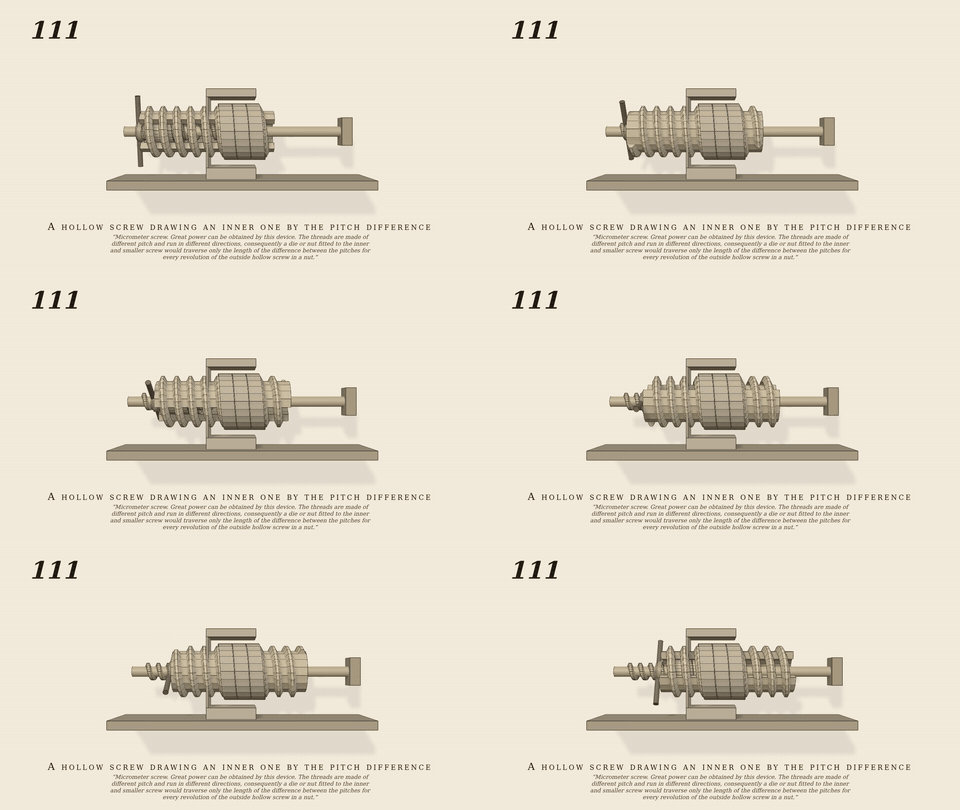
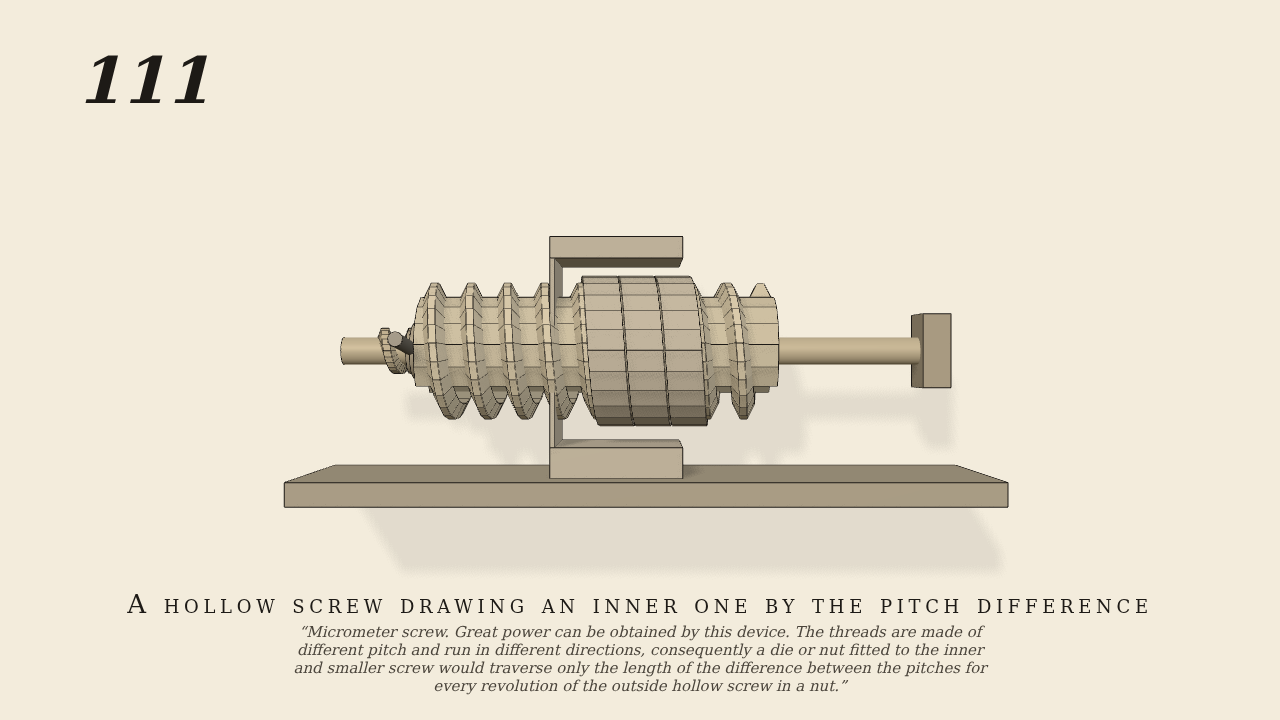
Micrometer screw. Great power can be obtained by this device. The threads are made of different pitch and run in different directions, consequently a die or nut fitted to the inner and smaller screw would traverse only the length of the difference between the pitches for every revolution of the outside hollow screw in a nut.
Only the input is driven; every other part of this model moves by physics (MuJoCo), and its ratios are measured. Run it live, change its parameters, or switch the friction off to see the output stop.
- Modelled as
- A hollow screw (pitch 1.6, driven) turns in a fixed nut and carries inside it a nut of pitch 1.2 on a held inner screw whose end is the die. Both threads are of the same hand (unlike hands would add rather than subtract). Real flank contact on both pairs.
- Measured
- Sleeve slope 0.002546 m/rad and die slope 0.000637 m/rad (difference of pitches, 0.4 cm a turn; 4 to 1 gain), r2 1.0000 and 0.9995; penetration 0.03 mm.
- Notes
- Brown says the threads run in different directions; the difference arises only for like hand, so both are right-handed here.
Film (MP4) · GIF · Still (PNG) · Spec (YAML) · Model (MJCF)