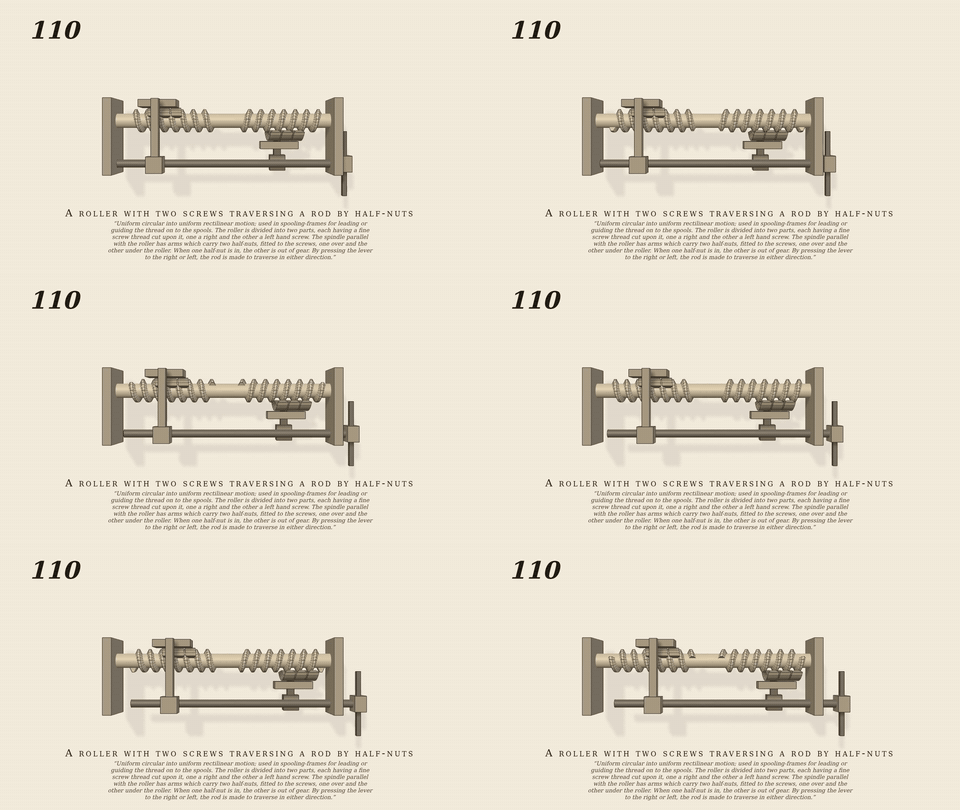
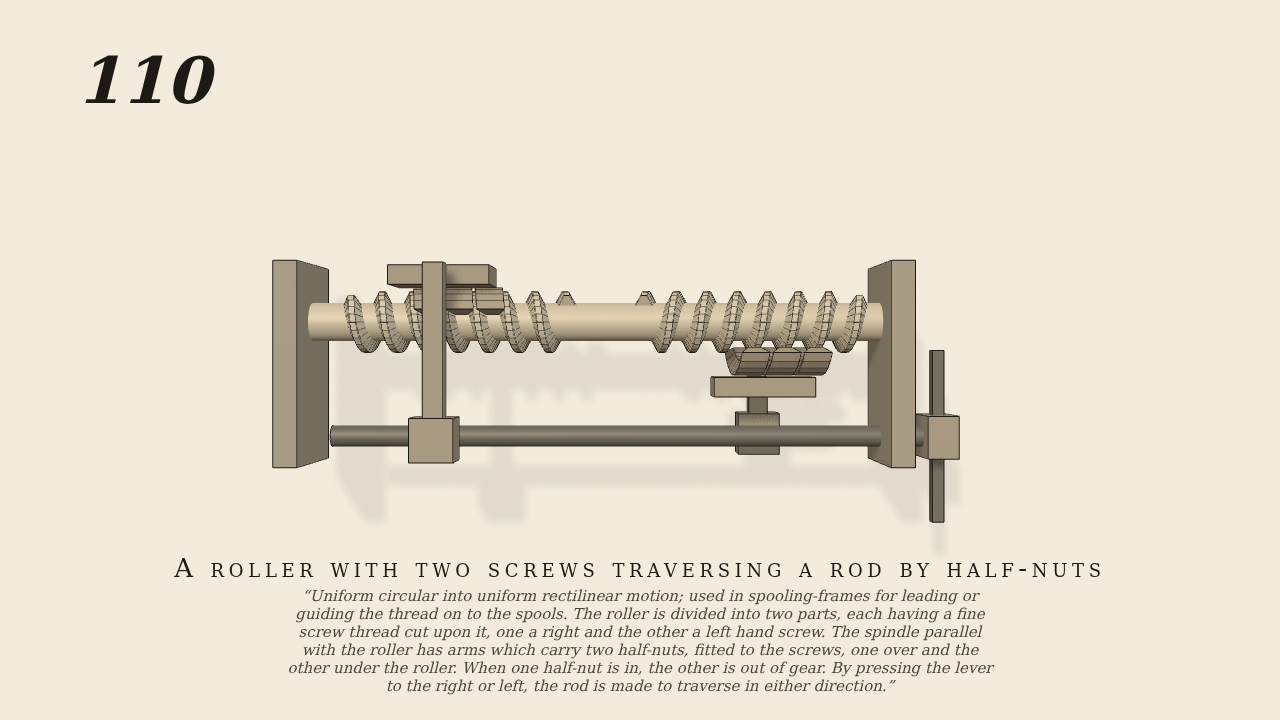
Uniform circular into uniform rectilinear motion
Uniform circular into uniform rectilinear motion; used in spooling-frames for leading or guiding the thread on to the spools. The roller is divided into two parts, each having a fine screw thread cut upon it, one a right and the other a left hand screw. The spindle parallel with the roller has arms which carry two half-nuts, fitted to the screws, one over and the other under the roller. When one half-nut is in, the other is out of gear. By pressing the lever to the right or left, the rod is made to traverse in either direction.
Only the input is driven; every other part of this model moves by physics (MuJoCo), and its ratios are measured. Run it live, change its parameters, or switch the friction off to see the output stop.
- Modelled as
- The roller turns in two plates, the one driven joint: a right-hand screw on its left part, a left-hand screw on its right, both 1.6 cm pitch, 7 turns each. A traverse rod under it carries two arms ending in half-nuts (3 turns, 140 degrees, 0.04 cm clear each flank), the upper over the left screw, the lower under the right. The lever lifts or lowers the arms 1 cm, so one half-nut is in gear when the other is out. In gear, a half-nut by real flank contact draws the rod 1.6 cm a turn of the roller. The hand throws the lever at 6 s.
- Measured
- Rod slope -0.0025 m/rad with the upper half-nut in vs -0.002546, +0.0025 after the lever is thrown vs +0.002546 (r2 1.0000); travel 3.1 cm; penetration 0.10 mm
- Notes
- The lever is a spring-held slide moved by a hand schedule.
Film (MP4) · GIF · Still (PNG) · Spec (YAML) · Model (MJCF)