The rotation of the screw at the left-hand side produces a uniform…
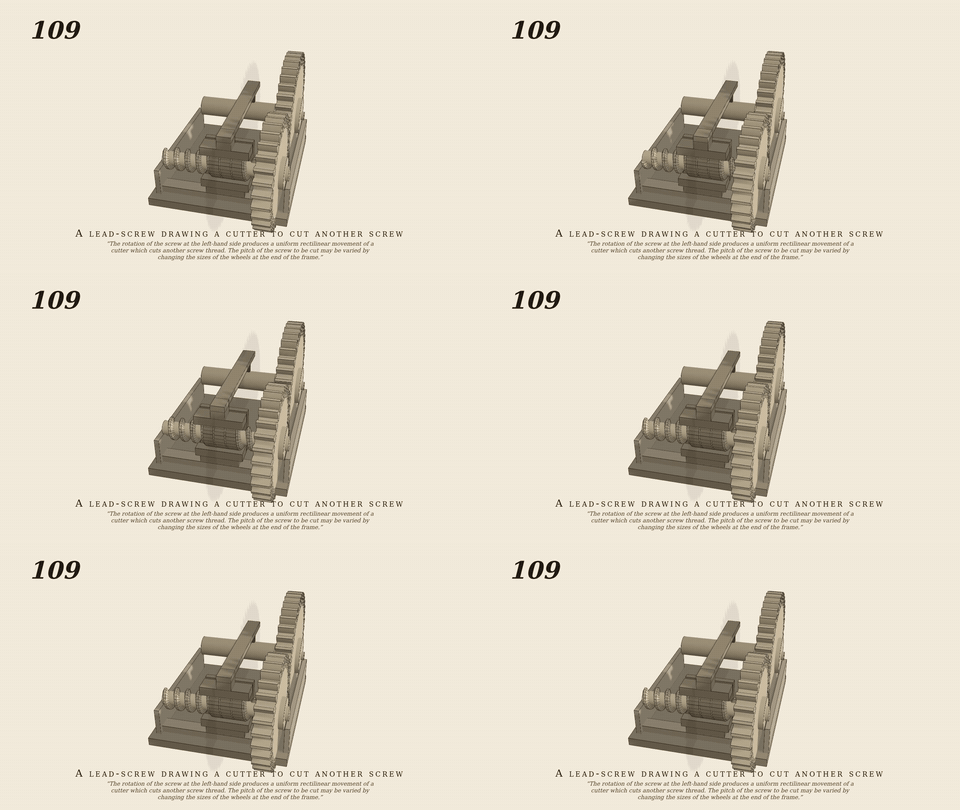
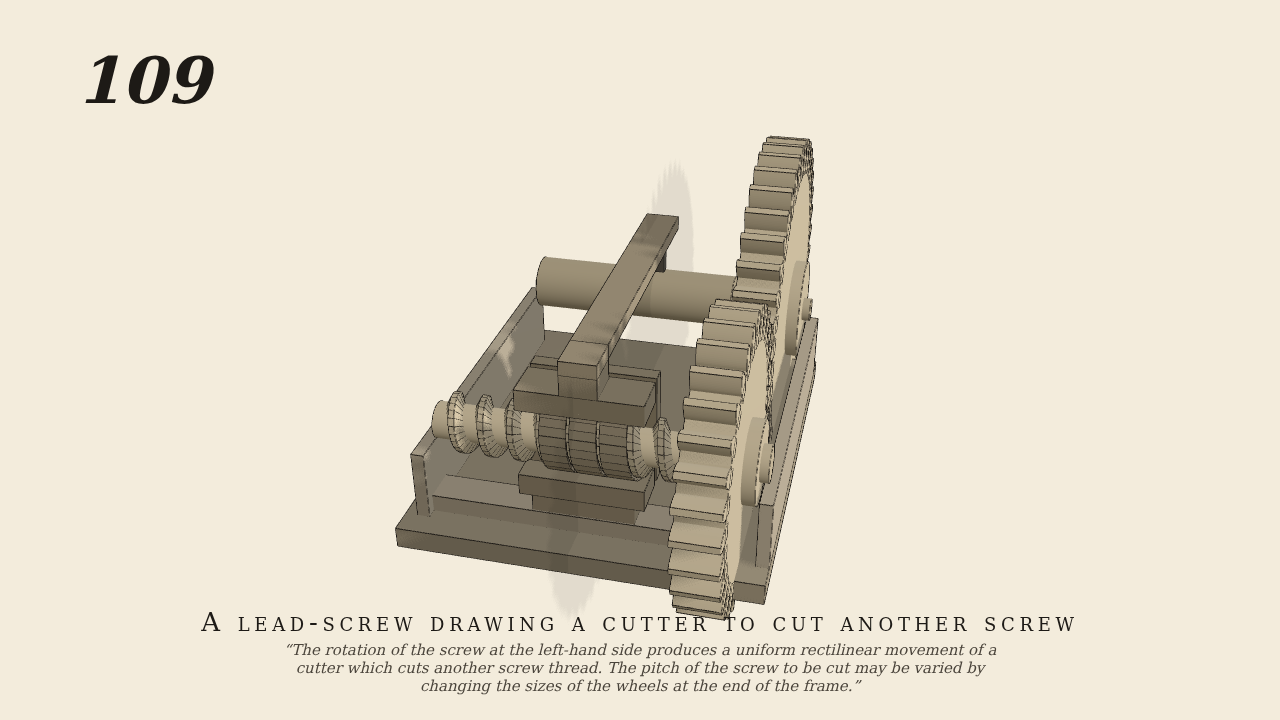
The rotation of the screw at the left-hand side produces a uniform rectilinear movement of a cutter which cuts another screw thread. The pitch of the screw to be cut may be varied by changing the sizes of the wheels at the end of the frame.
Only the input is driven; every other part of this model moves by physics (MuJoCo), and its ratios are measured. Run it live, change its parameters, or switch the friction off to see the output stop.
- Modelled as
- Two screws lie side by side in bearings. The lead-screw (right-hand thread, 1.6 cm pitch) is the one driven joint; its 30-tooth change wheel meshes by real tooth contact with the 40-tooth wheel of the blank to be cut, which it turns 0.75 turns to its own. The carriage holds a half-nut on the lead-screw and a cutter on an arm over the blank, so it runs 1.6 cm a turn of the lead-screw and 2.13 cm a turn of the blank: the pitch it would cut. Other wheels would change it. The blank is drawn plain; the cutter leaves no mark.
- Measured
- Cutter slope -0.0025 m/rad to the lead-screw vs -0.002546; +0.0034 to the blank vs +0.003395 (r2 0.9987-0.9996); wheels -0.7506 vs -0.75; travel 3.4 cm; penetration 0.31 mm
- Notes
- The cutter leaves no mark; the cut pitch is the carriage travel per turn of the blank.
Film (MP4) · GIF · Still (PNG) · Spec (YAML) · Model (MJCF)