Uniform reciprocating rectilinear motion from uniform rotary…
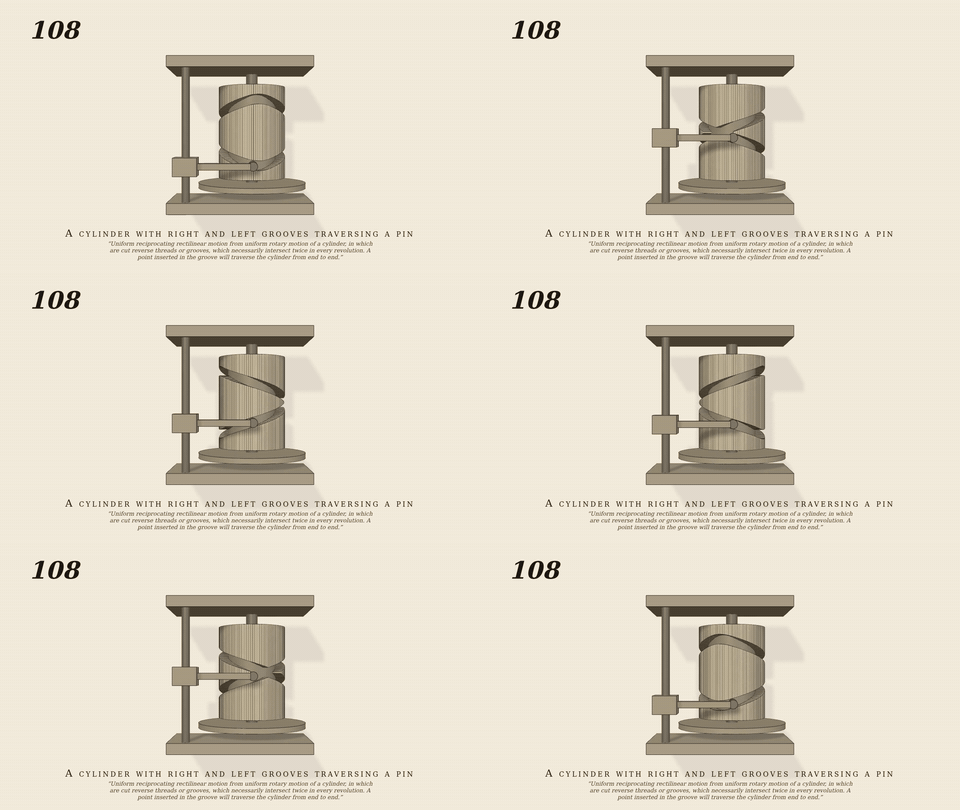
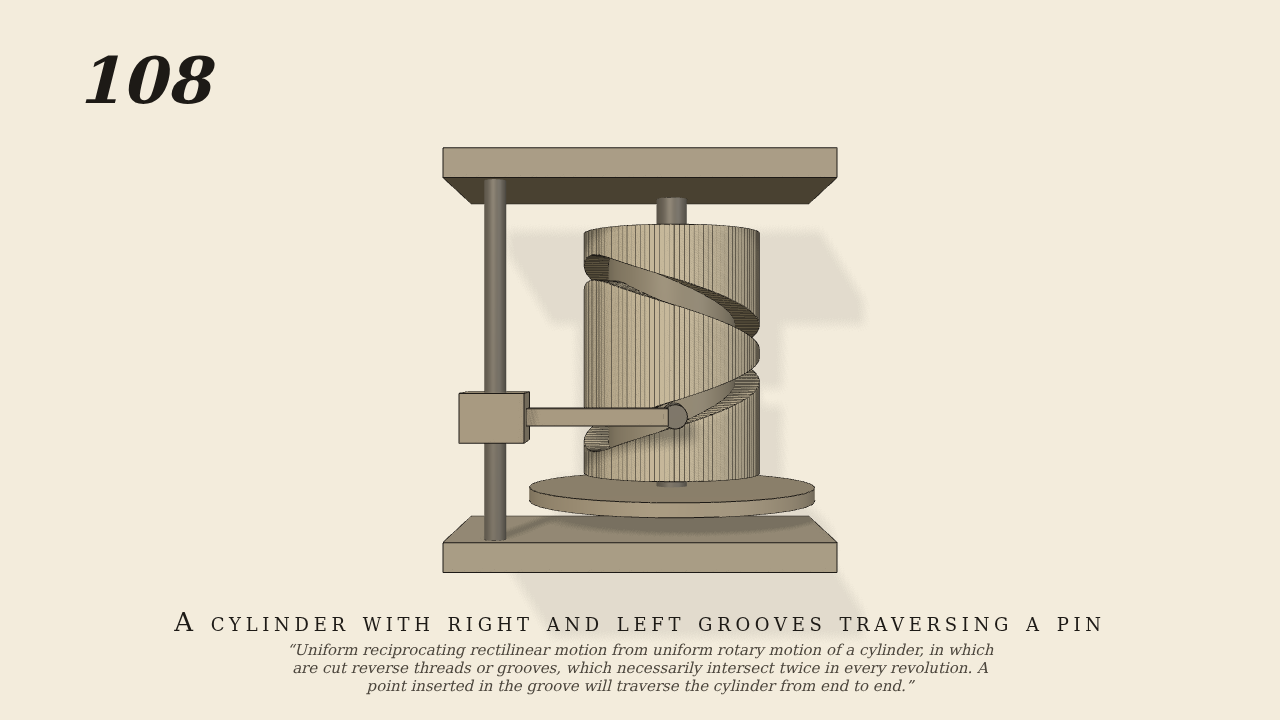
Uniform reciprocating rectilinear motion from uniform rotary motion of a cylinder, in which are cut reverse threads or grooves, which necessarily intersect twice in every revolution. A point inserted in the groove will traverse the cylinder from end to end.
Only the input is driven; every other part of this model moves by physics (MuJoCo), and its ratios are measured. Run it live, change its parameters, or switch the friction off to see the output stop.
- Modelled as
- A cylinder 8 cm across turns on its axis, the one driven joint. A right-hand and a left-hand groove, 1.13 cm wide, each run 8 cm end to end in one turn (1.27 cm to the radian), join at the ends (rounded) and cross where they meet. The lands are 340 convex pieces. A pin on a block sliding on a guide rod runs in the groove by real contact, goes straight through the crossing by its inertia (no gravity; the block is poised), and is drawn end to end and back.
- Measured
- Pin slope +/-0.0127 m/rad in five windows vs +/-0.01273 (r2 0.9998-1.0000); stroke 7.7 cm; penetration 0.41 mm
- Notes
- One crossing a turn here, where Brown says two (a leg of one turn; two-turn legs open the crossing too wide to hold the pin).
Film (MP4) · GIF · Still (PNG) · Spec (YAML) · Model (MJCF)