Continuous rotary converted into intermittent rotary motion
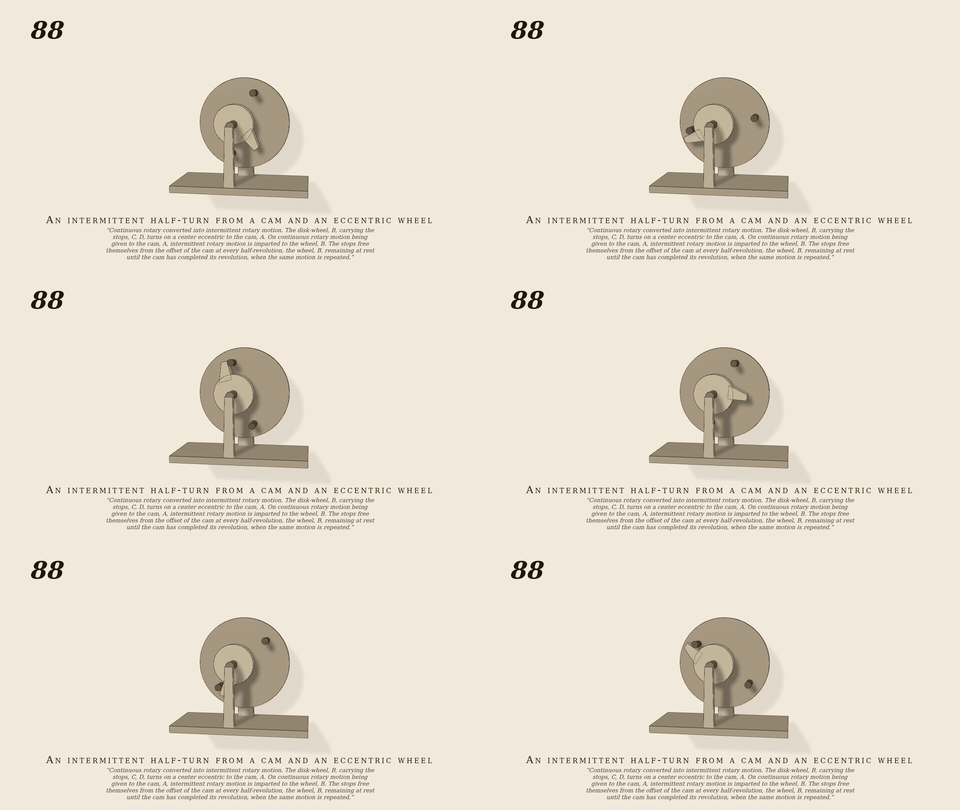
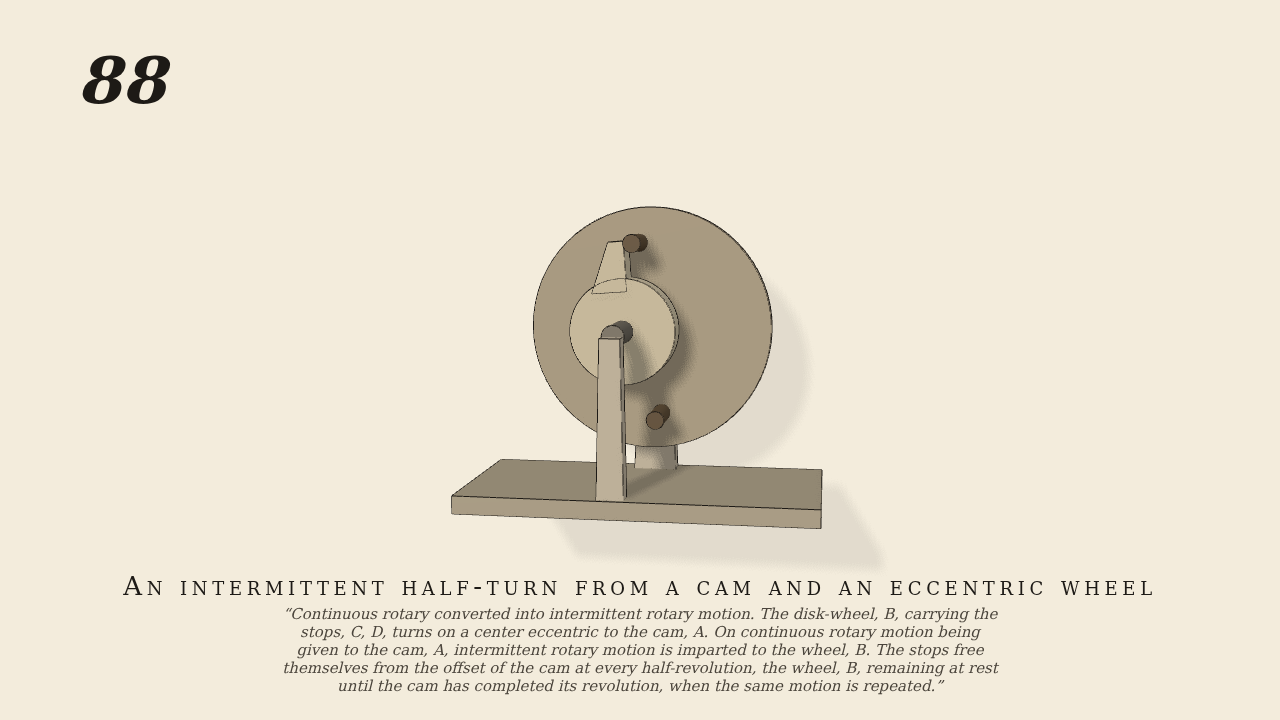
Continuous rotary converted into intermittent rotary motion. The disk-wheel, B, carrying the stops, C, D, turns on a center eccentric to the cam, A. On continuous rotary motion being given to the cam, A, intermittent rotary motion is imparted to the wheel, B. The stops free themselves from the offset of the cam at every half-revolution, the wheel, B, remaining at rest until the cam has completed its revolution, when the same motion is repeated.
Only the input is driven; every other part of this model moves by physics (MuJoCo), and its ratios are measured. Run it live, change its parameters, or switch the friction off to see the output stop.
- Modelled as
- The cam A turns clockwise at 15 rpm and is the only driven joint: a 2.4 cm disc with one offset reaching 4.05 cm. The disk-wheel B turns on a stud 1.0 cm to the right of A centre and carries the stops C and D half a turn apart at 4.0 cm from its own centre, so the stops pass from 3.0 to 5.0 cm from A centre. Only on A side is a stop within reach: the offset meets it by real contact and carries B round until, B having turned half a turn, the stop has moved out past the offset end and frees itself. The other stop is then within reach, and B (a little stud friction) rests until A completes its revolution.
- Measured
- B advances pi per turn of A: ratio 0.5032 vs 0.5 dwell to dwell over 3.5-15.5 s; B rests at 3.172, 6.314, 9.455, 12.597 rad (n pi + 0.03) while A completes each turn. Max penetration 0.08 mm.
- Notes
- B is pushed about 208 deg of A and rests for 152 deg. The release is geometric (the eccentricity), not a stop; B is held at rest by its stud friction (joint frictionloss).
Film (MP4) · GIF · Still (PNG) · Spec (YAML) · Model (MJCF)