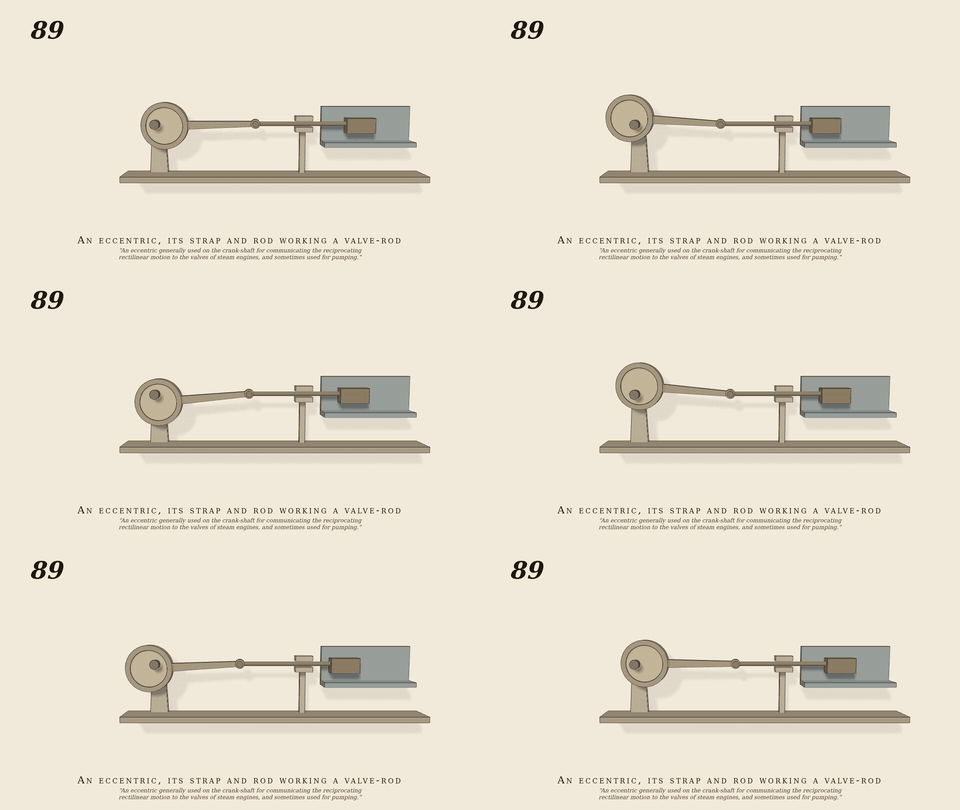
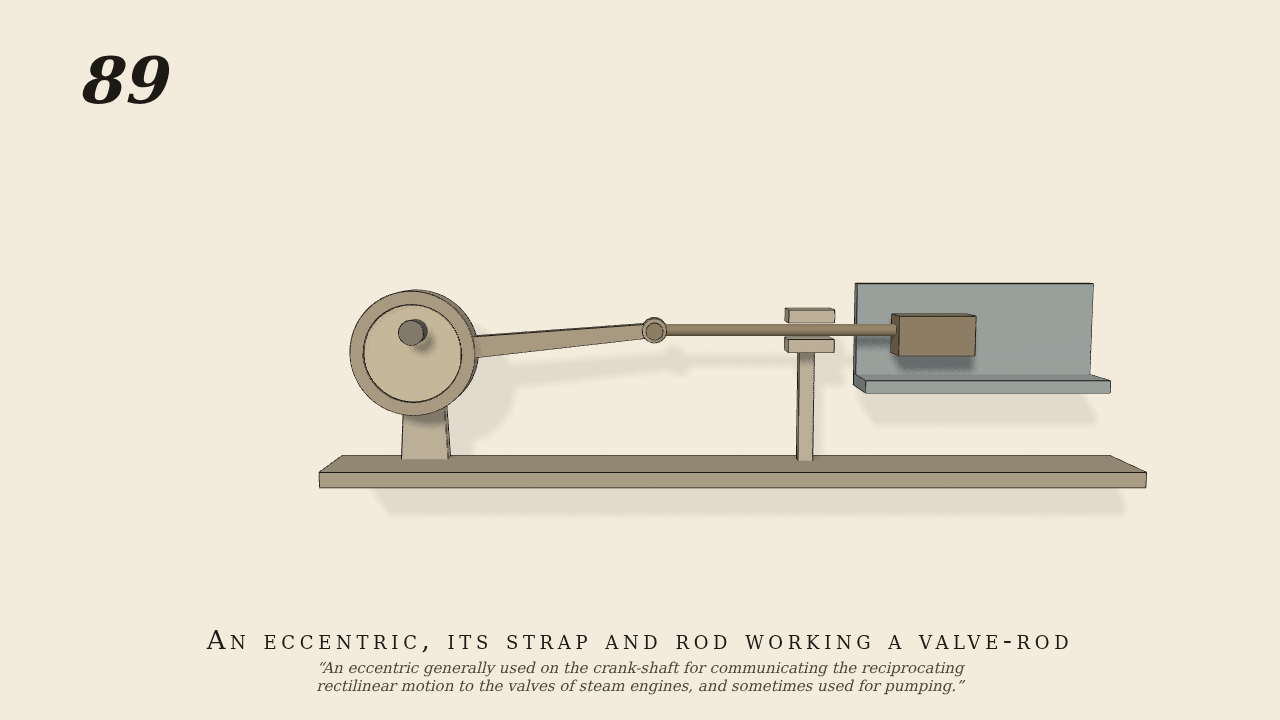
An eccentric generally used on the crank-shaft for communicating…
An eccentric generally used on the crank-shaft for communicating the reciprocating rectilinear motion to the valves of steam engines, and sometimes used for pumping.
Only the input is driven; every other part of this model moves by physics (MuJoCo), and its ratios are measured. Run it live, change its parameters, or switch the friction off to see the output stop.
- Modelled as
- The crank-shaft turns clockwise at 30 rpm and is the only driven joint; it carries an eccentric, a 3.2 cm disc whose centre is 1.5 cm from the shaft centre. The strap embraces the eccentric and turns on it (a hinge about the eccentric centre); the eccentric rod, forged with the strap, is pinned 16 cm away to the valve-rod, which slides in fixed guides to the steam-chest. The valve-rod moves 3 cm to and fro, twice the eccentricity, as by a crank of that length.
- Measured
- At mid-stroke: slope -0.0150 and +0.0148 m/rad vs eccentricity 0.015 (0.0%, -1.3%), r2 1.0000; the valve-rod runs -3.000..0.000 cm (throw 3.0 = 2e). Max penetration 0.00 mm (no contacts carry the motion).
- Notes
- An eccentric is a crank: the strap bearing and the rod pin are pins; the guides are the slide joint (drawn).
Film (MP4) · GIF · Still (PNG) · Spec (YAML) · Model (MJCF)