A method of working a reciprocating pump by rotary motion
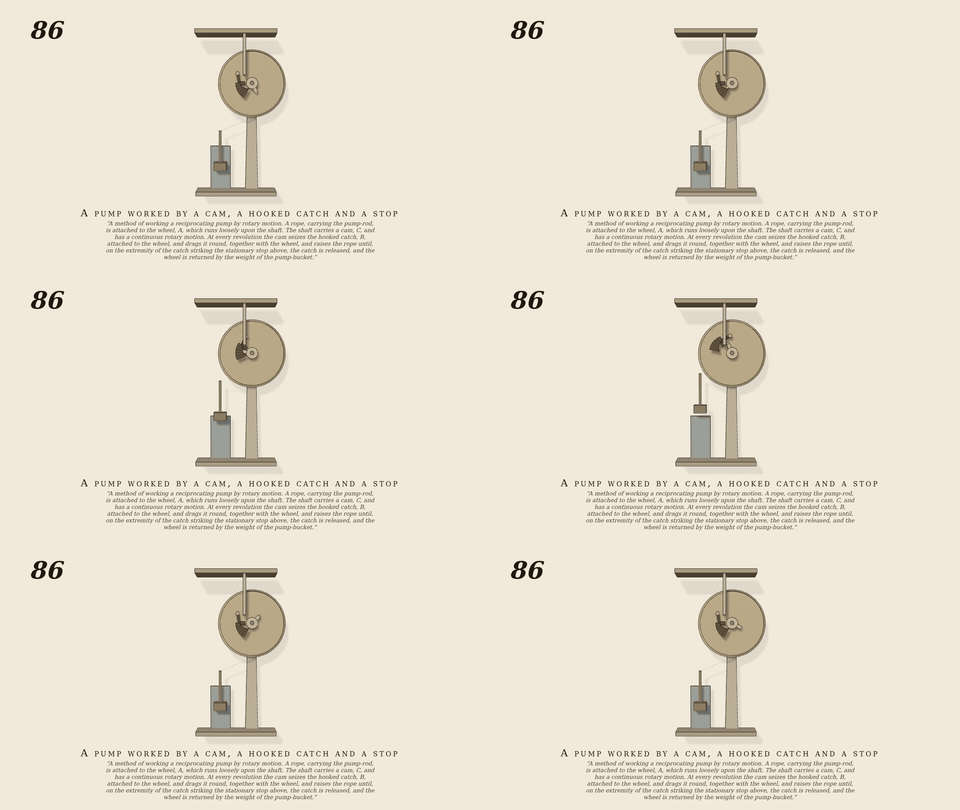
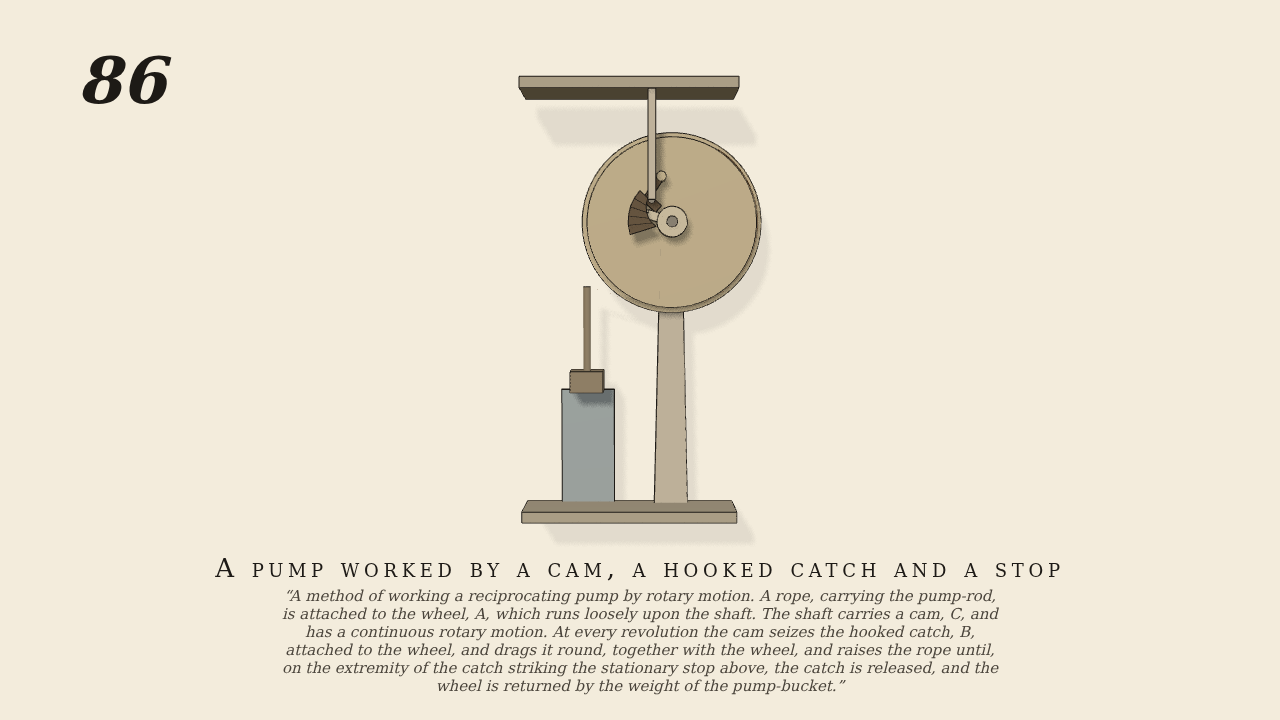
A method of working a reciprocating pump by rotary motion. A rope, carrying the pump-rod, is attached to the wheel, A, which runs loosely upon the shaft. The shaft carries a cam, C, and has a continuous rotary motion. At every revolution the cam seizes the hooked catch, B, attached to the wheel, and drags it round, together with the wheel, and raises the rope until, on the extremity of the catch striking the stationary stop above, the catch is released, and the wheel is returned by the weight of the pump-bucket.
Only the input is driven; every other part of this model moves by physics (MuJoCo), and its ratios are measured. Run it live, change its parameters, or switch the friction off to see the output stop.
- Modelled as
- The shaft turns clockwise at 10 rpm and is the only driven joint; its cam C is a single tooth. The wheel A (8 cm) runs loose on the shaft and rests against its stop under the pull of the rope, which is tied to its rim and runs down to the pump-rod and bucket. The catch B is pivoted on A and held in by a spring; the cam tooth comes up under its hook by real contact and drags A round, winding the rope and raising the bucket 8 cm a radian. After about 75 deg a shoe on the catch extremity (in front, behind the hook) runs over the stationary stop above the shaft, which presses the catch out until the hook clears the tooth; the bucket weight then returns A to rest. The cam seizes the hook again every revolution.
- Measured
- While dragged: slope 0.0805 m/rad vs wheel radius 0.0800 (0.6%), r2 0.9999, over 1.9 to 2.8 s. The bucket runs from -0.02 to 10.36 cm (ideal lift 8 cm x 1.3 rad = 10.4 cm). Max penetration 0.57 mm.
- Notes
- The release is by real contact of the shoe on the stop; the catch spring and damping are joint properties. The rope is a real rope wound on the rim.
Film (MP4) · GIF · Still (PNG) · Spec (YAML) · Model (MJCF)