Rectilinear motion is imparted to the slotted bar, A, by the…
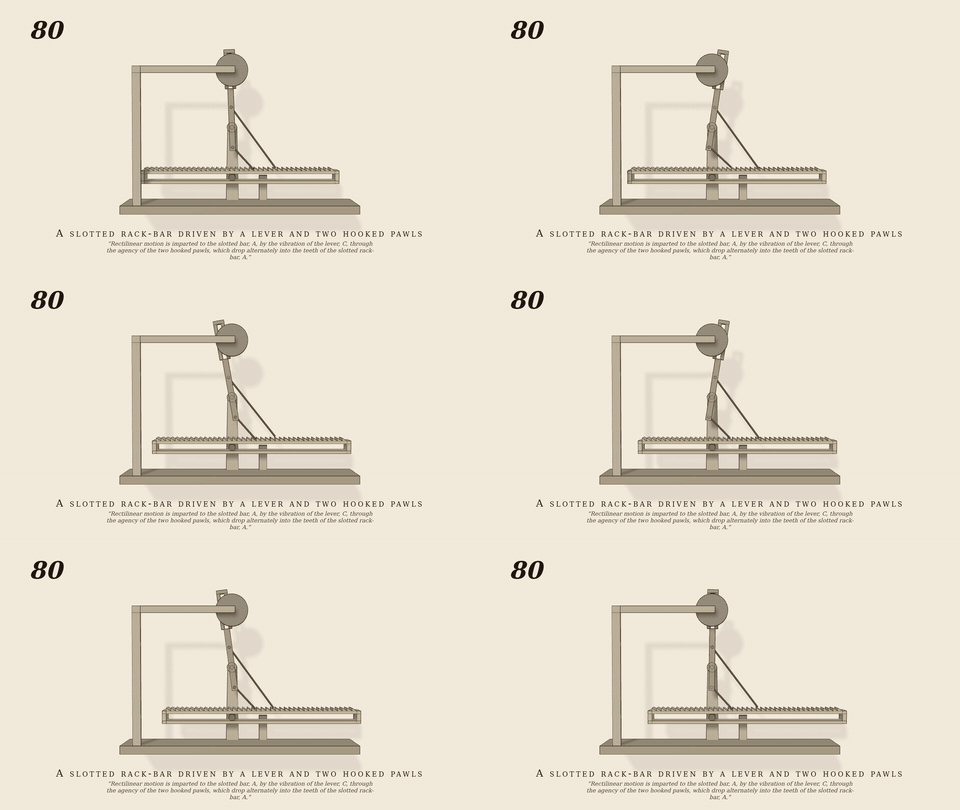
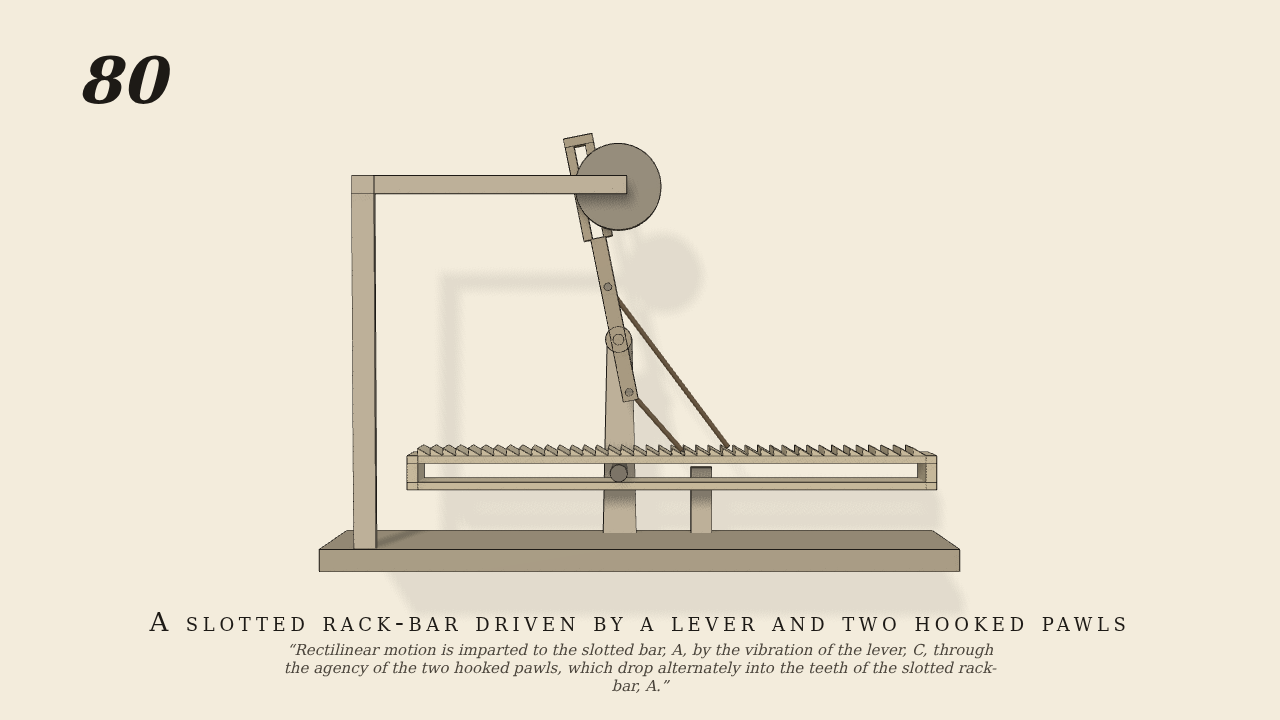
Rectilinear motion is imparted to the slotted bar, A, by the vibration of the lever, C, through the agency of the two hooked pawls, which drop alternately into the teeth of the slotted rack-bar, A.
Only the input is driven; every other part of this model moves by physics (MuJoCo), and its ratios are measured. Run it live, change its parameters, or switch the friction off to see the output stop.
- Modelled as
- The rack-bar A, with 0.6 cm ratchet teeth on top, slides on a fixed stud in its slot. The upright lever C turns on a fulcrum 5.5 cm over A. A crank, the only driven joint at 30 rpm, works a pin in a slot at the top of C and rocks it 11 deg each way. Two hooked pawls hang from C, 2.5 cm below and 2.5 cm above the fulcrum, so their pins go to and fro in opposite directions, 1.6 teeth each. Each leans forward onto the teeth and pushes A on the stroke when its pin goes forward. A is held by friction on its stud.
- Measured
- Ratio A/crank, 3 to 13 s: 0.0019 m/rad vs 2 x 0.6 cm per turn (slip 0.07%). One tooth each stroke. Max penetration 0.24 mm.
- Notes
- The crank and slot stand in for the hand or engine that works C in the plate. The two pawl tips are 5 teeth apart, a whole number, so each drops in 0.6 pitch behind a face and pushes exactly one tooth (the same indexing as No. 79).
Film (MP4) · GIF · Still (PNG) · Spec (YAML) · Model (MJCF)